Painter jobs in Denmark for foreigners.
Foreign painters and decorators in Denmark typically earn DKK 35,500 - DKK 41,500 a month gross. Painters and decorators are no. 5 of 9 on the list of trades Denmark recruits from abroad.
Updated September 2026
- Job offer signed
- Permit application sent
- Decision expected8-22 weeks
Key facts
- Typical pay
- DKK 35,500 - DKK 41,500 a month gross
- Main permit route
- Positivlisten for faglærte
- Processing time
- 8-22 weeks
- Certificates employers ask for
- NVQ Level 2 Painting and Decorating · CSCS card · FROSIO · NACE Coating Inspector
- Permits issued by
- Styrelsen for International Rekruttering og Integration (SIRI)
What painters and decorators do in Denmark.
Painting and decorating firms in Denmark (malerfirmaer) work on new housing, renovation of apartment blocks, offices, schools and hospitals. Most follow the Painters' Collective Agreement (Malerfagets overenskomst) between Danske Malermestre and Malerforbundet. Work is spread across the country, with the most jobs in the Copenhagen area and the larger cities.
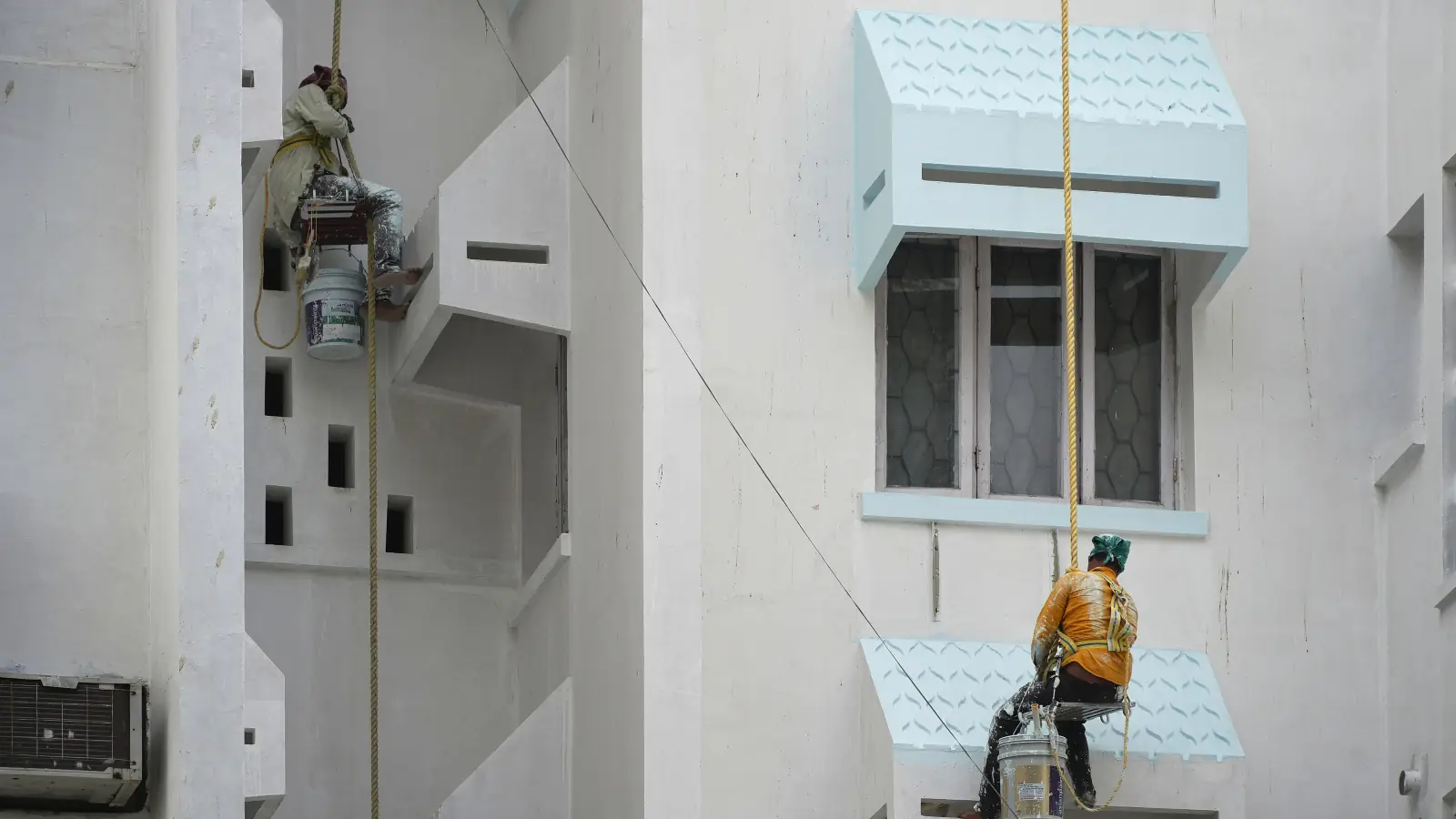
A week can include sanding, filling and priming, wall and ceiling painting, wallpapering, floor coatings and facade work from lifts or scaffolds. Industrial jobs, such as floor coatings in warehouses or corrosion protection, often use two-component products. Arbejdstilsynet notes that epoxy and isocyanates are common in surface treatment, powder coating, floor coatings, paint, sealants, PU foam and glue, so those products shape your training needs in Denmark.
Hours and shifts
Painting firms keep the 37-hour norm used across Danish agreements, mostly on day work. Piecework also exists in this trade.
Spray application of epoxy or isocyanate products is allowed in closed systems, spray cabins and spray booths; outside them it needs one of the exceptions or a dispensation listed by Arbejdstilsynet. That rule shapes how facade and floor jobs are planned, and it can mean brush and roller work in place of spraying on site.
Recognition and licence, step by step.
What to do, in order, to work as a painter in Denmark.
- 01
Show your trade level
Painting is not a licensed trade in Denmark. Bring your apprenticeship certificate or college diploma and a portfolio of jobs. Many firms start with a short trial on site. - 02
Take the epoxy and isocyanate course
Annex 10 of BEK nr. 1978 af 2021 sets the course for work with epoxy and isocyanates. Anyone doing or supervising that work needs the course certificate, renewed at least every five years. People trained before 24 August 2023 renew in 2028. - 03
Add the supplementary course for high-exposure work
Spraying outside closed systems, high-energy spraying and handling products above 45 °C need an extra course. Manual application with a spatula, brush, roller or sealant gun at room temperature needs only the basic course. - 04
Check your health against the product rules
Arbejdstilsynet lists health conditions that rule out epoxy or isocyanate work, including asthma, eczema, epoxy allergy and heavy hand sweating. Talk to a doctor before you start if any applies to you.
Certificates and language.
From the trade's list, an NVQ Level 2 in Painting and Decorating or a CSCS card shows your general level; FROSIO or NACE Coating Inspector help for industrial coating and corrosion jobs. The certificate Danish law asks for is the epoxy and isocyanate course certificate under BEK 1978/2021, plus the supplementary course for spraying. Products with 0.1% or more monomeric isocyanates carry the label "From 24 August 2023 adequate training is required before industrial or professional use", which tells you the course applies.
- NVQ Level 2 Painting and Decorating
- CSCS card
- FROSIO
- NACE Coating Inspector
Language at work
The rules set no Danish level for this trade. Safety data sheets, which you are expected to know how to find, and the written instructions your employer gives for epoxy and isocyanate work are often in Danish. Clients in occupied homes and offices speak Danish, so polite basic Danish helps on renovation jobs.
What painters and decorators earn in Denmark.
Foreign hires typically earn DKK 35,500 - 41,500 a month gross. Denmark has no minimum wage; the Painters' Collective Agreement has a minimum rate with personal and local supplements on top. The employer adds 11% pension and 15.55% for extra holiday, public holidays or free choice from 1 March 2026 (16.55% from March 2027), and the law adds 12.5% holiday pay. Confederation of Danish Employers data for 2025 show a median of DKK 289.51 per hour worked for building painters, with a quarter earning more than DKK 323.00 and a quarter less than DKK 266.50.
Before you sign.
Points to settle in writing before you sign a painter contract in Denmark.
- Ask whether the job uses epoxy or isocyanate products and who pays the course and its five-year renewal.
- Check whether you will spray, and whether that happens in a booth or under an Arbejdstilsynet exception.
- Confirm the Painters' Collective Agreement applies and your hourly rate above its minimum.
- Ask who supplies respirators, gloves and protective suits for two-component products.
- Check whether facade work is from scaffolds or lifts and who holds the training for them.
- Ask whether pay is hourly or piecework, and how piecework surplus is calculated.
What painters and decorators earn in other countries
Typical monthly gross pay for foreign hires, from official statistics and collective agreements.
Open painter vacancies in Denmark.
Recent openings from EURES, the European Commission's job portal. You apply directly with the employer.
- Vi søger 2 erfarne malere til længerevarende vikariat – opstart hurtigst muligtFirmaVikar - Vikar & Rekruttering ApS · DenmarkNov 19
- Maler søges til MGET ApSMGET ApS · DenmarkNov 19
- Maler søges Risnæs Byggeteknik v/Thomas Risnæs · DenmarkNov 17
- Erfaren Maler til Dekorativt DesignNova Maler ApS · DenmarkNov 13
- Maler søges til virksomhed i vækst A-Maler ApS · DenmarkNov 13
FAQ
Questions about working in Denmark.
How much do painters and decorators earn in Denmark?
Foreign painters and decorators in Denmark typically earn DKK 35,500 - DKK 41,500 a month gross.
What do I need before I can work as a painter in Denmark?
Show your trade level; Take the epoxy and isocyanate course; Add the supplementary course for high-exposure work; Check your health against the product rules.
Which language do I need to work in Denmark?
The rules set no Danish level for this trade. Safety data sheets, which you are expected to know how to find, and the written instructions your employer gives for epoxy and isocyanate work are often in Danish. Clients in occupied homes and offices speak Danish, so polite basic Danish helps on renovation jobs.
Sources
Checked September 2026. Rules change - confirm details with your employer or the authority before you apply.
- Arbejdstilsynet - Epoxy og isocyanater
- Arbejdstilsynet - Uddannelse i isocyanater
- Retsinformation - BEK nr. 1978 af 2021 om arbejdsmiljøfaglige uddannelser
- Workplace Denmark - Pay level and collective agreement terms for painters
- Styrelsen for International Rekruttering og Integration (SIRI)
- SIRI: Supplementary Pay Limit Scheme
- SIRI: Pay Limit Scheme
- SIRI: Wage statistics for the Positive List, valid from 1 August 2026
Get found by employers hiring for Denmark.
One free profile that employers hiring for Denmark and your other chosen destinations can find.
Create your profileFree. No subscription. No commission on your wages, ever.