Chef jobs in United States for foreigners.
Chefs and cooks are no. 5 of 6 on the list of trades United States recruits from abroad.
Updated September 2026
- Job offer signed
- Permit application sent
- Decision expected8-16 weeks
Key facts
- Main permit route
- H-2A Temporary Agricultural Workers
- Processing time
- 8-16 weeks
- Certificates employers ask for
- HACCP · Food hygiene certificate · City & Guilds Professional Cookery · Red Seal
- Permits issued by
- U.S. Citizenship and Immigration Services (USCIS)
What chefs and cooks do in United States.
Chefs and head cooks held about 220,300 US jobs in 2025. Restaurants, bars and other food services employ 64% of them, hotels and other traveler accommodation 8%, and casinos, amusement parks and recreation 5%. Hospitals and care homes employ another 4%. Seasonal resorts, ski areas and summer destinations hire foreign kitchen staff through H-2B for peak periods.
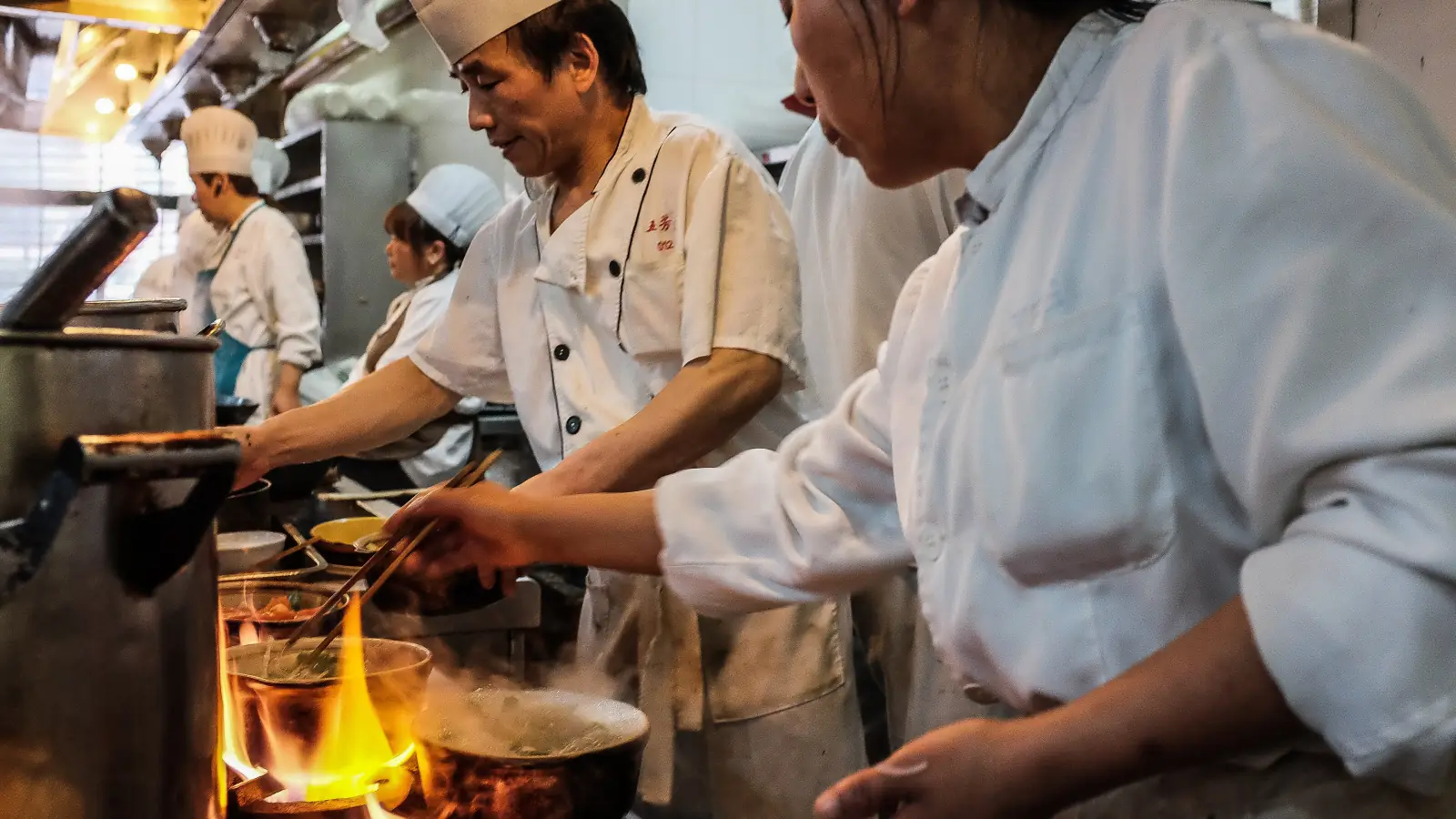
You plan menus, order and check deliveries, set prep lists, cook on the line, plate dishes and lead the brigade of line staff and dishwashers. You keep food at safe temperatures and train juniors in the rules your local health department enforces, which are based on the FDA Food Code, now in its 2026 edition. A week in a busy resort kitchen means early prep, evening service, weekend and holiday shifts, and some weeks over 40 hours. Burns from ovens, slips on wet floors and knife cuts are the common injuries, so long sleeves and nonslip shoes are standard kitchen wear.
Hours and shifts
Most chefs work full time, often with early mornings, late evenings, weekends and holidays. If you are paid by the hour, hours over 40 in the workweek earn time and a half under the FLSA. Federal law sets no cap on daily or weekly hours for adults, so long weeks are paid rather than limited. An H-2B kitchen job offers at least 35 hours a week for the whole job order, and the three-fourths guarantee covers each 12-week block, or 6-week block for jobs under 120 days.
Tips in US restaurants go to front-of-house staff. Kitchen staff can share a tip pool only when the employer pays everyone at least the full federal minimum cash wage, so check how the pool is shared. Your workweek is a fixed block of seven 24-hour days that can start on any day, and a quiet week cannot be averaged against a busy one to cancel overtime. Overtime earned in a week is due on the normal payday for that pay period.
Recognition and licence, step by step.
What to do, in order, to work as a chef in United States.
- 01
Show your kitchen experience
The usual US entry path is a high school diploma plus 5 years or more of work in a related kitchen job. Culinary school, a mentorship or an apprenticeship can also lead in. Bring a CV listing your stations, the covers you served and dated references from head chefs. - 02
Check the H-2B job order
The resort or restaurant gives you the job order before your visa interview. It names the kitchen role, the offered wage, at least 35 hours a week and any meal or staff-housing deductions, which must be reasonable and listed in advance. - 03
Get the local food handler certificate
Some states and localities require chefs and head cooks to hold a food handler's certificate. Ask the employer which course the county health department accepts, and complete it before or in your first week. - 04
Learn the local Food Code rules
State and local health departments base their inspections on the FDA Food Code, so learn the temperature, storage and labelling rules your kitchen is inspected against. Head chefs usually lead the kitchen during inspections. - 05
Keep your knife kit and costs straight
On H-2B the employer provides, without charge or deposit, all tools, supplies and equipment the job needs, so ask for the kitchen's knives, pans and thermometers in writing. Your visa and visa processing fees are paid or reimbursed in the first workweek, and passport costs stay with you.
Certificates and language.
No national licence is required to cook professionally in the US. Some states and localities require a food handler's certificate, and a HACCP course or food hygiene certificate from home shows you know cold-chain and allergen control. City and Guilds Professional Cookery or a Red Seal from Canada help prove your level. Other certifications are voluntary but may lead to promotion and higher pay. Resorts value banquet, pastry and high-volume line experience.
- HACCP
- Food hygiene certificate
- City & Guilds Professional Cookery
- Red Seal
Language at work
No English test is set by law for kitchen jobs. A head chef needs working English to read orders, allergen notes and supplier invoices, run the pass and talk to health inspectors. Line roles in multilingual kitchens can start with basic English, and the H-2B job order reaches you in a language you understand as necessary or reasonable.
What chefs and cooks earn in United States.
The Bureau of Labor Statistics gives chefs and head cooks a median of USD 62,470 a year in May 2025, about USD 5,206 a month or USD 30.03 an hour. That is about four times the federal minimum of USD 1,257 a month. On H-2B, the kitchen pays at least the highest of the prevailing wage and the federal, state or local minimum for all hours worked. Hourly staff earn half their rate again after 40 hours. Staff meals and housing may be offered, but any deduction for them must be listed in the job order.
Before you sign.
Points to settle in writing before you sign a chef contract in United States.
- Ask whether the post is head chef, sous chef or line, and how many covers the kitchen serves per day.
- Ask whether you are paid by the hour or a salary, and how hours over 40 are paid.
- Ask whether the kitchen joins a tip pool and confirm the cash wage is at least the full minimum.
- Ask who pays for the food handler certificate the county health department requires.
- Check if staff meals or staff housing are deducted from your pay, and the amount in the job order.
- Ask who supplies knives, chef whites and nonslip shoes, and whether there is a deposit.
What chefs and cooks earn in other countries
Typical monthly gross pay for foreign hires, from official statistics and collective agreements.
FAQ
Questions about working in United States.
What do I need before I can work as a chef in United States?
Show your kitchen experience; Check the H-2B job order; Get the local food handler certificate; Learn the local Food Code rules; Keep your knife kit and costs straight.
Which language do I need to work in United States?
No English test is set by law for kitchen jobs. A head chef needs working English to read orders, allergen notes and supplier invoices, run the pass and talk to health inspectors. Line roles in multilingual kitchens can start with basic English, and the H-2B job order reaches you in a language you understand as necessary or reasonable.
What is the minimum wage in United States?
The statutory minimum wage in United States is $1,257 a month gross (2026).
Sources
Checked September 2026. Rules change - confirm details with your employer or the authority before you apply.
- Bureau of Labor Statistics - Chefs and Head Cooks (Occupational Outlook Handbook)
- U.S. Department of Labor - Fact Sheet #15: Tipped Employees Under the FLSA
- FDA - FDA Food Code
- U.S. Department of Labor - Fact Sheet #78D: Deductions (H-2B)
- U.S. Department of Labor - Overtime Pay
- U.S. Citizenship and Immigration Services (USCIS)
- DOL FLAG - H-2A Adverse Effect Wage Rates
- DOL OFLC - H-2B Selected Statistics FY2026 Q1
Get found by employers hiring for United States.
One free profile that employers hiring for United States and your other chosen destinations can find.
Create your profileFree. No subscription. No commission on your wages, ever.