Farm worker jobs in United States for foreigners.
Foreign farm workers in United States typically earn $2,100 - $2,800 a month gross. Farm workers are no. 1 of 6 on the list of trades United States recruits from abroad.
Updated September 2026
Minimum wage 2026$1,257
Typical pay$2,100 - $2,800
- Job offer signed
- Permit application sent
- Decision expected8-16 weeks
Key facts
- Typical pay
- $2,100 - $2,800 a month gross
- Main permit route
- H-2A Temporary Agricultural Workers
- Processing time
- 8-16 weeks
- Certificates employers ask for
- Tractor driving licence · Pesticide application certificate · National forklift licence
- Permits issued by
- U.S. Citizenship and Immigration Services (USCIS)
What farm workers do in United States.
US farm work for foreign hires runs through H-2A, which has no yearly cap and covers seasonal jobs and temporary jobs lasting no longer than one year. Employers are fruit and vegetable growers, nurseries and greenhouses, and livestock operations. The Bureau of Labor Statistics counted 831,900 agricultural jobs in 2025, 546,800 of them crop, nursery and greenhouse labourers.
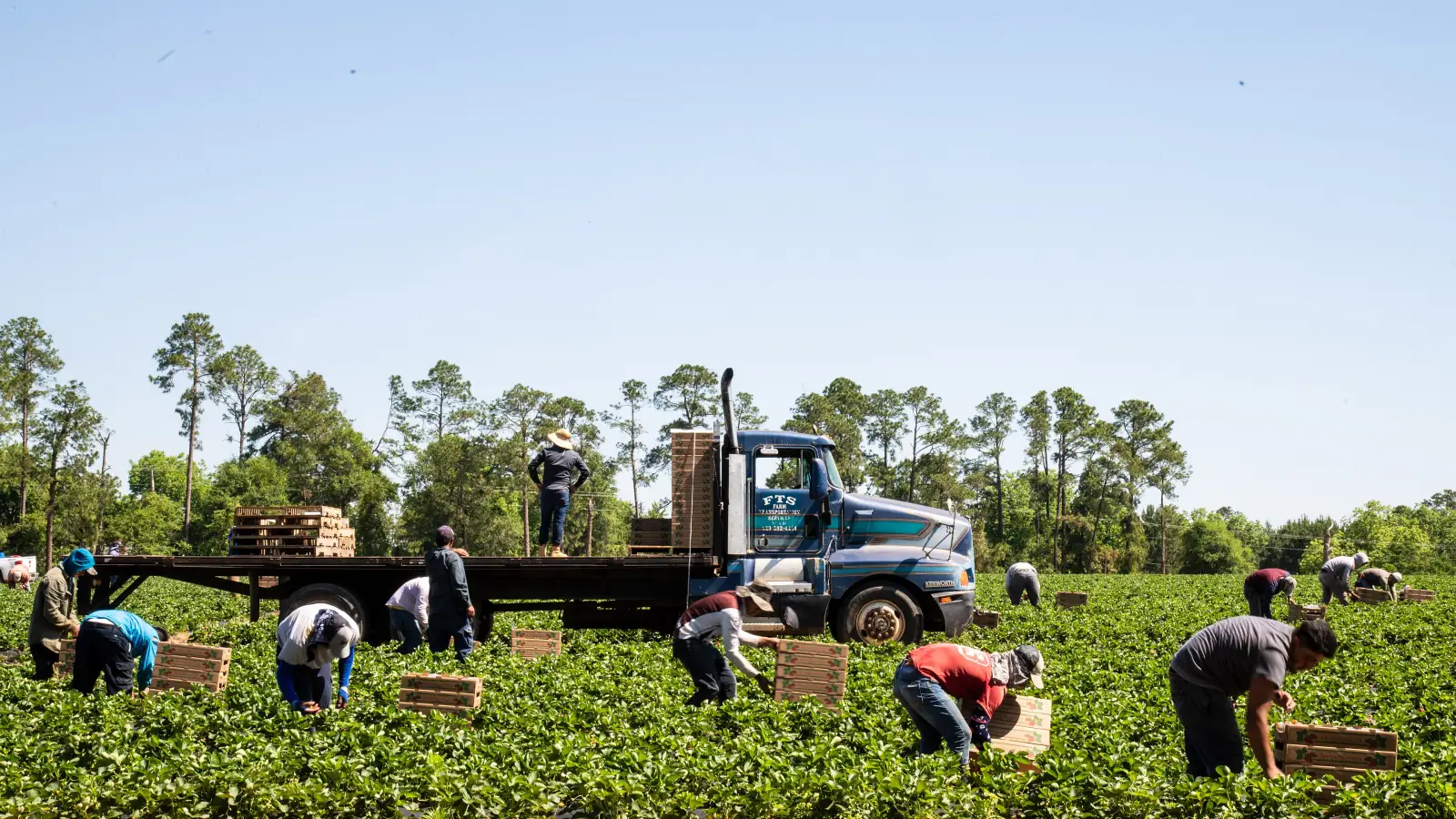
Your tasks depend on the crop and the season: planting, weeding and harvesting by hand, irrigating and clearing ditches and pumps, driving and servicing tractors, applying fertiliser, feeding animals, cleaning pens and checking stock for illness. The work is outdoors in all kinds of weather. Many crews move with the harvest, and hours grow during planting, picking and when animals must be sheltered and fed. A typical week has long days in peak season, with early starts and some weekend and holiday work.
Hours and shifts
Farm jobs that fall under the FLSA definition of agriculture are exempt from federal overtime, so hours over 40 do not by federal law earn time and a half. H-2A protects you with the three-fourths guarantee: the employer offers work for at least 75% of the workdays in your contract, or pays what you would have earned for the missing days. Small farms that used no more than 500 man-days of farm labour in every quarter of the previous year owe neither the FLSA minimum wage nor overtime, but on H-2A the AEWR still applies. When a farm labour contractor brings you in, the contractor and the grower are generally joint employers and share responsibility for your pay.
Pay comes at least twice a month, with a statement of hours offered, hours worked, the hourly or piece rate and units picked each day. OSHA advises water, rest and shade against heat illness, and shorter shifts with frequent breaks during your first few days in hot conditions.
Recognition and licence, step by step.
What to do, in order, to work as a farm worker in United States.
- 01
Check the H-2A contract before your visa
The employer gives you a copy of the work contract no later than when you apply for your visa. It files the job order 60 to 75 days before the start date and the H-2A application at least 45 days before, so you should see the crop, state and dates well ahead. - 02
Move into the employer's housing
H-2A employers provide housing at no cost to you when you cannot return home each night, and it must meet safety standards. They also provide safe transport from the housing to the fields, and either three meals a day at a DOL-set cost or free kitchen facilities. - 03
Take pesticide safety training
Under the EPA Worker Protection Standard (WPS), your employer gives you pesticide safety training every year. You stay out of treated fields during the restricted-entry interval on the label, and out of the 25-foot or 100-foot application exclusion zone around spraying equipment. - 04
Get licensed for spraying or driving
If you will mix or apply pesticides, you may need a state pesticide applicator licence. If you will run equipment on public roads, you usually need a valid driving licence. Ask the employer which licences the job needs and who arranges them. - 05
Claim your travel costs
Once you finish 50% of the contract period, the employer reimburses your inbound travel and daily subsistence if it did not already pay them. When you finish the contract, it pays your return travel and meals on the way home.
Certificates and language.
Most H-2A crews learn on the job in under a month, so a certificate is not a condition of hire. Equipment operators gain from a tractor driving licence and need longer training before running large machines. Spraying work may require a state pesticide applicator licence on top of the yearly WPS pesticide safety training your employer gives. A forklift licence helps in packing sheds and nurseries. Livestock farms value experience with feeding, vaccinating and checking animals. Some states license certain animal breeders.
- Tractor driving licence
- Pesticide application certificate
- National forklift licence
Language at work
No English test applies to H-2A work. Crews often work with a bilingual supervisor, and WPS pesticide safety training and the information posted at the central board must be given in a way you understand. Basic English helps you read field signs about treated areas and talk with the grower about hours and piece rates.
What farm workers earn in United States.
From 3 August 2026, H-2A Adverse Effect Wage Rates for Skill Levels I and II work out at about USD 2,100 to USD 2,800 a month for a 40-hour week, against a federal minimum of about USD 1,257 a month. You get the highest of the AEWR for your state and job, the prevailing wage, any union rate, and the federal or state minimum. A court found the 2025 AEWR method unlawful in August 2026, but the current rates stay in effect until new ones are published. Free housing and free tools add to the value of the job.
Typical pay of $2,100 - $2,800 a month gross is 1.7 to 2.2 times the statutory minimum wage of $1,257 (2026).
Before you sign.
Points to settle in writing before you sign a farm worker contract in United States.
- Ask which crop or livestock, which state and county, and the exact contract start and end dates.
- Check whether you are paid by the hour or by piece rate, and how the piece rate reaches the AEWR.
- Ask where the housing is, how many people share a room and how meals or kitchen access are arranged.
- Ask whether the job includes pesticide mixing or spraying, and who pays for a state applicator licence.
- Confirm the three-fourths guarantee and how many workdays the contract promises in total.
- Ask how the crew is moved between fields and who drives the vehicles.
FAQ
Questions about working in United States.
How much do farm workers earn in United States?
Foreign farm workers in United States typically earn $2,100 - $2,800 a month gross.
What do I need before I can work as a farm worker in United States?
Check the H-2A contract before your visa; Move into the employer's housing; Take pesticide safety training; Get licensed for spraying or driving; Claim your travel costs.
Which language do I need to work in United States?
No English test applies to H-2A work. Crews often work with a bilingual supervisor, and WPS pesticide safety training and the information posted at the central board must be given in a way you understand. Basic English helps you read field signs about treated areas and talk with the grower about hours and piece rates.
Other trades in United States:
Sources
Checked September 2026. Rules change - confirm details with your employer or the authority before you apply.
- U.S. Department of Labor - Fact Sheet #26: Section H-2A of the Immigration and Nationality Act
- U.S. Department of Labor - Fact Sheet #12: Agricultural Employment Under the FLSA
- DOL OFLC - H-2A Adverse Effect Wage Rates and announcement of 2 September 2026
- EPA - Agricultural Worker Protection Standard (WPS)
- Bureau of Labor Statistics - Agricultural Workers (Occupational Outlook Handbook)
- U.S. Citizenship and Immigration Services (USCIS)
- DOL FLAG - H-2A Adverse Effect Wage Rates
- DOL OFLC - H-2B Selected Statistics FY2026 Q1
Get found by employers hiring for United States.
One free profile that employers hiring for United States and your other chosen destinations can find.
Create your profileFree. No subscription. No commission on your wages, ever.