Farm worker jobs in Portugal for foreigners.
Farm workers are no. 7 of 8 on the list of trades Portugal recruits from abroad.
Updated September 2026
- Job offer signed
- Permit application sent
- Decision expected8-16 weeks
Key facts
- Main permit route
- Visto de residência para exercício de atividade profissional subordinada
- Processing time
- 8-16 weeks
- Certificates employers ask for
- Tractor driving licence · Pesticide application certificate · National forklift licence
- Permits issued by
- AIMA - Agência para a Integração, Migrações e Asilo
What farm workers do in Portugal.
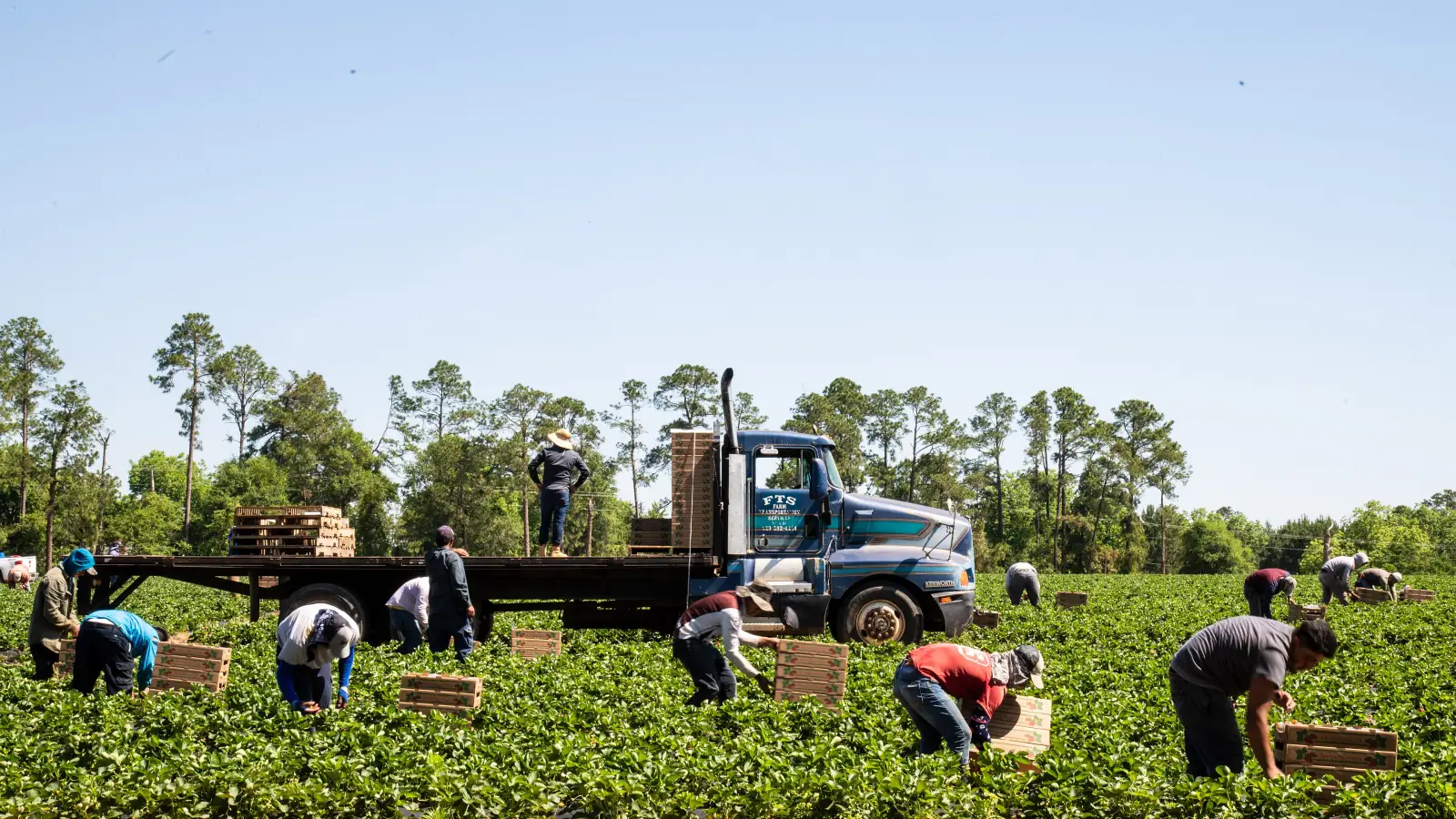
Farming is one of the sectors that recruit the most foreign workers in Portugal, and there is a separate seasonal visa (visto para trabalho sazonal) for harvests. You pick fruit, vegetables and grapes, prune orchards and vines, plant and weed, pack produce and look after greenhouses and irrigation. Larger farms also need people to drive tractors and spray crops.
Seasonal peaks follow the crops: summer and autumn harvests, grape picking for wine, and pruning in winter. A week on a farm is usually six days in peak season and shorter outside it, with an early start in the cool hours. Accommodation on or near the farm is common, especially in rural areas far from towns. Packing houses and cold stores work through the year, sorting, grading and boxing produce for shops and export.
Hours and shifts
The 8-hour day and 40-hour week cap applies on farms too, and the contract shows how hours are spread when the farm averages longer harvest weeks against quieter ones. Short seasonal jobs may use a short-duration contract: up to 35 days per contract and no more than 70 days in a calendar year with the same employer, and the farm has to notify Social Security online with the place of work.
If those limits are broken, the contract is treated as lasting 6 months. Seasonal workers also build up paid holiday: 2 working days for each month of contract in the first year.
Recognition and licence, step by step.
What to do, in order, to work as a farm worker in Portugal.
- 01
Find out if you will drive a tractor
In Portugal a tractor needs a category T licence from IMT: type I for small two-wheel tractors up to 2,500 kg, type II for simple tractors up to 3,500 kg (or 6,000 kg with a trailer), and type III for larger tractors and heavy farm machines. Types II and III need you to be 18. - 02
Take the category T exam
You learn at a driving school or a recognised training centre. Types II and III have a theory and a practical test; if you already hold a category B licence, you take only the practical test. IMT fees are EUR 10 for the learner licence, EUR 15 for the theory test, EUR 15 for the practical test and EUR 30 to issue the licence. - 03
Or add COTS training to a car licence
A category B holder driving type II tractors must complete the COTS course (Conduzir e Operar com o Trator em Segurança) or UFCD 9596. The deadline for some tractors was moved to 1 August 2027. IMT then adds restriction 792 to the licence for EUR 30 with a valid electronic medical certificate. - 04
Get the pesticide applicator card for spraying
Under Lei n.º 26/2013, professional users who handle or apply plant protection products need a habilitação proven by a card, on the model set by Despacho 12848/2024. Ask the regional CCDR (formerly DRAP) where you train. Decreto-Lei n.º 127/2026 extended the card's validity to 15 years. - 05
Swap a foreign licence for farm driving
If your car licence comes from outside the EU/EEA, IMT exchanges it after your doctor sends an electronic medical certificate. You may keep driving on the foreign licence for 90 days from the date of your residence permit, so apply early if the farm wants you on a tractor with a category B.
Certificates and language.
Portuguese farms ask for a category T licence or a category B licence with the COTS training for tractor work, and the pesticide applicator card (cartão de aplicador) under Lei 26/2013 for spraying. A forklift licence from home helps in packing houses. Soil and greenhouse fumigation products marked for specialised applicators need a separate habilitação as aplicador especializado, granted under Article 22 of the same law. Spraying in Portugal is done from the ground, as Article 34 of Lei 26/2013 bans application from aircraft across the country.
- Tractor driving licence
- Pesticide application certificate
- National forklift licence
Language at work
Field work is shown more than explained, and many farm crews are mixed nationalities, so you can start with little Portuguese. Tractor exams, the applicator course and pesticide labels are in Portuguese, so plan to learn enough to read safety labels and pass a theory test. No official level is set for picking or packing work. Supervisors often show the task first, so watching closely and asking questions early helps you keep pace with the crew.
What farm workers earn in Portugal.
The national minimum is EUR 920 a month in 2026, the base for most seasonal and year-round farm contracts, paid 14 times a year for full-year contracts. A worker with a tractor licence or an applicator card can ask for a higher category under the collective agreement named in the contract. If the farm gives you housing, its value counts as pay but cannot be more than the cash part of your wage. Ask how long the probation period is on a seasonal contract, since its length depends on the contract type.
Before you sign.
Points to settle in writing before you sign a farm worker contract in Portugal.
- Ask whether the job is a short-duration seasonal contract and how many days it lasts in total.
- Ask whether you will drive tractors, and whether the farm pays for the category T licence or the COTS course.
- Ask whether spraying is part of the job and who pays for the applicator card training.
- Get the value of any farm housing in writing, and check it is below your cash pay.
- Ask how many days a week you work at harvest and how longer weeks are averaged.
- Check who supplies gloves, boots, rain gear and the protective masks and suits needed for spraying, and where they are stored on the farm.
What farm workers earn in other countries
Typical monthly gross pay for foreign hires, from official statistics and collective agreements.
Open farm worker vacancies in Portugal.
Recent openings from EURES, the European Commission's job portal. You apply directly with the employer.
- TRABALHADOR NÃO QUALIFICADO DA AGRICULTURA (EXCLUI HORTICULTURA E FLORICULTURA)PortugalNov 19
- TRABALHADOR NÃO QUALIFICADO DA AGRICULTURA E PRODUÇÃO ANIMAL COMBINADASPortugalNov 14
- TRABALHADOR NÃO QUALIFICADO DA AGRICULTURA E PRODUÇÃO ANIMAL COMBINADASPortugalOct 7
- TRABALHADOR NÃO QUALIFICADO DA AGRICULTURA E PRODUÇÃO ANIMAL COMBINADASPortugalSep 16
FAQ
Questions about working in Portugal.
What do I need before I can work as a farm worker in Portugal?
Find out if you will drive a tractor; Take the category T exam; Or add COTS training to a car licence; Get the pesticide applicator card for spraying; Swap a foreign licence for farm driving.
Which language do I need to work in Portugal?
Field work is shown more than explained, and many farm crews are mixed nationalities, so you can start with little Portuguese. Tractor exams, the applicator course and pesticide labels are in Portuguese, so plan to learn enough to read safety labels and pass a theory test. No official level is set for picking or packing work. Supervisors often show the task first, so watching closely and asking questions early helps you keep pace with the crew.
What is the minimum wage in Portugal?
The statutory minimum wage in Portugal is €920 a month gross (2026).
Other trades in Portugal:
Sources
Checked September 2026. Rules change - confirm details with your employer or the authority before you apply.
Get found by employers hiring for Portugal.
One free profile that employers hiring for Portugal and your other chosen destinations can find.
Create your profileFree. No subscription. No commission on your wages, ever.