Farm worker jobs in Italy for foreigners.
Farm workers are no. 1 of 8 on the list of trades Italy recruits from abroad.
Updated September 2026
- Job offer signed
- Permit application sent
- Decision expected12-30 weeks
Key facts
- Main permit route
- Nulla osta al lavoro subordinato (Decreto Flussi)
- Processing time
- 12-30 weeks
- Certificates employers ask for
- Tractor driving licence · Pesticide application certificate · National forklift licence
- Permits issued by
- Sportello Unico per l'Immigrazione (Ministero dell'Interno)
What farm workers do in Italy.
Italian farms hire for fruit and vegetable picking, vineyards, olive groves, greenhouses, nurseries and livestock. The main agreement is the CCNL per gli operai agricoli e florovivaisti (code A011 at CNEL), signed by Confagricoltura, Coldiretti and CIA with FLAI CGIL, FAI CISL, UILA UIL and UGL Agroalimentare. Farm cooperatives and consortia use their own agreement (code A016).
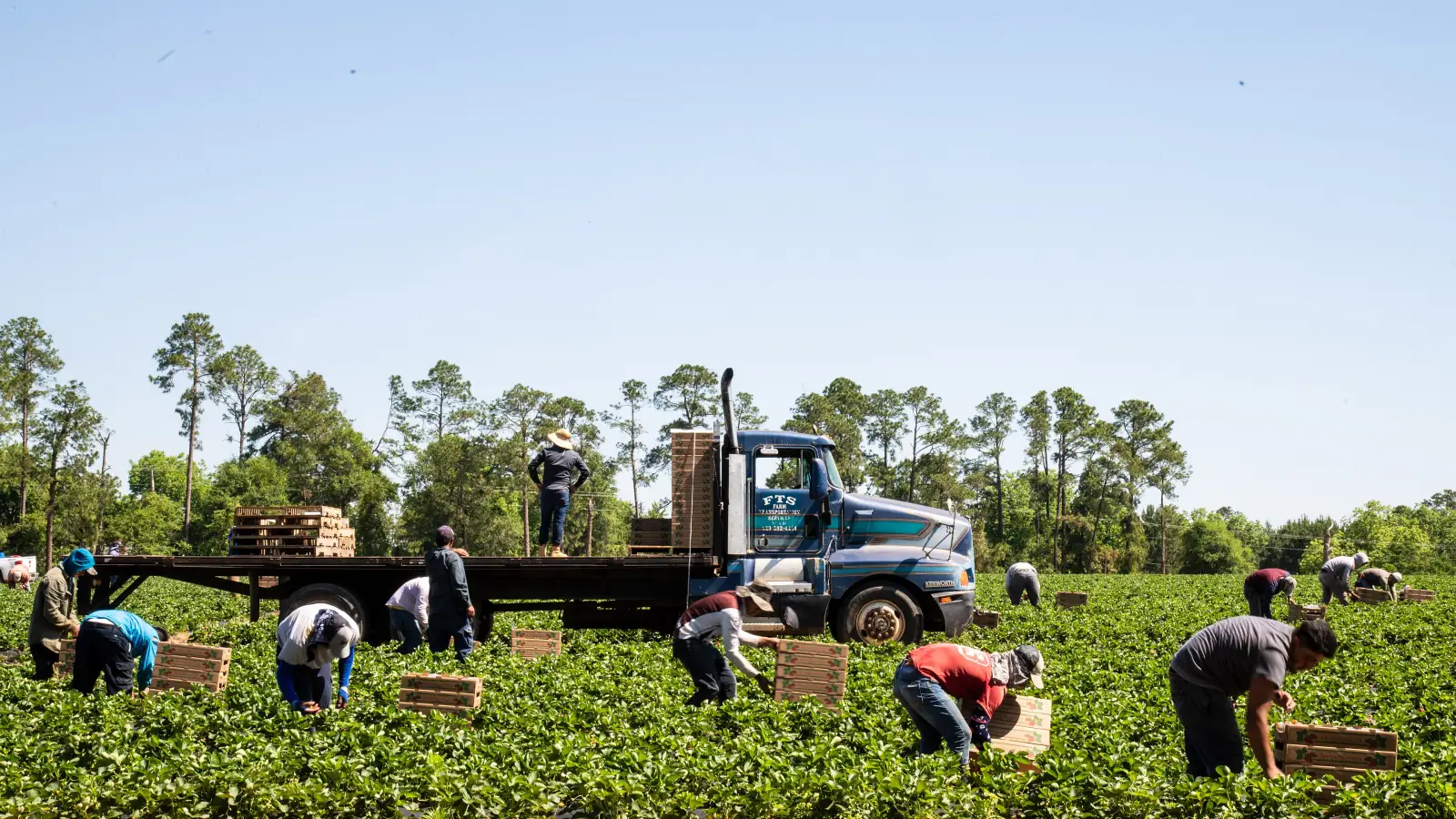
Work follows the seasons: grapes and apples in the north in late summer, tomatoes and citrus in the south, greenhouse crops in Sicily and Lazio most of the year. You pick, prune, plant, tie vines, sort and pack produce, and feed or milk animals on livestock farms. Many jobs are fixed-term (operai a tempo determinato) for a single harvest.
Hours and shifts
The law sets a normal week of 40 hours, and the agricultural agreement and its provincial agreements set the daily schedule and overtime rates. Average hours, overtime included, stay within 48 a week over up to four months.
Field days start early in summer to avoid the heat. You get 11 hours of rest in a row each day and 24 hours every seven days, averaged over 14 days. Paid holiday is at least four weeks a year. Livestock and harvest work can fall on Sundays, with the rest day moved to another day.
Recognition and licence, step by step.
What to do, in order, to work as a farm worker in Italy.
- 01
Find out your farm's agreement and province
Farm pay comes from the national agricultural agreement plus a provincial agreement where the farm sits, so the same job can pay differently in Verona and Foggia. Ask for the name of the provincial agreement and your area (area) or level in writing. - 02
Take the safety induction
Under article 37 of D.Lgs. 81/2008 the farm gives you safety training at the start: machinery, heat, manual handling, ladders and chemicals. Practice on the job is recorded in a register. Keep the certificate (attestato) for your next season. - 03
Qualify for tractors and machines
Article 73 of D.Lgs. 81/2008 requires specific training before you use equipment that needs special skills, and the Conferenza Stato-Regioni lists those needing an abilitazione. Ask which tractors, forklifts or harvesters you will drive and who books the course. - 04
Get the plant protection certificate if you spray
Only holders of the certificato di abilitazione all'acquisto e all'utilizzo, issued by the Region after a course and a positive assessment, can use plant protection products. You must be over 18, and the certificate lasts five years, renewed after refresher training.
Certificates and language.
Farms ask for the Italian safety training certificate, a tractor driving qualification for machine work, and the regional certificato di abilitazione all'acquisto e all'utilizzo for anyone spraying plant protection products. A forklift qualification helps in packing houses. A pesticide application certificate from abroad shows experience, but the Region issues the Italian one after its own course and test.
- Tractor driving licence
- Pesticide application certificate
- National forklift licence
Language at work
Picking and packing need only basic Italian for instructions, numbers and safety warnings; supervisors often show the task first. Spraying is different: the regional plant protection course ends with an assessment, so ask in which language it runs. Safety training must take account of your language knowledge under D.Lgs. 81/2008.
What farm workers earn in Italy.
Italy has no statutory minimum wage. Farm pay follows the CCNL operai agricoli e florovivaisti plus the provincial agreement, which sets the hourly or daily rate for each area of work, so rates differ by province. The national CNEL archive and the provincial agreement show the exact figure, and you can ask the employer which page applies. The ministry has not published a cost table for farm work, so we list no number here. Seasonal contracts are usually paid by the day worked, and the agreement adds holiday, 13th and 14th month amounts to the daily rate.
Before you sign.
Points to settle in writing before you sign a farm worker contract in Italy.
- Ask which provincial agricultural agreement applies and the daily or hourly rate for your area or level.
- Ask how many days of work the season is expected to give and how days lost to rain are handled.
- Ask whether housing is provided, how far it is from the fields and what it costs.
- Ask who drives you to the fields each morning and whether that transport is free.
- Ask whether you will use tractors or spray products, and who pays the abilitazione or regional course.
- Ask for water, shade and breaks on hot days and how the work hours change in summer.
What farm workers earn in other countries
Typical monthly gross pay for foreign hires, from official statistics and collective agreements.
FAQ
Questions about working in Italy.
What do I need before I can work as a farm worker in Italy?
Find out your farm's agreement and province; Take the safety induction; Qualify for tractors and machines; Get the plant protection certificate if you spray.
Which language do I need to work in Italy?
Picking and packing need only basic Italian for instructions, numbers and safety warnings; supervisors often show the task first. Spraying is different: the regional plant protection course ends with an assessment, so ask in which language it runs. Safety training must take account of your language knowledge under D.Lgs. 81/2008.
What is the minimum wage in Italy?
Italy has no single statutory minimum wage. Pay is set by collective agreements for each sector.
Sources
Checked September 2026. Rules change - confirm details with your employer or the authority before you apply.
- CNEL - Report CCNL vigenti al 30 giugno 2025 (agricoltura)
- Normattiva - D.Lgs. 150/2012, art. 9 (certificato di abilitazione all'acquisto e all'utilizzo)
- Normattiva - D.Lgs. 81/2008, art. 73 (attrezzature e abilitazione)
- Normattiva - D.Lgs. 66/2003, art. 4 (durata massima dell'orario)
- Sportello Unico per l'Immigrazione (Ministero dell'Interno)
Get found by employers hiring for Italy.
One free profile that employers hiring for Italy and your other chosen destinations can find.
Create your profileFree. No subscription. No commission on your wages, ever.