Farm worker jobs in Spain for foreigners.
Farm workers are no. 5 of 8 on the list of trades Spain recruits from abroad.
Updated September 2026
- Job offer signed
- Permit application sent
- Decision expected12-20 weeks
Key facts
- Main permit route
- Autorización de residencia temporal y trabajo por cuenta ajena
- Processing time
- 12-20 weeks
- Certificates employers ask for
- Tractor driving licence · Pesticide application certificate · National forklift licence
- Permits issued by
- Ministerio de Inclusión, Seguridad Social y Migraciones - Oficinas de Extranjería
What farm workers do in Spain.
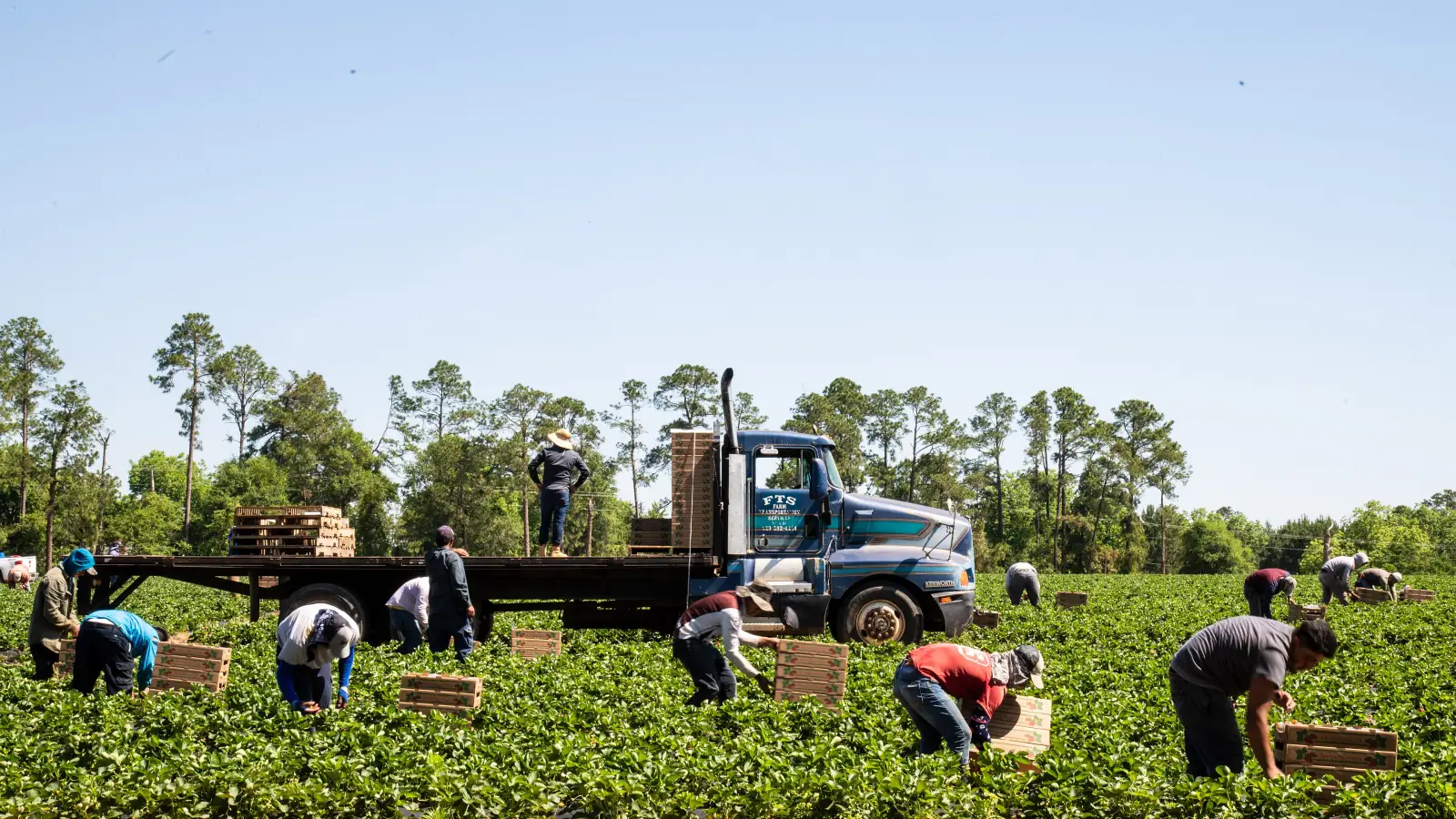
Spanish agriculture hires most heavily at harvest time: fruit and vegetables under plastic greenhouses in Almería, strawberries and berries in Huelva, olives in Jaén and the rest of Andalusia, citrus around Valencia and Murcia, and grapes across the wine regions. Packing houses (almacenes de manipulación) near the fields sort, grade and box the produce, running conveyor lines in shifts during the campaign and stacking pallets for export. Large farms and cooperatives employ crews for a season, often renewing contracts year after year.
Field days mean picking, pruning, tying plants, weeding, setting irrigation and loading crates, with tractors and sprayers moving between rows. Livestock farms need people for feeding, milking, moving animals and keeping sheds in order, on a rota that covers every day of the week.
Hours and shifts
Under Real Decreto 1561/1995, farm hours follow the collective agreement for the farm or, where there is none, local custom. During harvests and other seasonal peaks, and in livestock and rural guard work, the working week can grow by up to 20 hours, with a ceiling of 12 hours of effective work in a day, and you keep at least 10 hours of rest between days.
Hours above your agreed schedule are paid or given back as rest under article 35 of the Estatuto. Hard tasks are shorter by law: in extreme heat or humidity, or work of extraordinary effort, the ordinary day is capped at 6 hours 20 minutes and 38 hours a week, and work with feet in water or mud, or open digging, at 6 hours a day and 36 a week.
Recognition and licence, step by step.
What to do, in order, to work as a farm worker in Spain.
- 01
Check your papers for tractors
Under the Reglamento General de Conductores, a class B car licence covers self-propelled agricultural vehicles within ordinary size and weight limits. Without a B licence, the licencia de conducción for agricultural vehicles (minimum age 16) covers those machines up to 45 km/h. Larger or faster agricultural machines need a B licence in every case. - 02
Take the plant-protection course
Anyone who applies plant protection products as part of their job needs a carné under Real Decreto 1311/2012. The nivel básico, for auxiliary staff in spraying teams, needs at least 25 teaching hours; the nivel cualificado, for those in charge of treatments or of auxiliary staff, at least 60. - 03
Apply for the carné in your region
Send the course certificate to the competent body of the autonomous community where you live. It decides within three months unless regional rules say otherwise; with no answer in that time, the application counts as approved. The carné is valid across Spain for 10 years, and certificates from other EU states are recognised at the equivalent level. - 04
Have your farm experience assessed
Seasons worked abroad can be assessed through the acreditación de competencias profesionales, open all year under Real Decreto 659/2023 and run by your region. A certificate in crop or livestock competences gives you an official Spanish record of your skills for later contracts, including work as a tractor or machinery hand.
Certificates and language.
Farms ask most for the plant-protection carné (básico or cualificado) under Real Decreto 1311/2012, and for machinery a class B licence or the agricultural vehicle licence. A tractor licence or pesticide certificate from your home country shows experience but is checked against these Spanish rules. In packing houses, food hygiene training is the employer's job under Real Decreto 109/2010, and a national forklift licence from your own country helps when moving pallets. A carné issued in one autonomous community is valid in all of Spain, so you keep it when you follow harvests from one region to another.
- Tractor driving licence
- Pesticide application certificate
- National forklift licence
Language at work
No language level is required for field and harvest work. You need Spanish for machinery safety instructions, product labels and spraying records. Under Real Decreto 1311/2012 the carné is issued in Spanish and can be bilingual in autonomous communities with a second official language, so in Valencia or Catalonia you may see both on the same card. Crew leaders (encargados) give the day's tasks and safety rules in Spanish, so learn the words for rows, crates, ladders and breaks early.
What farm workers earn in Spain.
No range for this trade is in our Spain data, so use the national floor. The 2026 minimum wage is EUR 1,221 a month in 14 payments (EUR 17,094 a year). For seasonal contracts of up to 120 days with the same farm, the minimum is EUR 57.82 per legal working day, which already includes the share of Sundays, public holidays and the two extra payments. Your provincial farm agreement sets the actual daily or hourly rate, so ask for its 2026 table, and harvest-peak hours above your schedule are paid or given back as rest.
Before you sign.
Points to settle in writing before you sign a farm worker contract in Spain.
- Ask whether you are paid per day (jornal), per hour or per box, and check a short-contract day reaches EUR 57.82.
- Ask how long harvest-peak days will be - the legal ceiling is 12 hours of effective work, with 10 hours of rest after.
- Ask who pays the plant-protection course and carné if you will spray or handle crop products.
- Confirm the tractors and machines you will drive are covered by your licence or the agricultural vehicle licence.
- Ask where you will live during the season, what it costs or is deducted, and how you get to the fields.
- Ask for the season dates and whether the farm calls the same crew back for the next harvest.
What farm workers earn in other countries
Typical monthly gross pay for foreign hires, from official statistics and collective agreements.
Open farm worker vacancies in Spain.
Recent openings from EURES, the European Commission's job portal. You apply directly with the employer.
- PEONES GANADEROS, EN GENERALSpainNov 15
- PEONES AGRÍCOLAS, EN GENERALSpainNov 12
- PEONES GANADEROS, EN GENERALSpainNov 12
- PEÓN GANADERO PARA GANADO CAPRINOSpainNov 12
- PEONES GANADEROS, EN GENERALSpainNov 12
- TRABAJADORES/AS GANADO VACUNO (CID)SpainNov 11
- PEONES GANADEROS, EN GENERALSpainNov 11
- PEONES GANADEROS, EN GENERALSpainNov 11
FAQ
Questions about working in Spain.
What do I need before I can work as a farm worker in Spain?
Check your papers for tractors; Take the plant-protection course; Apply for the carné in your region; Have your farm experience assessed.
Which language do I need to work in Spain?
No language level is required for field and harvest work. You need Spanish for machinery safety instructions, product labels and spraying records. Under Real Decreto 1311/2012 the carné is issued in Spanish and can be bilingual in autonomous communities with a second official language, so in Valencia or Catalonia you may see both on the same card. Crew leaders (encargados) give the day's tasks and safety rules in Spanish, so learn the words for rows, crates, ladders and breaks early.
What is the minimum wage in Spain?
The statutory minimum wage in Spain is €1,221 a month gross (2026).
Sources
Checked September 2026. Rules change - confirm details with your employer or the authority before you apply.
- BOE - Real Decreto 1561/1995, jornadas especiales de trabajo
- BOE - Real Decreto 1311/2012, uso sostenible de productos fitosanitarios
- BOE - Real Decreto 818/2009, Reglamento General de Conductores
- La Moncloa - Salario mínimo interprofesional 2026
- Ministerio de Inclusión, Seguridad Social y Migraciones - Oficinas de Extranjería
Get found by employers hiring for Spain.
One free profile that employers hiring for Spain and your other chosen destinations can find.
Create your profileFree. No subscription. No commission on your wages, ever.