Carpenter jobs in Spain for foreigners.
Carpenters are no. 3 of 8 on the list of trades Spain recruits from abroad.
Updated September 2026
- Job offer signed
- Permit application sent
- Decision expected12-20 weeks
Key facts
- Main permit route
- Autorización de residencia temporal y trabajo por cuenta ajena
- Processing time
- 12-20 weeks
- Certificates employers ask for
- NVQ Level 3 Carpentry and Joinery · CSCS card · Red Seal
- Permits issued by
- Ministerio de Inclusión, Seguridad Social y Migraciones - Oficinas de Extranjería
What carpenters do in Spain.
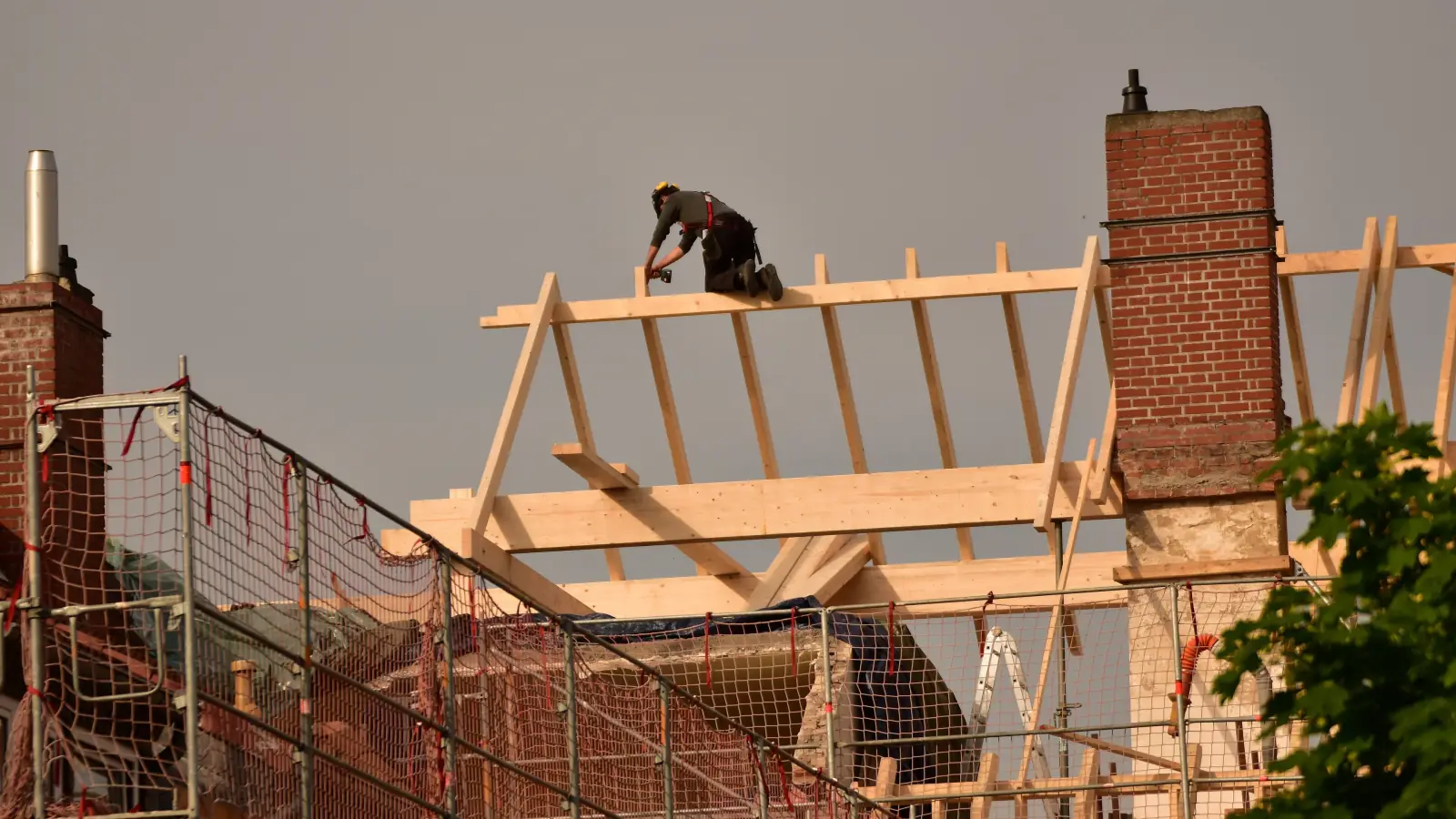
Woodwork jobs in Spain split three ways. On building sites, encofradores build and strip the timber and metal formwork for concrete slabs, columns and walls. In workshops and on fit-outs, firms in the wood and furniture sector (sector de la madera) make and install doors, windows, stairs, kitchens and built-in units. A third group fits aluminium, metal and PVC frames: 'carpinteros de aluminio, metálico y pvc' and 'montadores de carpintería metálica, aluminio y pvc' appear for all provinces in the SEPE shortage catalogue for the first quarter of 2026.
Formwork crews follow the concrete pour schedule: setting out panels and props, checking levels and ties before the mixer trucks arrive, then stripping and cleaning shuttering for the next floor. Workshop joiners spend more of the week at saws, planers and CNC machines, with a day or two fitting on site. The side you join decides your agreement, your safety card and your pay table.
Hours and shifts
On formwork jobs the construction agreement shapes the year. The 2026 Madrid tables fix 1,736 hours of effective work, Monday to Friday, and site calendars cannot plan more than nine hours in a day unless the firm spreads hours irregularly across the year. Overtime there is voluntary: the firm asks in writing, you accept expressly, and it is paid at the Tabla Anexa XI rates or swapped for rest within four months.
Wood and furniture workshops follow the state agreement for the wood sector, within the Estatuto limits of 40 hours a week on annual average, 12 hours between shifts and a day and a half of weekly rest. Ask for the shift times in writing if the workshop runs morning and afternoon turns.
Recognition and licence, step by step.
What to do, in order, to work as a carpenter in Spain.
- 01
Find out which sector hires you
Your contract decides whether you fall under the construction agreement (formwork, site joinery) or the wood and furniture agreement (workshop joinery). Each has its own prevention training and its own version of the Tarjeta Profesional de la Construcción, issued by the Fundación Laboral de la Construcción or by the Fundación Laboral de la Madera y el Mueble. - 02
Complete the aula permanente
Formwork work starts with the general prevention course of at least 8 teaching hours: basic safety, falls, lifting loads, collective and personal protection, hanging and modular scaffolds, trestles and first aid. To count, it is taught by the Fundación Laboral or an approved centre and carries the course code from the Fundación's system. - 03
Add the 20-hour 'Encofrados' module
The trade module for formwork is 'Encofrados', at least 20 teaching hours under the VII Convenio General del Sector de la Construcción. If you later add a second site trade, a 6-hour polyvalent module for that trade builds on the 20 hours you already hold. - 04
Apply for the TPC
Bring the application form, a photo, your residence card, a vida laboral report issued within the last 90 days, your course diplomas and a contract, payslip or employer certificate to a punto de tramitación. The card arrives within one month of complete papers and lasts five years. - 05
Get your skill level on record
Ask your region about the acreditación de competencias profesionales for joinery or formwork, open all year under Real Decreto 659/2023. The certificate it leads to is an official Spanish record of your skill level that you can show to employers.
Certificates and language.
Site contractors ask first for the 8-hour and 20-hour 'Encofrados' diplomas and the Tarjeta Profesional de la Construcción, which also records your category, health checks and job history. Workshop firms ask for the wood-sector TPC from the Fundación Laboral de la Madera y el Mueble. Papers from abroad such as an NVQ Level 3 Carpentry and Joinery, a CSCS card or a Red Seal show experience; a Spanish certificado de profesionalidad or a regional accreditation gives you a local equivalent.
- NVQ Level 3 Carpentry and Joinery
- CSCS card
- Red Seal
Language at work
Spain sets no formal language level for joinery. On formwork you follow the site manager's pour plan, prop spacing and the safety plan, all in Spanish, and the prevention courses are taught locally. Workshop joiners read cutting lists, drawings and machine settings. Ask the training centre which language it uses for the course and its test.
What carpenters earn in Spain.
Our Spain data has no separate range for joinery, so compare with the 2026 minimum wage of EUR 1,221 a month, paid 14 times (EUR 17,094 a year). On Madrid building sites, the 2026 construction tables pay an Oficial 2ª de Oficio EUR 64.16 per working day and EUR 23,831.20 a year with extra payments, and an Encargado (level VI) EUR 70.01 a day. When the firm sends you away from home, the half allowance (media dieta) is EUR 14.50 a day and the full dieta EUR 61.83.
Before you sign.
Points to settle in writing before you sign a carpenter contract in Spain.
- Ask whether you are hired under the construction or the wood-sector agreement, since it sets your pay table, training and which TPC you need.
- Confirm the firm pays the 20-hour 'Encofrados' course and counts the hours as paid working time.
- Ask who supplies saws, nail guns and hand tools, and whether you are expected to bring your own.
- Check your category - Oficial 1ª, Oficial 2ª or Ayudante de Oficio - is written in the contract from day one.
- For formwork at height, ask what edge protection and fall-arrest equipment the site provides.
- Ask whether distant sites come with the media dieta, the full dieta or lodging paid by the firm.
Good to know.
- Pay in construction follows provincial collective agreements, so rates differ by province.
What carpenters earn in other countries
Typical monthly gross pay for foreign hires, from official statistics and collective agreements.
Open carpenter vacancies in Spain.
Recent openings from EURES, the European Commission's job portal. You apply directly with the employer.
- 2 PEONES DE CARPINTERÍA DE MADERASpainNov 12
- CARPINTEROS EN GENERALSpainNov 12
- Oficial de carpintería de aluminio para SoriaSpainNov 12
- PEONES DE LA INDUSTRIA DE LA MADERA Y DEL CORCHOSpainNov 11
- TRABAJOS OFICIAL ALUMINIOSpainNov 11
- PEON ESPECIALISTA DE LA CARPINTERÍASpainNov 11
- FABRICANTE Y MONTADOR DE VENTANASSpainNov 11
- CARPINTERO/A EN GENERAL (OFICIAL SEGUNDA)SpainNov 11
FAQ
Questions about working in Spain.
What do I need before I can work as a carpenter in Spain?
Find out which sector hires you; Complete the aula permanente; Add the 20-hour 'Encofrados' module; Apply for the TPC; Get your skill level on record.
Which language do I need to work in Spain?
Spain sets no formal language level for joinery. On formwork you follow the site manager's pour plan, prop spacing and the safety plan, all in Spanish, and the prevention courses are taught locally. Workshop joiners read cutting lists, drawings and machine settings. Ask the training centre which language it uses for the course and its test.
What is the minimum wage in Spain?
The statutory minimum wage in Spain is €1,221 a month gross (2026).
Carpenters are also hired in:
Sources
Checked September 2026. Rules change - confirm details with your employer or the authority before you apply.
- Fundación Laboral de la Construcción - Formación en PRL para la TPC
- Fundación Laboral de la Madera y el Mueble - TPC sector de la madera
- BOCM - Convenio colectivo de Construcción de la Comunidad de Madrid, tablas 2026
- BOE - Catálogo de Ocupaciones de Difícil Cobertura, 1.º trimestre 2026
- Fundación Laboral de la Construcción - Información general TPC (febrero 2026)
- Ministerio de Inclusión, Seguridad Social y Migraciones - Oficinas de Extranjería
Get found by employers hiring for Spain.
One free profile that employers hiring for Spain and your other chosen destinations can find.
Create your profileFree. No subscription. No commission on your wages, ever.