Construction worker jobs in Spain for foreigners.
Foreign construction workers in Spain typically earn €1,900 - €2,100 a month gross. Construction workers are no. 1 of 8 on the list of trades Spain recruits from abroad.
Updated September 2026
Minimum wage 2026€1,221
Typical pay€1,900 - €2,100
- Job offer signed
- Permit application sent
- Decision expected12-20 weeks
Key facts
- Typical pay
- €1,900 - €2,100 a month gross
- Main permit route
- Autorización de residencia temporal y trabajo por cuenta ajena
- Processing time
- 12-20 weeks
- Certificates employers ask for
- CSCS card · SafePass · OSHA 10 · VCA
- Permits issued by
- Ministerio de Inclusión, Seguridad Social y Migraciones - Oficinas de Extranjería
What construction workers do in Spain.
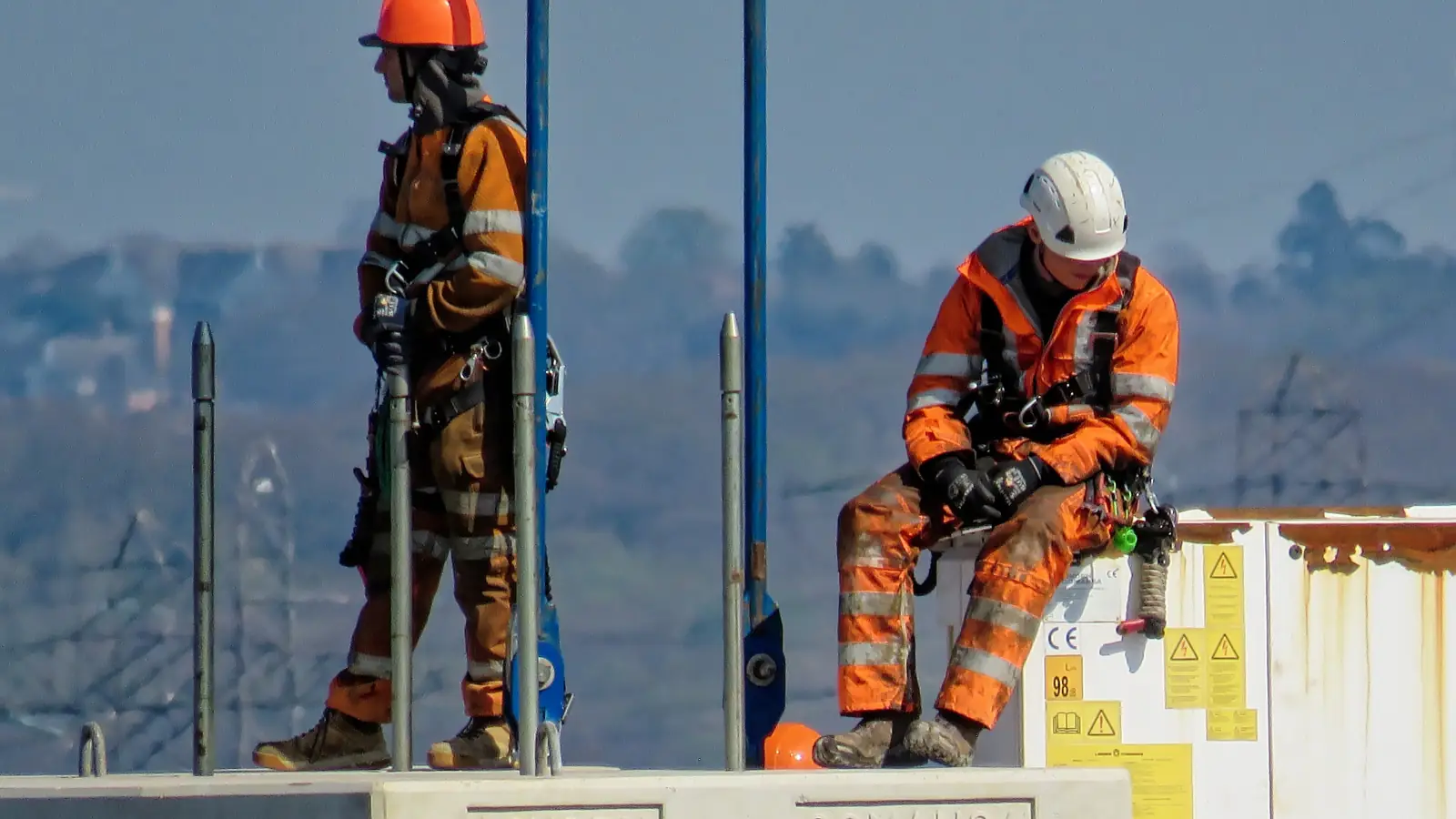
General site work in Spain is done by peones and especialistas: unloading and moving materials, preparing and placing concrete, digging trenches, setting up site protections, feeding the trades with what they need and keeping work areas safe. Employers are building contractors, civil-engineering firms on roads and railways, demolition and renovation companies, and temporary work agencies (Empresas de Trabajo Temporal) that place crews with them. The 2026 Madrid tables group peón especializado with especialista de 2ª in level XI, and peón suelto in level XII.
Days begin with a short briefing from the encargado or capataz, then a mix of manual work and hand-held machines such as compactors, cut-off saws and vibrators. On civil works you may spend weeks on one stretch of road or rail line; on housing jobs your tasks change as the building rises from foundations to roof. Safety set-up is part of the job too: guardrails, nets, site signage, and keeping walkways and access ramps clear for everyone else.
Hours and shifts
Site hours come from the agreement: the Madrid construction convenio fixes 1,736 effective hours for 2026, worked Monday to Friday, with at most nine ordinary hours a day on the agreed calendar. The Estatuto de los Trabajadores adds a minimum of 12 hours between one working day and the next, and overtime cannot pass 80 hours a year.
Night shifts on road and rail work earn, in Madrid, a supplement of 25% of base salary for hours between 10 pm and 6 am. Where a site runs two shifts and only one hour of yours falls in the night window, the supplement is 1% of base salary. Travel to sites is covered by the agreement's locomoción rules.
Recognition and licence, step by step.
What to do, in order, to work as a construction worker in Spain.
- 01
Start with the 8-hour aula permanente
Your first step is the initial prevention course of the construction agreement: general site risks, falls, collective and personal protection, small machinery, signage and the symbols on building products. Only courses from the Fundación Laboral de la Construcción or an approved centre, registered with a course code, count for the card. - 02
Choose a 20-hour module for your role
A labourer using hand-held machines can take 'Operadores de equipos manuales' (20 hours). Road crews take 'Trabajos de conservación y explotación de carreteras', and demolition crews 'Trabajos de demolición y rehabilitación'. The 60-hour 'Nivel básico de prevención en la construcción' is a wider option. - 03
Apply for the TPC
You qualify with a current job in a firm under the construction agreement, or 30 days registered with such firms in the last 60 months. Apply online or at a punto de tramitación and hand in the form, photo, TIE, a vida laboral under 90 days old, diplomas and an employer certificate, contract or payslip. A decision comes within one month. - 04
Keep the medical check on file
The TPC records your health surveillance (vigilancia de la salud). A medical aptitude result stays valid for one year for the same job, so the card saves you repeating it when you move between firms within that year. - 05
Coming through an agency
Workers placed by an ETT with a construction company can also hold the TPC. Ask the agency to issue the employer certificate and to book your prevention course before your first day on site.
Certificates and language.
Gate checks on Spanish sites centre on the prevention diplomas and the Tarjeta Profesional de la Construcción. Foreign safety cards such as CSCS, Ireland's SafePass, OSHA 10 or VCA show earlier training; other prevention training is validated at a punto de tramitación before it counts. If you run machines, the 20-hour modules for earth-moving machinery or lifting equipment add to your card, and 'Primeros auxilios en equipos de emergencia' is a 4-hour option.
- CSCS card
- SafePass
- OSHA 10
- VCA
Language at work
No formal level applies to labouring jobs in Spain. You need enough Spanish to follow the morning briefing, warning signs and instructions such as where to stack materials or when to stop a machine. The prevention courses are taught by local centres, so ask the Fundación Laboral or the approved centre which language it teaches in before you book. The initial course also teaches the hazard symbols printed on building products, which helps on day one.
What construction workers earn in Spain.
Our Spain data puts general site work at EUR 1,900 - 2,100 gross a month, well above the 2026 minimum wage of EUR 1,221 a month in 14 payments. The 2026 Madrid tables pay a peón especializado EUR 62.66 a day, or EUR 23,079.10 a year with extra payments and holidays, and a peón suelto EUR 62.61 a day (EUR 23,051.90 a year). Their June and Christmas payments are EUR 1,935.00 and EUR 1,929.55 each. A half dieta of EUR 14.50 applies when you eat away from home.
Typical pay of €1,900 - €2,100 a month gross is 1.6 to 1.7 times the statutory minimum wage of €1,221 (2026).
Before you sign.
Points to settle in writing before you sign a construction worker contract in Spain.
- Ask which 20-hour module the firm will book for your tasks, and that the course hours are paid.
- Check your level (XI or XII in the Madrid tables, or the provincial equivalent) is written in the contract.
- If an ETT hires you, ask which construction firm you will be placed with and who pays the prevention course.
- Confirm boots, helmet, gloves, high-visibility clothing and ear protection are supplied by the employer.
- Ask how you get to each site every day and whether the locomoción or dieta rules of the agreement apply.
- Ask whether night shifts are planned and how the 25% night supplement shows on your payslip.
Good to know.
- Pay in construction follows provincial collective agreements, so rates differ by province.
What construction workers earn in other countries
Typical monthly gross pay for foreign hires, from official statistics and collective agreements.
Open construction worker vacancies in Spain.
Recent openings from EURES, the European Commission's job portal. You apply directly with the employer.
- 4 PEONES/AS DE EDIFICACIÓN Y OBRA CIVIL AYUNTAMIENTO NAVIA PLE ITINERARIOS INTEGRALES ACTIVACIÓN EN EL ÁMBITO LOCAL (REF.: 8180)SpainNov 12
- OPERARIO/A SERVICIOS MÚLTIPLES (EMPLEO PÚBLICO)SpainNov 11
- PEON DE CONSTRUCCIÓNSpainNov 11
- PEONES DE LA CONSTRUCCIÓN DE EDIFICIOSSpainNov 11
- PEONES DE LA CONSTRUCCIÓN DE EDIFICIOSSpainNov 11
- PEONES DE LA CONSTRUCCIÓN DE EDIFICIOSSpainNov 11
- PEONES DE LA CONSTRUCCIÓN DE EDIFICIOSSpainNov 11
- PEONES DE OBRAS PUBLICAS, EN GENERALSpainNov 11
FAQ
Questions about working in Spain.
How much do construction workers earn in Spain?
Foreign construction workers in Spain typically earn €1,900 - €2,100 a month gross.
What do I need before I can work as a construction worker in Spain?
Start with the 8-hour aula permanente; Choose a 20-hour module for your role; Apply for the TPC; Keep the medical check on file; Coming through an agency.
Which language do I need to work in Spain?
No formal level applies to labouring jobs in Spain. You need enough Spanish to follow the morning briefing, warning signs and instructions such as where to stack materials or when to stop a machine. The prevention courses are taught by local centres, so ask the Fundación Laboral or the approved centre which language it teaches in before you book. The initial course also teaches the hazard symbols printed on building products, which helps on day one.
Construction workers are also hired in:
Sources
Checked September 2026. Rules change - confirm details with your employer or the authority before you apply.
- Fundación Laboral de la Construcción - Información general TPC (febrero 2026)
- Fundación Laboral de la Construcción - Formación en PRL para la TPC
- BOCM - Convenio colectivo de Construcción de la Comunidad de Madrid, tablas 2026
- BOE - Estatuto de los Trabajadores (Real Decreto Legislativo 2/2015), consolidated text
- Ministerio de Inclusión, Seguridad Social y Migraciones - Oficinas de Extranjería
Get found by employers hiring for Spain.
One free profile that employers hiring for Spain and your other chosen destinations can find.
Create your profileFree. No subscription. No commission on your wages, ever.