Bricklayer jobs in Spain for foreigners.
Foreign bricklayers in Spain typically earn €2,000 - €2,200 a month gross. Bricklayers are no. 2 of 8 on the list of trades Spain recruits from abroad.
Updated September 2026
Minimum wage 2026€1,221
Typical pay€2,000 - €2,200
- Job offer signed
- Permit application sent
- Decision expected12-20 weeks
Key facts
- Typical pay
- €2,000 - €2,200 a month gross
- Main permit route
- Autorización de residencia temporal y trabajo por cuenta ajena
- Processing time
- 12-20 weeks
- Certificates employers ask for
- NVQ Level 2 Trowel Occupations · CSCS card · Red Seal
- Permits issued by
- Ministerio de Inclusión, Seguridad Social y Migraciones - Oficinas de Extranjería
What bricklayers do in Spain.
Albañilería is the core of Spanish building work: brick facades (fábrica de ladrillo) with cement render, interior partition walls (tabiquería), and finishes in ceramic, plasterboard and escayola - the same list the construction agreement's own albañilería course is built around. Employers range from large contractors on housing developments to small builders renovating flats in town centres. Pay in this sector follows provincial collective agreements, so the rate for the same work differs by province.
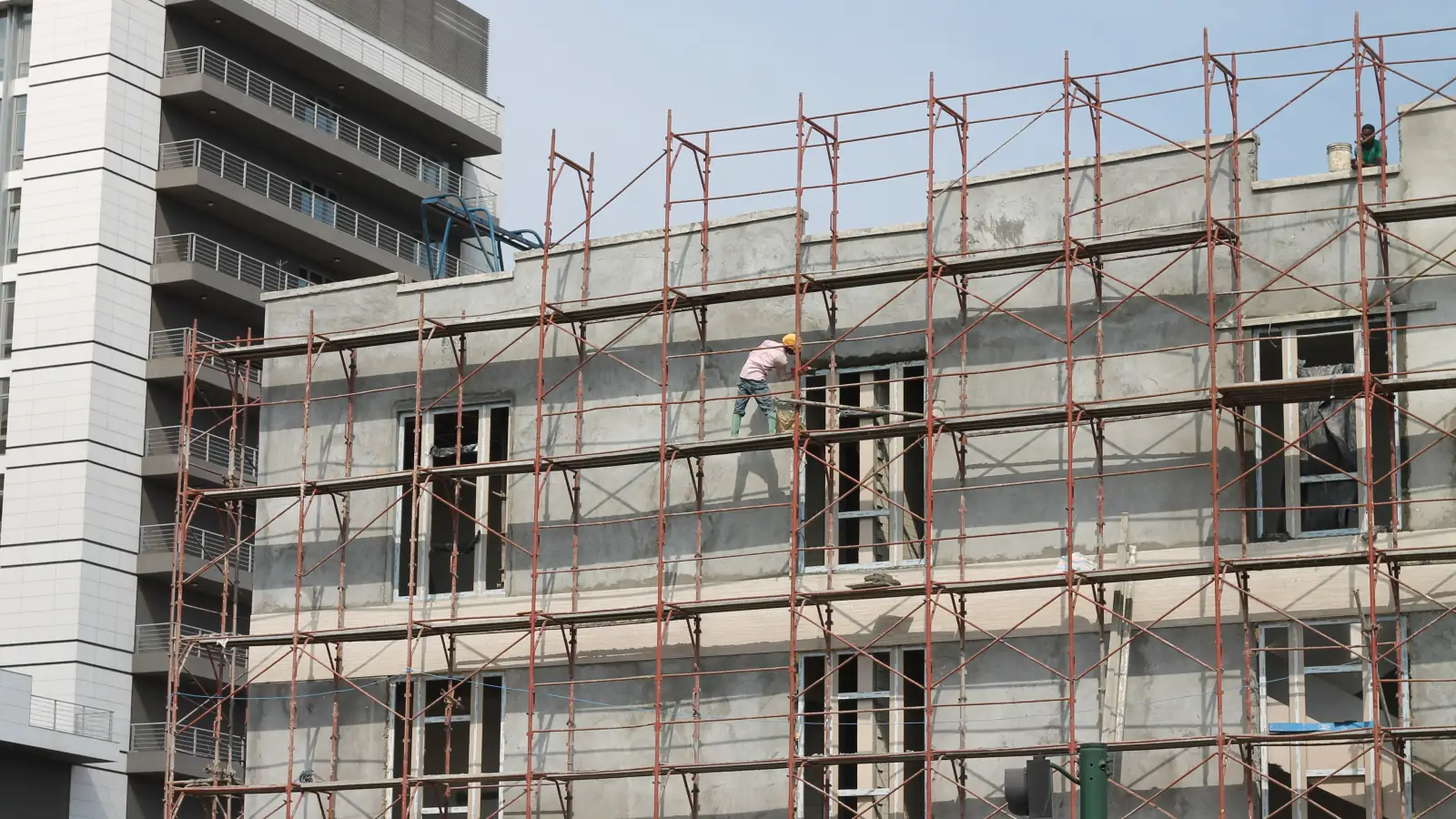
A typical week starts with setting out lines and levels, receiving or mixing mortar and laying courses of brick or block, then moves on to openings, lintels and render. Trestles and modular scaffolds are part of most days. Teams are built around an Oficial 1ª de Oficio, with an Oficial 2ª and helpers, under a capataz or encargado who runs the site. On renovation jobs you also open and close walls for new pipes and cables, rebuild damaged facades and patch render while residents live around you.
Hours and shifts
The Madrid construction agreement, published in the BOCM on 31 December 2025, fixes the ordinary year at 1,736 hours of effective work for 2025 and 2026, spread from Monday to Friday. Each firm agrees its calendar with staff representatives by 30 January; without one, the agreement's own calendar for the year applies. Days are capped at nine ordinary hours unless the firm uses an irregular spread across the year.
Overtime is voluntary and needs a written request plus your acceptance; Madrid pays it at its Tabla Anexa XI rates or gives rest within four months. Work between 10 pm and 6 am earns a night supplement of 25% of base salary, paid for the whole day once more than four hours fall in that window. Other provinces publish their own agreement in their official bulletin.
Recognition and licence, step by step.
What to do, in order, to work as a bricklayer in Spain.
- 01
Initial prevention course (8 hours)
Before your first day on a site, complete the aula permanente: at least 8 teaching hours on site risks, falls, loads, protective equipment, signage, product symbols and first aid. It is run by the Fundación Laboral de la Construcción or a centre it has approved, and the diploma must show the course code from the Fundación's system. - 02
Albañilería trade module (20 hours)
Next comes the 20-hour 'Albañilería' module of the VII Convenio General. Its specific part covers facades in brick and render, partition walls and materials such as ceramics, plasterboard and escayola, with the risks of each. Ask the firm whether it books and pays for the course. - 03
Apply for the Tarjeta Profesional
Take the form, a photo, your TIE, a vida laboral report under 90 days old, the diplomas and one proof of work, such as a payslip, to a punto de tramitación: Fundación centres, CNC employer associations, CCOO del Hábitat or UGT FICA offices. The card arrives within a month and lasts five years. - 04
Get your experience accredited
The acreditación de competencias profesionales, open all year under Real Decreto 659/2023, lets you prove brick and block skills gained abroad against Spain's national competence standards. Your regional administration runs the assessment and issues the certificate. - 05
Use the TPC to skip a repeat trial period
Once your TPC shows you completed a trial period in your category with an earlier Spanish employer, you are exempt from a new trial period for that category on fixed-site or other temporary contracts.
Certificates and language.
Spanish contractors check the prevention diplomas (8-hour initial plus 20-hour Albañilería) and the Tarjeta Profesional de la Construcción, which records your training, category and medical checks. An NVQ Level 2 Trowel Occupations, a UK CSCS card or a Red Seal shows your level from abroad. If you also lay tiles, the 'Solados y alicatados' module adds 20 hours, or just 6 hours as a polyvalent extra once you hold a 20-hour trade module. Plasterboard partitions you put up alongside brickwork are covered by the 'Montaje de escayola, placas de yeso laminado y asimilados' module.
- NVQ Level 2 Trowel Occupations
- CSCS card
- Red Seal
Language at work
Spain sets no formal language level for this trade. Day to day you need site Spanish for measurements, materials and instructions from the encargado or capataz, plus enough to follow the safety plan and the prevention course in the region where you train. Learn the trade words early: ladrillo, mortero, tabique, nivel, andamio, enfoscado.
What bricklayers earn in Spain.
Our Spain data puts this trade at EUR 2,000 - 2,200 gross a month, against the 2026 minimum wage of EUR 1,221 a month paid 14 times. In the 2026 Madrid tables an Oficial 1ª de Oficio earns EUR 67.36 per working day (base EUR 34.02, activity bonus EUR 23.50, non-salary plus EUR 9.84), and an Oficial 2ª EUR 64.16, plus June, Christmas and holiday payments. Night work adds 25% of base salary, and a full dieta for sites away from home is EUR 61.83 a day.
Typical pay of €2,000 - €2,200 a month gross is 1.6 to 1.8 times the statutory minimum wage of €1,221 (2026).
Before you sign.
Points to settle in writing before you sign a bricklayer contract in Spain.
- Ask for your category (Oficial 1ª or 2ª de Oficio) and the province whose construction table sets your daily rate.
- Confirm the firm pays the aula permanente and the Albañilería module and counts both as working time.
- Ask who supplies trowels, levels and hand tools, and that boots, helmet and harness come from the firm.
- Check whether you are paid on the daily table or the monthly one, and how the June, Christmas and holiday payments are added.
- If the firm pays food and lodging on distant sites, the Madrid agreement pays only 20% of the full dieta - ask which applies.
- Keep your vida laboral and payslips, as you need 30 days in the sector within 60 months to renew the TPC.
Good to know.
- Pay in construction follows provincial collective agreements, so rates differ by province.
What bricklayers earn in other countries
Typical monthly gross pay for foreign hires, from official statistics and collective agreements.
Open bricklayer vacancies in Spain.
Recent openings from EURES, the European Commission's job portal. You apply directly with the employer.
FAQ
Questions about working in Spain.
How much do bricklayers earn in Spain?
Foreign bricklayers in Spain typically earn €2,000 - €2,200 a month gross.
What do I need before I can work as a bricklayer in Spain?
Initial prevention course (8 hours); Albañilería trade module (20 hours); Apply for the Tarjeta Profesional; Get your experience accredited; Use the TPC to skip a repeat trial period.
Which language do I need to work in Spain?
Spain sets no formal language level for this trade. Day to day you need site Spanish for measurements, materials and instructions from the encargado or capataz, plus enough to follow the safety plan and the prevention course in the region where you train. Learn the trade words early: ladrillo, mortero, tabique, nivel, andamio, enfoscado.
Sources
Checked September 2026. Rules change - confirm details with your employer or the authority before you apply.
- BOCM - Convenio colectivo de Construcción de la Comunidad de Madrid, tablas 2026
- Fundación Laboral de la Construcción - Formación en PRL para la TPC
- Fundación Laboral de la Construcción - Información general TPC (febrero 2026)
- BOE - Real Decreto 659/2023, ordenación del Sistema de Formación Profesional
- Ministerio de Inclusión, Seguridad Social y Migraciones - Oficinas de Extranjería
Get found by employers hiring for Spain.
One free profile that employers hiring for Spain and your other chosen destinations can find.
Create your profileFree. No subscription. No commission on your wages, ever.