Bricklayer jobs in Poland for foreigners.
Foreign bricklayers in Poland typically earn PLN 4,800 - PLN 7,000 a month gross. Bricklayers are no. 6 of 10 on the list of trades Poland recruits from abroad.
Updated September 2026
Minimum wage 2026PLN 4,806
Typical payPLN 4,800 - PLN 7,000
- Job offer signed
- Permit application sent
- Decision expected10-24 weeks
Key facts
- Typical pay
- PLN 4,800 - PLN 7,000 a month gross
- Main permit route
- Zezwolenie na pracę typu A
- Processing time
- 10-24 weeks
- Certificates employers ask for
- NVQ Level 2 Trowel Occupations · CSCS card · Red Seal
- Permits issued by
- Wojewoda (Urząd Wojewódzki) - Zatrudnianie cudzoziemców
What bricklayers do in Poland.
A murarz in Poland builds walls of ceramic blocks, silicate blocks and aerated concrete for blocks of flats, single-family houses and commercial buildings. Many houses in Poland are still built with masonry walls, so general contractors and small family building firms hire through most of the year. Jobs often combine bricklaying with plastering (murarz-tynkarz), chimney work and repairs.
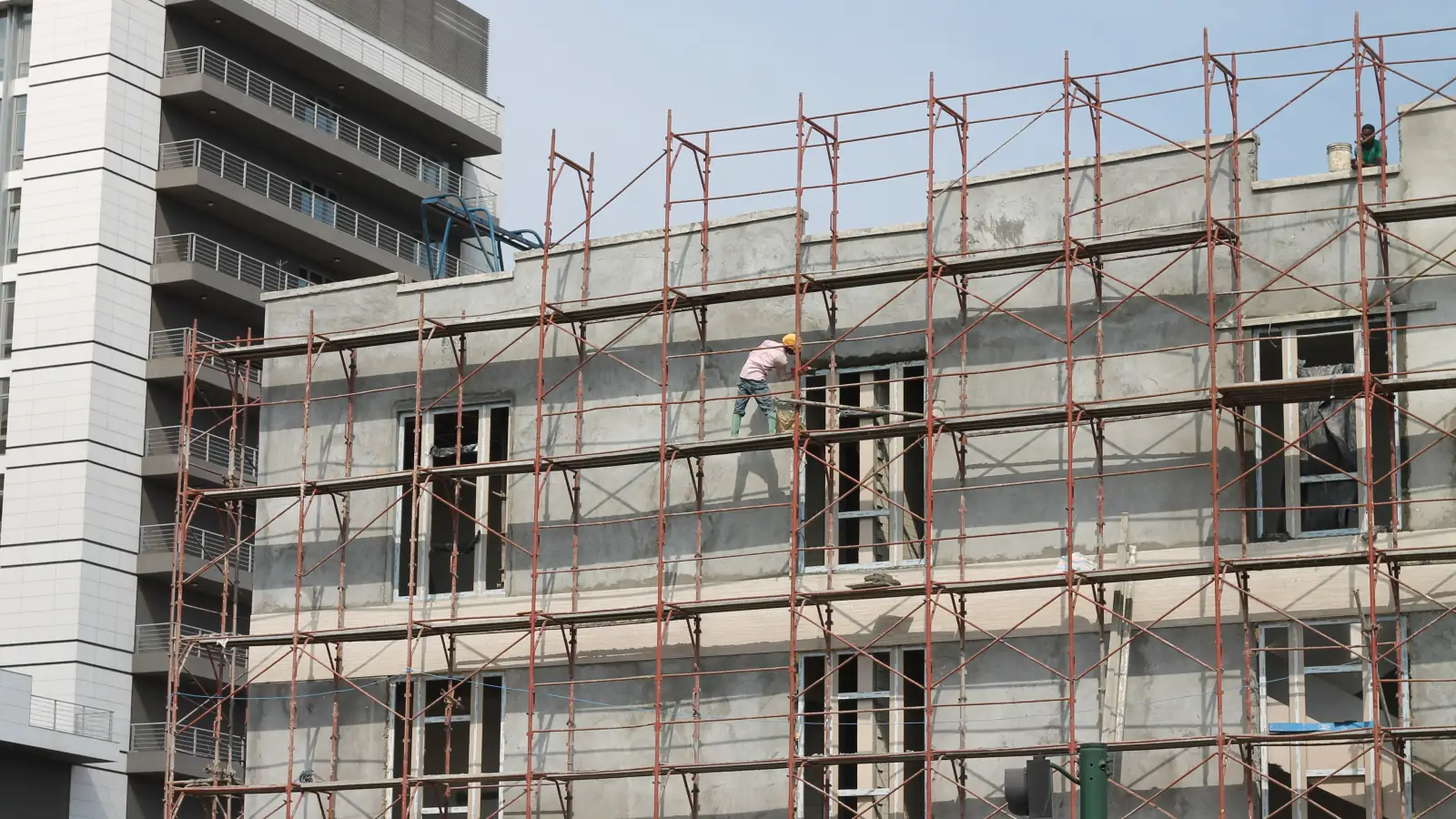
Your day starts with setting out lines and levels, then mixing or receiving mortar and glue, laying blocks, building corners and openings, and fitting lintels. You work from scaffolds and mobile platforms as the wall rises. Housing estates around Warsaw, Kraków, Wrocław, Gdańsk and Poznań need large teams, while smaller firms build houses in villages and towns. Work slows in frost, and the busiest months run from spring to late autumn.
Hours and shifts
Your daily limit is 8 hours with an average 40-hour week over the settlement period. Weekday overtime adds 50% and overtime on a Sunday, holiday or at night adds 100%. Unless an agreement sets another number, overtime for the employer's special needs stops at 150 hours in a calendar year, which matters in busy summer months.
Site safety rules also shape your hours. Work on scaffolds and mobile platforms stops in a storm or when the wind is stronger than 10 m/s. Your employer must give at least 11 hours of rest every day and a 35-hour weekly rest, so a late pour cannot push you straight into an early start.
Recognition and licence, step by step.
What to do, in order, to work as a bricklayer in Poland.
- 01
Show your skill on a trial wall
Bricklaying is not a regulated profession in Poland and there is no licence to obtain. Employers usually check you with a practical trial on site, such as building a corner with an opening to line and level. Bring references, a work record and photos of buildings you worked on. - 02
Take the journeyman exam at an izba rzemieślnicza
To prove your skill with a Polish document, apply to an izba rzemieślnicza (chamber of crafts) for the egzamin czeladniczy (journeyman exam) in the murarz-tynkarz trade. The Ustawa o rzemiośle sets the base fee at PLN 700, indexed with inflation, and a resit costs half. The chamber can waive the fee. - 03
Attend the occupational medicine check
The employer sends you to the occupational medicine doctor at its cost before you start, and you start only with a positive certificate. Bring glasses or hearing aids you use, because the doctor checks whether you can work safely on scaffolds and with mixers and cutters. - 04
Complete BHP training for the site
The employer runs initial BHP training in paid time before you start. On the site, check that the scaffold has a written acceptance entry, which lists its user, purpose, the firm that built it and the date of the next inspection. - 05
Follow the scaffold and weather rules
Metal scaffolds must be earthed and fitted with lightning protection, and work on them stops during a storm or in wind above 10 m/s. A board on each scaffold names the firm that assembled it and the permitted load. If the acceptance record or the board is missing, ask the site manager before you climb.
Certificates and language.
Most Polish building firms hire on a practical trial plus your work record. A Polish świadectwo czeladnicze from an izba rzemieślnicza in the murarz-tynkarz trade is valued, and so are foreign papers such as NVQ Level 2 Trowel Occupations or a Red Seal. A CSCS card shows UK site training but does not replace the Polish BHP briefing. Some contractors ask for a UDT certificate for mobile platforms if you work from them.
- NVQ Level 2 Trowel Occupations
- CSCS card
- Red Seal
Language at work
Polish is the working language on most sites, and foremen give plans, quantities and safety instructions in Polish. You need everyday words for materials, sizes and warnings to work safely in a crew. The journeyman exam at the craft chamber is in Polish. No language level is set by law for this trade.
What bricklayers earn in Poland.
Bricklaying jobs in Poland pay about PLN 4,800 to 7,000 gross a month. That starts at the 2026 minimum wage of PLN 4,806 for full-time work, which is the legal floor on an employment contract, and reaches about 46% above it at the top. Overtime supplements of 50% and 100% add to busy months. Some firms pay per square metre of wall, so ask how that converts into a monthly gross that stays at or above the minimum. Experienced murarz-tynkarz workers who can also plaster earn toward the upper end. In frost breaks, a monthly wage keeps running under your contract, so a fixed monthly gross gives you steadier income through the winter than pay by the square metre.
Typical pay of PLN 4,800 - PLN 7,000 a month gross is 1 to 1.5 times the statutory minimum wage of PLN 4,806 (2026).
Before you sign.
Points to settle in writing before you sign a bricklayer contract in Poland.
- Is your pay a monthly wage or a rate per square metre, and what is the fixed gross monthly amount?
- Will the employer pay the PLN 700 journeyman exam fee if you want a Polish murarz-tynkarz certificate?
- Who supplies trowels, levels, mixers, helmets and safety boots? Protective equipment is free from the employer.
- Are the scaffolds accepted in writing, and does work stop in wind over 10 m/s?
- How are hours spread across the building season, and what happens to pay during frost breaks?
- Who pays for accommodation and daily travel to the building site?
What bricklayers earn in other countries
Typical monthly gross pay for foreign hires, from official statistics and collective agreements.
Open bricklayer vacancies in Poland.
Recent openings from EURES, the European Commission's job portal. You apply directly with the employer.
- Murarz (K/M)ANDRZEJ STANISŁAW MIAŁKOWSKI ZAKŁAD USŁUG REMONTOWO - BUDOWLANYCH · PolandNov 20
- Murarz/cieśla K/MTER-BUD Jarosław Terpiłowski · PolandNov 20
- Brukarz/ pracownik budowlany (kobieta/ mężczyzna)Zakład Ogólnobudowlany Piotr Nowicki · PolandNov 20
- Murarz K/M"GARBACIAK" GOSPODARSTWO HODOWLANE KÓZ MLECZNYCH · PolandNov 20
- Murarz/pracownik budowlany (K/M)Przedsiębiorstwo Budowlane BOROS Paweł Boros · PolandNov 20
- Murarz (K/M)Radosław Dyjak Firma Budowlana RAD-BUD · PolandNov 19
- Brukarz (K/M)BARTŁOMIEJ KUSIAK BARTEX · PolandNov 19
- Brukarz k/mRYSZARD ZBYL "ZBYLBRUK" · PolandNov 18
FAQ
Questions about working in Poland.
How much do bricklayers earn in Poland?
Foreign bricklayers in Poland typically earn PLN 4,800 - PLN 7,000 a month gross.
What do I need before I can work as a bricklayer in Poland?
Show your skill on a trial wall; Take the journeyman exam at an izba rzemieślnicza; Attend the occupational medicine check; Complete BHP training for the site; Follow the scaffold and weather rules.
Which language do I need to work in Poland?
Polish is the working language on most sites, and foremen give plans, quantities and safety instructions in Polish. You need everyday words for materials, sizes and warnings to work safely in a crew. The journeyman exam at the craft chamber is in Polish. No language level is set by law for this trade.
Sources
Checked September 2026. Rules change - confirm details with your employer or the authority before you apply.
- Sejm (ISAP) - Ustawa o rzemiośle, Dz.U. 2026 poz. 46
- Minister Infrastruktury - BHP podczas wykonywania robót budowlanych (Dz.U. 2003 poz. 401)
- Sejm (ISAP) - Kodeks pracy, consolidated text Dz.U. 2026 poz. 1245
- GUS - Structure of wages by occupation, October 2024
- Wojewoda (Urząd Wojewódzki) - Zatrudnianie cudzoziemców
- Ministry of Family, Labour and Social Policy - Minimum wage
Get found by employers hiring for Poland.
One free profile that employers hiring for Poland and your other chosen destinations can find.
Create your profileFree. No subscription. No commission on your wages, ever.