Bricklayer jobs in France for foreigners.
Bricklayers are no. 1 of 10 on the list of trades France recruits from abroad.
Updated September 2026
- Job offer signed
- Permit application sent
- Decision expected8-16 weeks
Key facts
- Main permit route
- Carte de séjour salarié / travailleur temporaire
- Processing time
- 8-16 weeks
- Certificates employers ask for
- NVQ Level 2 Trowel Occupations · CSCS card · Red Seal
- Permits issued by
- Direction générale des étrangers en France (ANEF)
What bricklayers do in France.
Masonry (maçonnerie) is one of the largest building trades in France and appears on the official list of shortage jobs. Employers include local builders of houses and extensions, general contractors on apartment blocks, and renovation firms working on stone and brick buildings. Housing growth around the big cities keeps many sites open all year.
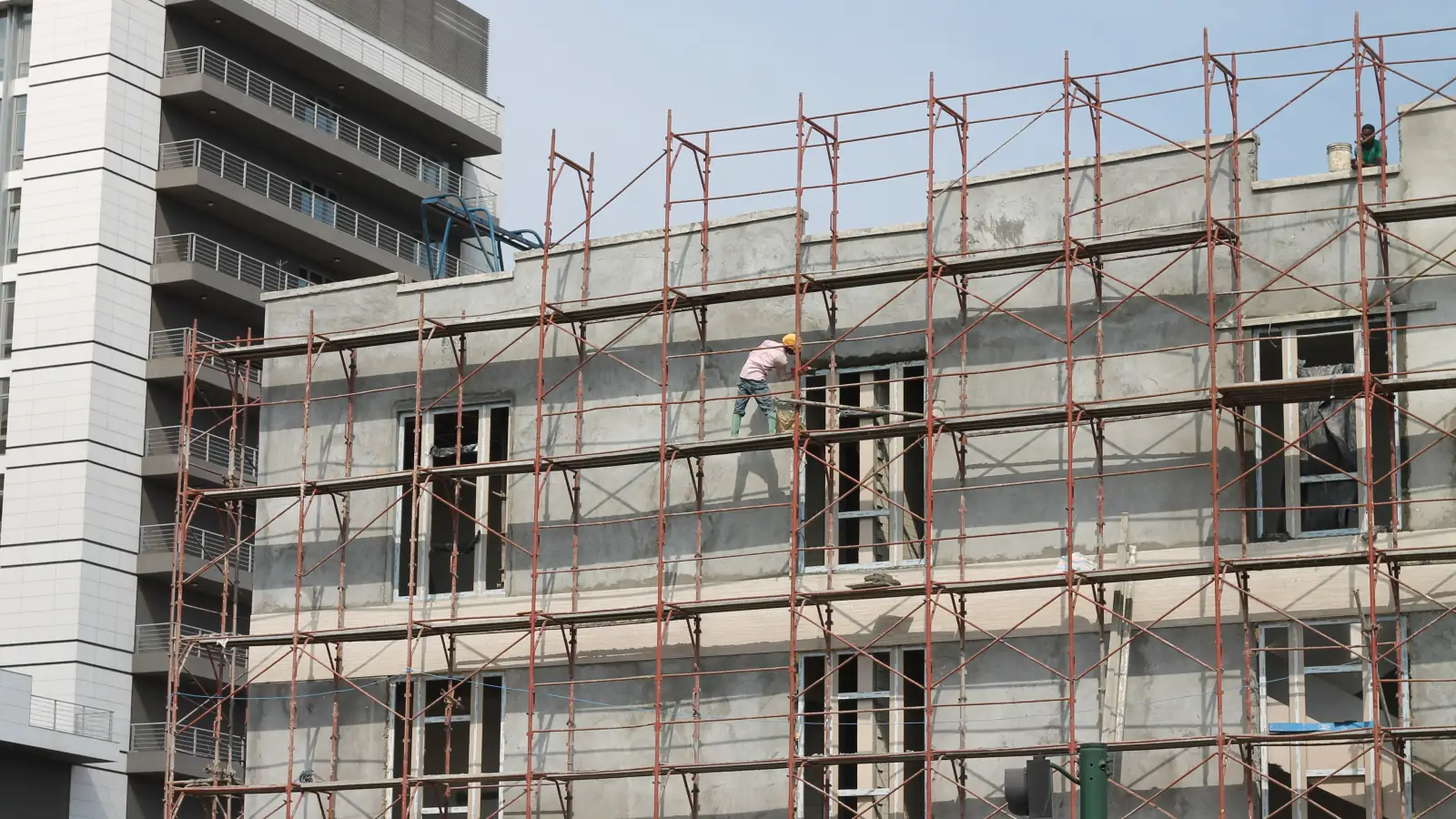
On a normal week you set out walls from plans, build in concrete blocks, brick or stone, pour and level small concrete parts, and fit lintels around openings. Older buildings need repointing and repairs. You work outdoors most of the year in a small team with a mixer or crane, and move to a new site as each job ends, which is why the travel allowances of the building agreements matter so much in this trade.
Hours and shifts
Masonry firms follow IDCC 1596 up to 10 employees or IDCC 1597 above that, with 35 hours as the legal base. Where a site has no running water, the employer provides at least 3 litres of drinking water per worker per day, all year round. In heat waves the employer adapts hours, adds rest periods and includes heat in the risk assessment.
The building agreements give non-sedentary site workers three daily flat allowances: one for meals, one for transport and one for travel time. The meal allowance is the same in every zone, while transport and travel amounts rise with the distance zone of the site from the firm's base. Each region sets its own table, for example Bretagne for 1 January 2025.
Recognition and licence, step by step.
What to do, in order, to work as a bricklayer in France.
- 01
Understand the rule for maçon
Maçon is a regulated craft. Running a firm or working alone needs a CAP, a BP or an RNCP diploma at that level, or three years of real masonry experience in the EU/EEA followed by a CMA attestation. Working without the qualification can bring a fine of EUR 7,500, so check this before you set up on your own. - 02
Ask the CMA to recognise your diploma
For a diploma from abroad, the Chambre de métiers et de l'artisanat issues an attestation of recognition. It sends a receipt within one month, and if it gives no decision three months after the file is complete, your recognition is deemed granted. A fee may apply depending on the chamber. - 03
Receive your carte BTP
Your employer must ask for your site card as soon as you are hired, online, for a fee of EUR 9.80. Keep it on you at all times on site. A missing card can cost your employer up to EUR 4,000 per worker. - 04
Take the site induction
On your first site you get a safety induction on scaffolds, lifting, dust and the site's risk assessment. Bring your own safety boots if the firm asks, and check which helmet, gloves and knee pads it supplies. - 05
Have your training recorded
From 16 March 2026 employers declare mandatory health and safety training in the Passeport de prévention. Ask your employer to record your scaffold and lifting training there, so a future employer can see it without new courses. - 06
Know your rights on heat warning days
Since 1 July 2025 a decree sets heat duties for every employer. In the building sector, orange or red Météo-France warnings give a right to compensation for hours stopped. Ask your site manager who decides to stop and how the stopped hours appear on your payslip.
Certificates and language.
French employers ask for a CAP maçon or proof of years in masonry, and test your speed and accuracy on site. Your NVQ Level 2 Trowel Occupations, CSCS card or Red Seal can support your CV, and the site card French law requires is the carte BTP. If you will use a mixer, a saw or lifting gear, your employer trains you and records it in your Passeport de prévention.
- NVQ Level 2 Trowel Occupations
- CSCS card
- Red Seal
Language at work
A set French level is not part of the hiring rules for masonry. You need to understand the site manager's instructions, the measurements on French plans and the daily safety talk, especially about scaffolds and lifting. Learning the names of materials and tools in French in your first weeks helps a lot, as does reading the levels and dimensions written on the plans.
What bricklayers earn in France.
Masonry has no pay range in the France data used here. The floor is the SMIC of EUR 12.31 gross an hour, or EUR 1,867.02 a month for 35 hours, in 2026. Regional building grids, published on Légifrance for regions such as Pays de la Loire, Grand Est and Nouvelle-Aquitaine, set a minimum for each level and coefficient, and the higher of grid and SMIC applies. On top come the daily meal, transport and travel allowances for each site zone. Extra hours add 25% for the first eight above 35 and 50% after.
Before you sign.
Points to settle in writing before you sign a bricklayer contract in France.
- Ask which regional grid the firm applies and your coefficient, and see the hourly minimum written next to it.
- Ask for the amounts of the meal, transport and travel allowances for each site zone you will work in.
- Ask how rain, frost and heat warning days are handled and what you are paid on those days.
- Ask who supplies safety boots, helmet, gloves and knee pads, and how often they are replaced.
- Ask whether you travel to sites in a company van or on your own, and who pays the cost.
- Ask your employer to record scaffold and lifting training in your Passeport de prévention.
What bricklayers earn in other countries
Typical monthly gross pay for foreign hires, from official statistics and collective agreements.
Open bricklayer vacancies in France.
Recent openings from EURES, the European Commission's job portal. You apply directly with the employer.
- Maçon Voiries et Réseaux Divers -VRD- H/FNon renseigné · FranceNov 21
- Maçon Voiries et Réseaux Divers -VRD- H/FNon renseigné · FranceNov 21
- MACON H/FENTHALPIA SUD OUEST · FranceNov 20
- Maçon finisseur H/FHays France · FranceNov 20
- Maçon F/HSYNERGIE · FranceNov 20
- Maçon F/HSYNERGIE · FranceNov 20
- Maçon F/HSYNERGIE · FranceNov 20
- Maçon H/FNon renseigné · FranceNov 20
FAQ
Questions about working in France.
What do I need before I can work as a bricklayer in France?
Understand the rule for maçon; Ask the CMA to recognise your diploma; Receive your carte BTP; Take the site induction; Have your training recorded; Know your rights on heat warning days.
Which language do I need to work in France?
A set French level is not part of the hiring rules for masonry. You need to understand the site manager's instructions, the measurements on French plans and the daily safety talk, especially about scaffolds and lifting. Learning the names of materials and tools in French in your first weeks helps a lot, as does reading the levels and dimensions written on the plans.
What is the minimum wage in France?
The statutory minimum wage in France is €1,867 a month gross (2026).
Sources
Checked September 2026. Rules change - confirm details with your employer or the authority before you apply.
- Service Public Entreprendre - Maçon: conditions d'accès et d'exercice en France
- Légifrance - Convention collective nationale des ouvriers du bâtiment (plus de 10 salariés)
- Code du travail numérique - Bâtiment ouvriers (IDCC 1597): salaire minimum
- Service Public Entreprendre - Chaleur: quelles obligations pour l'employeur ?
- Direction générale des étrangers en France (ANEF)
- Service Public - Carte de séjour salarié / travailleur temporaire
Get found by employers hiring for France.
One free profile that employers hiring for France and your other chosen destinations can find.
Create your profileFree. No subscription. No commission on your wages, ever.