Welder jobs in France for foreigners.
Welders are no. 5 of 10 on the list of trades France recruits from abroad.
Updated September 2026
- Job offer signed
- Permit application sent
- Decision expected8-16 weeks
Key facts
- Main permit route
- Carte de séjour salarié / travailleur temporaire
- Processing time
- 8-16 weeks
- Certificates employers ask for
- EN ISO 9606-1 · ISO 9606-1 · AWS D1.1 · ASME Section IX · International Welder (IW)
- Permits issued by
- Direction générale des étrangers en France (ANEF)
What welders do in France.
Welding jobs in France sit mostly in metalworking firms covered by the national metallurgy agreement: steel structure shops, boiler and tank makers (chaudronnerie), pipework contractors, makers of rail and road vehicles, and repair yards. Many of these firms are small and medium sized, with fewer than 150 staff, and that matters for the pay scale they apply in the first years of the new agreement. Large plants and subcontractors to energy and transport projects also hire through temporary work agencies.
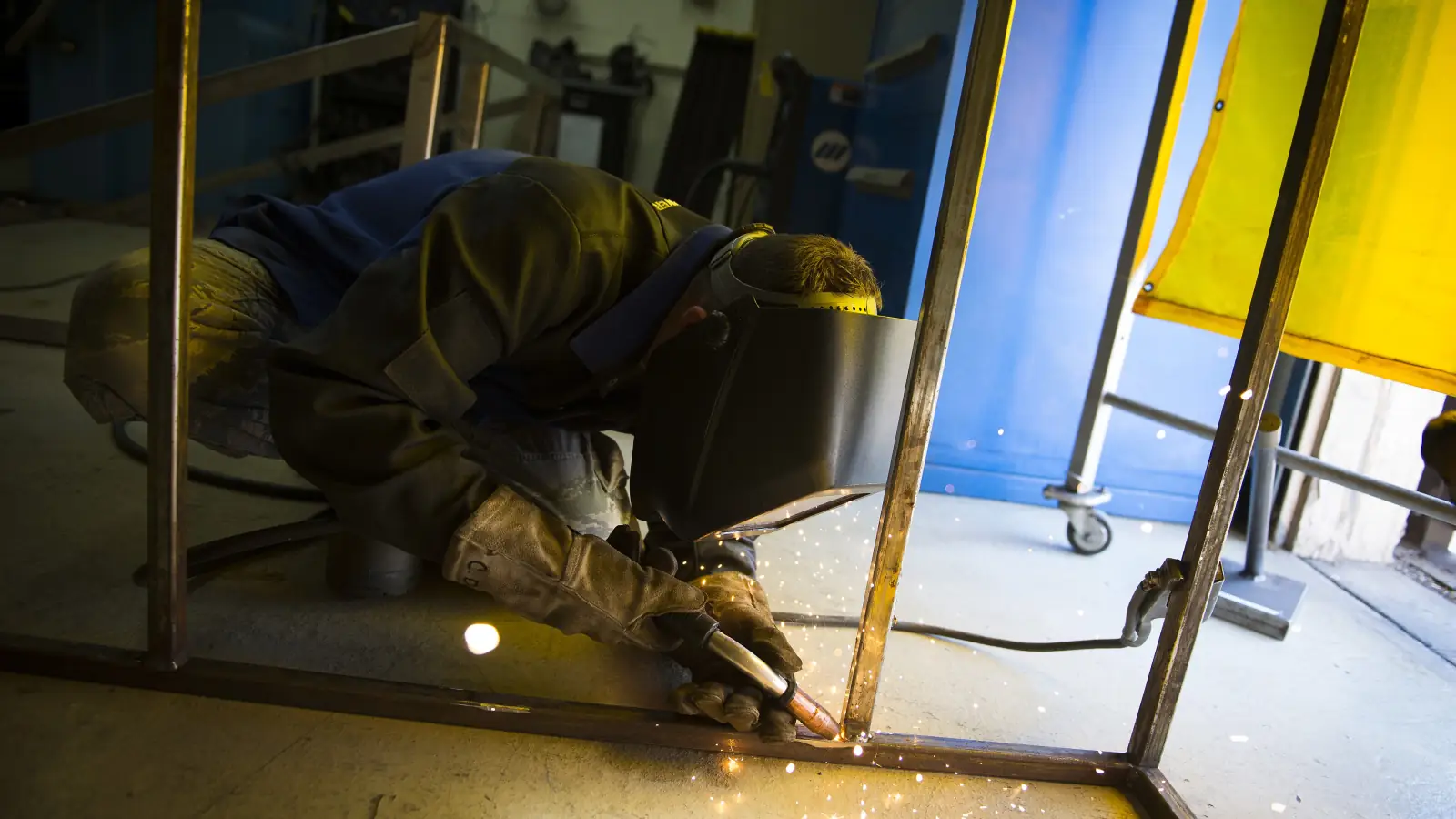
A normal week is five days in a workshop or on an industrial site. You read the drawing and the welding procedure, prepare and tack the parts, weld with MAG, TIG or stick, and check your own seams before the inspector does. On site jobs you may weld inside plants that keep running, with a hot work permit and someone on fire watch. Employers often ask you to weld a test coupon in your first days to see which processes and positions you master.
Hours and shifts
Metalworking companies apply the Convention collective nationale de la métallurgie of 7 February 2022 (IDCC 3248). The base is the legal 35 hours, and the 2026 pay scale is worked out on 151.66 hours a month. Large plants often run two or three shifts a day, and the 11 hours of daily rest between two shifts still apply. Extra hours beyond 35 follow the overtime rules of the agreement or of the Code du travail.
Under this agreement the minimum is set per job class, from group A class 1 up to group I class 18. Your class depends on the job you hold, not only on your diploma, so ask for it in writing. Staff on a yearly hours or days package (forfait) get the scale amount raised by 15% or 30%, and a company agreement that pays more than the branch scale takes priority.
Recognition and licence, step by step.
What to do, in order, to work as a welder in France.
- 01
Start without a licence
Welding as an employee is not a regulated profession in France, so there is no state licence to apply for. Your employer judges your skills, usually with a practical test in the workshop. If they also want proof of your school level, the Centre ENIC-NARIC France issues an attestation de comparabilité online for EUR 120, with an answer within four months. - 02
Bring your ISO 9606-1 test certificates
French clients and inspection bodies ask for welder qualification to EN ISO 9606-1 for each process, material group and position. Bring the original certificates, with the test date and the process numbers, for example 135 for MAG or 141 for TIG. Where a certificate has lapsed, ask your new employer to arrange and pay a fresh test. - 03
Ask for your job class under IDCC 3248
Before you sign, ask which group and class of the 2022 metallurgy classification your post is placed in. The class sets your yearly minimum under the avenant of 20 February 2026. Between class A1 and class D7 the yearly minimum differs by EUR 4,700, so the class written in your contract makes a real difference. - 04
Complete the plant safety training
Your employer trains you on the risks of the plant, on hot work permits, on fumes and on protective equipment. From 16 March 2026 employers declare mandatory health and safety training in your Passeport de prévention, a digital record run by the Caisse des dépôts. Ask for access so that your training follows you when you change employer. - 05
Add the electrical authorisation if needed
Some plant jobs mean welding near live cables or switchboards. Under the Code du travail only workers holding an habilitation électrique may work on or near electrical installations, and the employer issues it after training. Ask whether your post needs it and when the course is planned.
Certificates and language.
French employers ask first for EN ISO 9606-1 (the same as ISO 9606-1) certificates for the processes and positions of the job, and on structural steel they check the welding procedure of the company. For export work or pressure equipment a client may ask for AWS D1.1 or ASME Section IX qualifications. An International Welder (IW) diploma helps when your school diploma is hard to compare. Plant jobs may add an habilitation électrique, and every safety course should appear in your Passeport de prévention.
- EN ISO 9606-1
- ISO 9606-1
- AWS D1.1
- ASME Section IX
- International Welder (IW)
Language at work
No official French level is set for welding jobs. You need enough French to follow a welding procedure sheet, a hot work permit and the safety briefing in the plant, and to talk with your team leader about defects and repairs. Drawings, weld symbols and process numbers are the same as in other countries, which helps in the first months.
What welders earn in France.
Our France data gives no set pay range for welding, so compare offers with the law and the metallurgy scale. The SMIC is EUR 22,404.20 gross a year for 35 hours a week in 2026. The metallurgy scale in force from 11 March 2026 gives yearly minimums on a 35-hour basis of EUR 21,980 for class A1, EUR 24,510 for C5, EUR 25,780 for C6 and EUR 26,680 for D7. Where a class minimum sits below the SMIC, the SMIC applies. Firms with 150 staff or fewer may delay the national scale until 1 January 2030 at the latest under conditions.
Before you sign.
Points to settle in writing before you sign a welder contract in France.
- Ask which group and class of the IDCC 3248 classification your welding post has, and see the yearly minimum written next to it.
- List the ISO 9606-1 processes and positions the job needs, and ask who pays the test if your certificates must be renewed.
- Ask whether the work is in the workshop or on client plants, and how travel, meals and lodging away from base are paid.
- Ask if the plant runs two or three shifts and what extra the company pays for night hours.
- Ask which protective gear the company supplies, such as the welding mask, fume extraction and flame resistant clothing.
- Ask your employer to declare your safety courses in your Passeport de prévention so they follow you.
What welders earn in other countries
Typical monthly gross pay for foreign hires, from official statistics and collective agreements.
Open welder vacancies in France.
Recent openings from EURES, the European Commission's job portal. You apply directly with the employer.
- Technicien SAV France & Atelier - Solutions hydrauliques H/FNon renseigné · FranceNov 21
- Soudeur H/FFINANCIERE MATTHIEU HEDE FMH · FranceNov 20
- Coordinateur IWS H/FFINANCIERE MATTHIEU HEDE FMH · FranceNov 20
- SOUDEUR ROBOT / REGLEUR-PROGRAMMEUR H/FTEOPLUS · FranceNov 20
- Soudeur H/F/XABOUTIR EMPLOI · FranceNov 20
- TUYAUTEUR NUCLEAIRE H/FCRIT INTERIM · FranceNov 20
- Tuyauteur F/HGi Group France · FranceNov 20
- MONTEUR TUYAUTEUR NUCLEAIRE H/FCRIT · FranceNov 20
FAQ
Questions about working in France.
What do I need before I can work as a welder in France?
Start without a licence; Bring your ISO 9606-1 test certificates; Ask for your job class under IDCC 3248; Complete the plant safety training; Add the electrical authorisation if needed.
Which language do I need to work in France?
No official French level is set for welding jobs. You need enough French to follow a welding procedure sheet, a hot work permit and the safety briefing in the plant, and to talk with your team leader about defects and repairs. Drawings, weld symbols and process numbers are the same as in other countries, which helps in the first months.
What is the minimum wage in France?
The statutory minimum wage in France is €1,867 a month gross (2026).
Welders are also hired in:
Sources
Checked September 2026. Rules change - confirm details with your employer or the authority before you apply.
- Code du travail numérique - Métallurgie (IDCC 3248): salaire minimum
- Légifrance - Métallurgie: avenant du 20 février 2026 relatif aux salaires minima hiérarchiques
- Service Public Entreprendre - Passeport de prévention pour les salariés
- Service Public - Smic 2026
- Légifrance - Code du travail, articles R4544-9 à R4544-11-2 (travailleurs habilités)
- Direction générale des étrangers en France (ANEF)
- Service Public - Carte de séjour salarié / travailleur temporaire
Get found by employers hiring for France.
One free profile that employers hiring for France and your other chosen destinations can find.
Create your profileFree. No subscription. No commission on your wages, ever.