Welder jobs in Estonia for foreigners.
Welders are no. 1 of 9 on the list of trades Estonia recruits from abroad.
Updated September 2026
- Job offer signed
- Permit application sent
- Decision expected4-18 weeks
Key facts
- Main permit route
- Lühiajalise töötamise registreerimine
- Processing time
- 4-18 weeks
- Certificates employers ask for
- EN ISO 9606-1 · ISO 9606-1 · AWS D1.1 · ASME Section IX · International Welder (IW)
- Permits issued by
- Politsei- ja Piirivalveamet (Police and Border Guard Board)
What welders do in Estonia.
Most welding jobs in Estonia are in the machinery and metal industry, which employed about 30,000 people in 2021, according to the OSKA labour-market study by Kutsekoda. These firms make steel structures, machine parts and equipment. Many of them export: OSKA says these industrial businesses account for one sixth of all Estonian business exports. Foreign workers already make up about one tenth of staff in the main jobs of the machinery and metal industry, so you will likely join a mixed team.
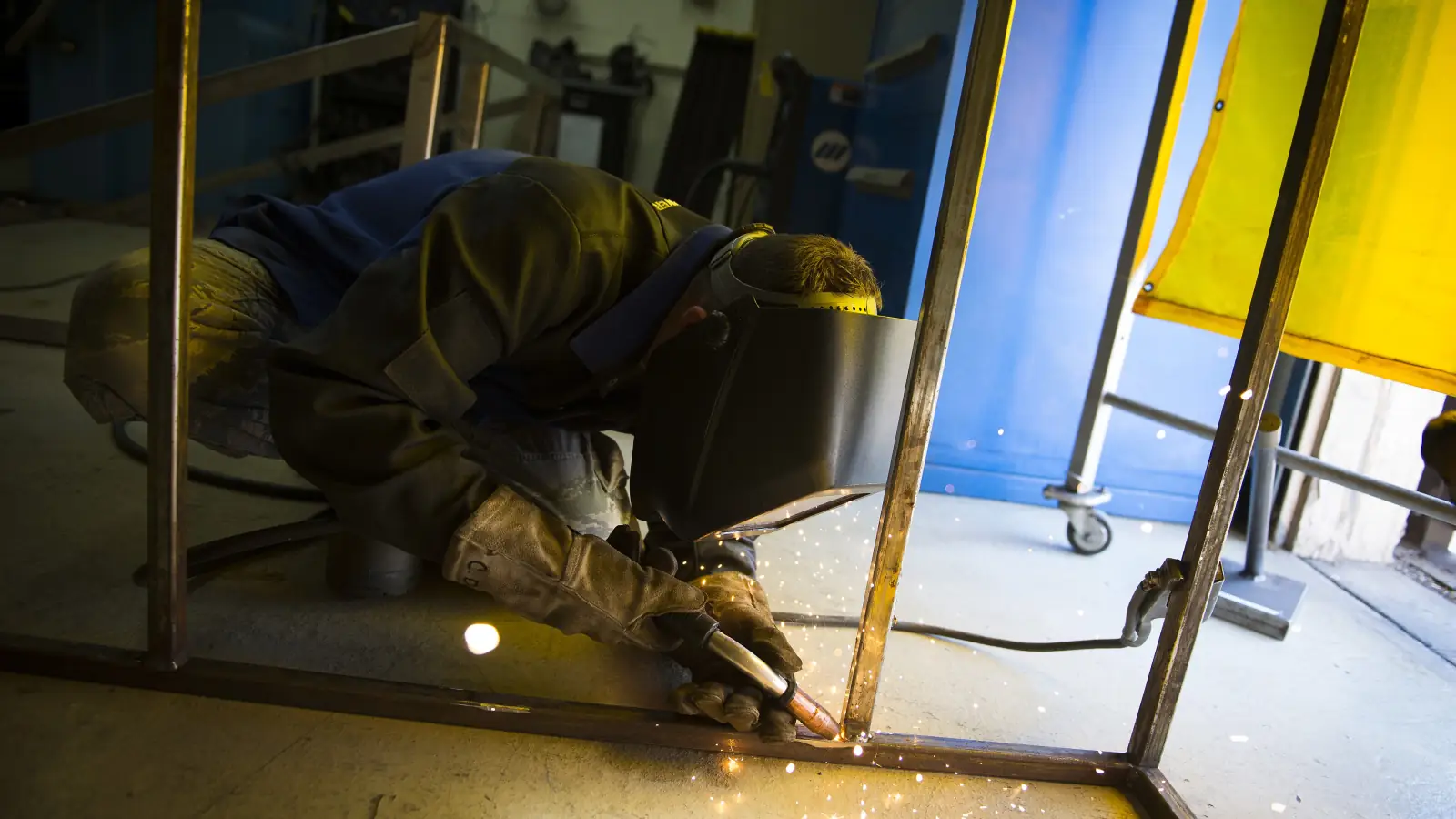
Your day is mostly in a production hall. You read drawings, prepare joints, weld frames, beams, tanks or pipe spools, then grind and check each seam. Some firms also send crews to assemble structures at the customer's site. Work on gas, pressure or lifting equipment is closer to regulated work, because the Consumer Protection and Technical Regulatory Authority (Tarbijakaitse ja Tehnilise Järelevalve Amet, TTJA) is the competent body for workers on that equipment. A normal week is five days of 8 hours in the hall.
Hours and shifts
Your full-time week is 40 hours. With overtime, your hours may average up to 48 a week across a four-month calculation period. Workshops with busy and quiet months often use summarised working time (summeeritud tööaeg), so a long week of welding is balanced by shorter weeks later. Weld shifts between 10pm and 6am count as night work and earn at least 1.25 times your wage, unless your agreed pay already includes it.
Extra hours come back as paid time off, or as one and a half times your hourly pay if you agree on money. You get at least 30 minutes of break per 6 hours of work and 11 hours of rest in each 24 hours. No collective agreement for metalworking is extended across Estonia, so your own contract sets the pay.
Recognition and licence, step by step.
What to do, in order, to work as a welder in Estonia.
- 01
Gather proof of your welding skills
Collect your welder qualification test certificates (for example EN ISO 9606-1, showing process, material and position), your diploma and letters from past employers. Your Estonian employer must confirm you have the education, work experience and professional skills for the job, and the Police and Border Guard Board may want extra proof. - 02
Check if the job touches TTJA equipment
Welding itself is not on Estonia's list of regulated professions. Work on gas, pressure or lifting equipment is overseen by TTJA. If your job includes that equipment, send TTJA your certificate together with proof of identity and of the paid state duty. The law gives it four months to decide. - 03
Compare a college diploma if you have one
Haridus- ja Noorteamet (Education and Youth Board) runs Estonian ENIC/NARIC, which compares foreign higher education with the Estonian system. You or your employer can ask for this assessment. For a vocational welding diploma, your test certificates and work record usually carry more weight with the employer. - 04
Consider the Estonian Keevitaja qualification
The Kutseregister lists a Keevitaja (welder) occupational standard. Certificates (kutsetunnistus) are awarded by bodies chosen by Kutsekoda in an open competition. Each certificate states a level on the 8-level Estonian Qualifications Framework (EKR, matched to the EQF) and the dates it is valid. Ask if your employer pays the assessment. - 05
Have the occupational health check
Welding halls bring noise, vibration and forced body positions. When the hall's risk analysis lists them, a check-up with an occupational health doctor is arranged for you. Ask for it in your first weeks, together with the safety instruction for the hall, the fume extraction and your welding machine.
Certificates and language.
Estonian metal firms ask first for a valid ISO 9606-1 or EN ISO 9606-1 test for each process you will use, such as MIG/MAG (135, 136) or TIG (141). If you hold AWS D1.1, ASME Section IX or an International Welder (IW) diploma, bring them too, because the customer's order decides which standard applies. An Estonian Keevitaja kutsetunnistus from the Kutseregister shows your EKR level. For welds on pressure or lifting equipment, ask which competence TTJA rules require.
- EN ISO 9606-1
- ISO 9606-1
- AWS D1.1
- ASME Section IX
- International Welder (IW)
Language at work
No Estonian language level is set for welding work. In the hall you read drawings and the welding procedure specification (WPS), check weld symbols, and follow the shift leader and safety signs. Ask which language your safety instruction comes in: for agency staff, the Labour Inspectorate (Tööinspektsioon) requires instruction in a way the worker understands. Learning the Estonian words for joints, materials and defects helps you in quality checks.
What welders earn in Estonia.
We hold no typical Estonian pay range for welding, so judge an offer against two official figures. The legal floor in 2026 is EUR 946 gross for a full-time month. Permit routes mostly require the employer to match the Estonian average gross wage, set at EUR 2,092 from 5 March 2026. OSKA says the machinery and metal subsectors pay more than manufacturing overall and more than the national average. Weld shifts between 10pm and 6am add a quarter on top, and a public holiday shift doubles the rate. Ask whether the offer is hourly or monthly, and how each certified process raises it.
Before you sign.
Points to settle in writing before you sign a welder contract in Estonia.
- Which ISO 9606-1 processes, materials and positions the job needs, and whether your current tests cover them.
- Who pays a new weld test in Estonia if the customer asks for one, and who pays a re-test.
- Whether the hall runs night shifts, and if the 1.25 night rate is added or already built into your wage.
- Whether any work is on gas, pressure or lifting equipment that TTJA oversees, and which competence you need for it.
- Who supplies the welding helmet, gloves, jacket and respiratory protection, and whether the hall has fume extraction.
- Whether you travel to assemble at customer sites, and who covers travel and lodging there.
What welders earn in other countries
Typical monthly gross pay for foreign hires, from official statistics and collective agreements.
Open welder vacancies in Estonia.
Recent openings from EURES, the European Commission's job portal. You apply directly with the employer.
- KeevitajaFinesta Baltic OÜ · EstoniaNov 20
- KeevitajaOÜ LATTER NT · EstoniaNov 19
- Keevitaja-koostelukkseppSAL Metall OÜ · EstoniaNov 19
- KeevitajaPunch Club OÜ · EstoniaNov 18
- Lukksepp-Keevitaja PõllumajandusesSAVALA MASINAÜHISTU · EstoniaNov 18
- LaevakeevitajaARC Repair OÜ · EstoniaNov 18
- Keevitaja1D OÜ · EstoniaNov 16
- Keevitaja-koostajaGGPartners OÜ · EstoniaNov 13
FAQ
Questions about working in Estonia.
What do I need before I can work as a welder in Estonia?
Gather proof of your welding skills; Check if the job touches TTJA equipment; Compare a college diploma if you have one; Consider the Estonian Keevitaja qualification; Have the occupational health check.
Which language do I need to work in Estonia?
No Estonian language level is set for welding work. In the hall you read drawings and the welding procedure specification (WPS), check weld symbols, and follow the shift leader and safety signs. Ask which language your safety instruction comes in: for agency staff, the Labour Inspectorate (Tööinspektsioon) requires instruction in a way the worker understands. Learning the Estonian words for joints, materials and defects helps you in quality checks.
What is the minimum wage in Estonia?
The statutory minimum wage in Estonia is €946 a month gross (2026).
Sources
Checked September 2026. Rules change - confirm details with your employer or the authority before you apply.
- Kutsekoda OSKA - Machinery, metal, electronics and motor vehicles
- Haridus- ja Noorteamet (Estonian ENIC/NARIC) - Professional recognition
- Kutseregister - Kutsestandardid (occupational standards)
- Tööinspektsioon - Working environment and safety at work (foreign workers)
- Tööelu (Labour Inspectorate) - Working time
- Politsei- ja Piirivalveamet (Police and Border Guard Board)
- Tööelu (Labour Inspectorate): Wages and minimum wage
Get found by employers hiring for Estonia.
One free profile that employers hiring for Estonia and your other chosen destinations can find.
Create your profileFree. No subscription. No commission on your wages, ever.