Welder jobs in Switzerland for foreigners.
Foreign welders in Switzerland typically earn CHF 5,500 - CHF 6,400 a month gross.
Updated September 2026
- Job offer signed
- Permit application sent
- Decision expected8-16 weeks
Key facts
- Typical pay
- CHF 5,500 - CHF 6,400 a month gross
- Main permit route
- Aufenthaltsbewilligung B (Drittstaaten)
- Processing time
- 8-16 weeks
- Certificates employers ask for
- EN ISO 9606-1 · ISO 9606-1 · AWS D1.1 · ASME Section IX · International Welder (IW)
- Permits issued by
- Staatssekretariat für Migration (SEM) with the cantonal migration and labour offices
What welders do in Switzerland.
In Switzerland, welding jobs sit mostly in the metal trades: steel and metal construction firms, locksmith and fabrication shops, and makers of railings, facades, stairs and steel frames. These firms fall under the GAV für das Metallgewerbe, which the Federal Council has declared generally binding until 30 June 2028. The Swiss training for this work is Metallbauer/in EFZ (Metallbau, Schmiedearbeiten, Stahlbau). Employers compare foreign welding papers with that certificate.
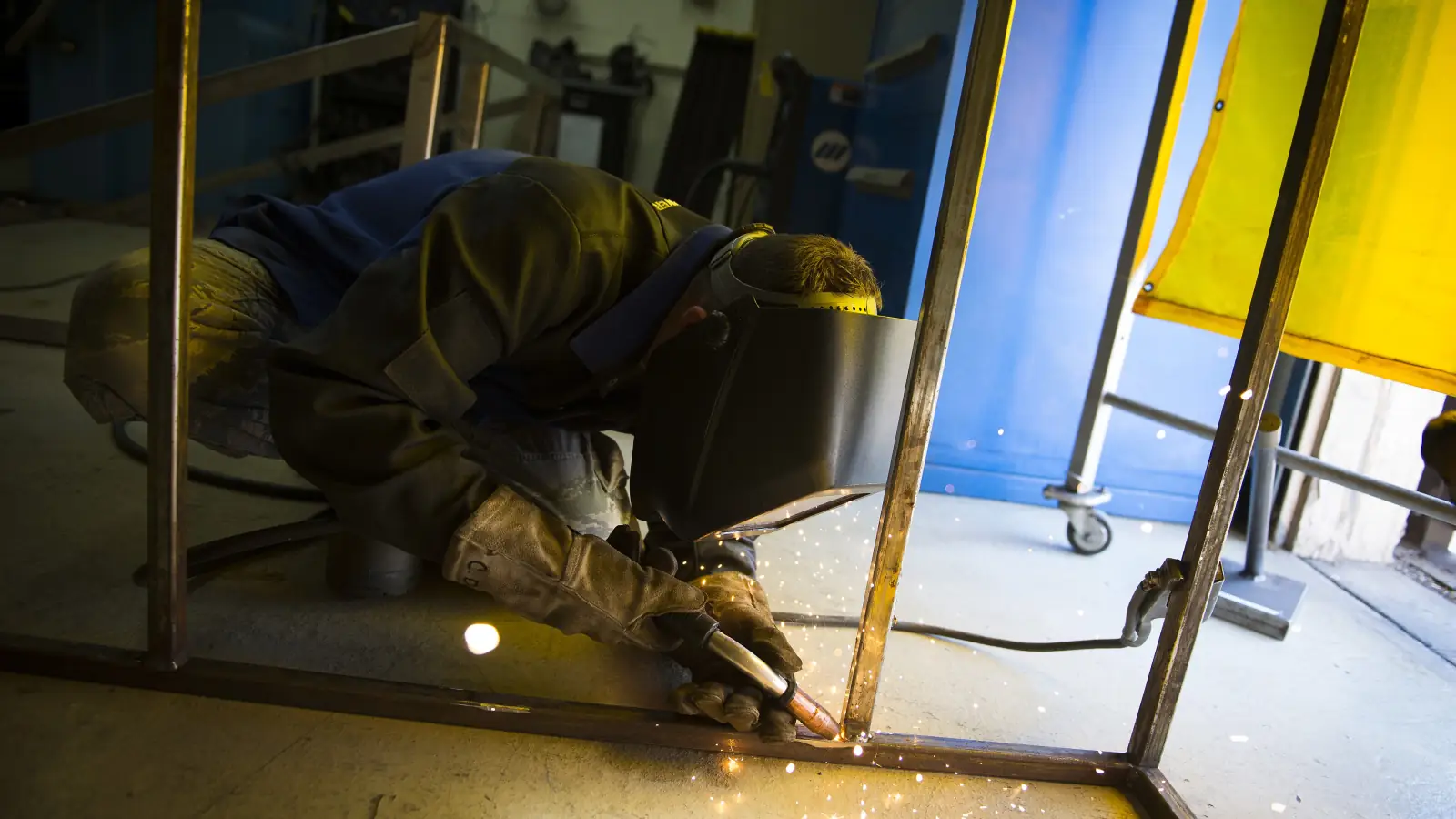
A week usually splits between the workshop and fitting on site. In the shop you cut, fit, tack and weld parts from drawings, mostly steel, also stainless steel and aluminium. On site you install and finish the work on building projects. For permits from outside the EU/EFTA, Swiss employers look for experienced specialists, so a welder with years of certified work in several processes and some fabrication skills fits best.
Hours and shifts
The Metallgewerbe GAV sets an average of 2,086 working hours a year for metal construction, smithing, locksmith and steel construction firms. That is 8 hours a day and 40 a week. Normal overtime, worked between 6 am and 11 pm, is first compensated with free time in the following calendar year. Up to 100 hours a year can be paid out without a supplement. Hours beyond that which still cannot be compensated get 25% extra.
The GAV uses 8 hours a day, 40 a week and 174 hours a month to work out holiday and sick pay. Sunday and public-holiday work earns 100% extra under this GAV, and work at trade fairs on Sundays 50%. Night work between 11 pm and 6 am on fewer than 25 nights a year earns 50%. When you work away from base, the GAV pays a lunch allowance (Mittagszulage) of CHF 15 a day.
Recognition and licence, step by step.
What to do, in order, to work as a welder in Switzerland.
- 01
Check how your trade is treated
Search your occupation on recognition.swiss. Metal and welding trades are usually not regulated, so you do not need recognition to be hired. A Swiss comparison of your training still helps your GAV wage class. - 02
Apply to SBFI for a level certificate
Your welding diploma goes to SBFI through its online portal, together with a scan of your passport. Welding papers written in, say, Turkish or Serbian need an official translation; papers in English do not. - 03
Pay and wait
SBFI charges CHF 350 for the level certificate and starts work on the file only once that is paid. Expect a receipt email first. The certificate itself may take as long as 10 months, so apply as soon as you have an offer. - 04
Bring your welder tests
Carry your EN ISO 9606-1 test certificates with the process, material, position and thickness ranges, plus records showing they are still valid. Swiss employers check them against the work they do. - 05
Agree your GAV wage class
The Metallgewerbe GAV puts you in a wage class: Metallbauer/in EFZ, or trained-on-the-job worker (Angelernte im Fachbereich). Experience years count from 1 January after you finished your training. Ask the employer to write your class into the contract. - 06
Know who checks the GAV
A joint commission of employers and unions (PLKM) enforces the Metallgewerbe GAV and runs wage-book checks in firms and on sites. If your pay seems below your class, you can ask it to check.
Certificates and language.
Swiss metal firms ask for EN ISO 9606-1 welder tests for each process and material, and often aluminium or stainless steel tests too. AWS D1.1, ASME Section IX or International Welder (IW) qualifications show broader training and help with steel construction and plant work. A Swiss level certificate from SBFI, or a Metallbauer EFZ, decides whether the GAV pays you as skilled or as trained on the job. That difference is CHF 550 a month in the first two years.
- EN ISO 9606-1
- ISO 9606-1
- AWS D1.1
- ASME Section IX
- International Welder (IW)
Language at work
Work languages depend on the canton: German in most of the north and centre, French in the west and Italian in Ticino. Welding drawings and procedure sheets are technical. For a long-term B permit, SEM also looks at your language skills. Aim to follow site safety rules and talk with the foreman in the local language.
What welders earn in Switzerland.
Swiss welding jobs typically pay CHF 5,500 to 6,400 gross a month. No national minimum wage exists, so the Metallgewerbe GAV sets a floor for Metallbauer/in EFZ of CHF 4,100 a month (CHF 23.55 an hour) in years 1 and 2, rising to CHF 5,000 from year 11. Workers trained on the job start at CHF 3,550. The GAV adds a 13th salary of 100% of the average monthly wage, paid by December. The typical range sits above these floors.
Before you sign.
Points to settle in writing before you sign a welder contract in Switzerland.
- Ask which GAV wage class you are placed in, Metallbauer EFZ or Angelernte, and how your experience years are counted.
- Check which welding processes and materials the job needs, and who pays any new ISO 9606-1 test in Switzerland.
- Ask how many overtime hours are paid without supplement (up to 100 a year) and how the rest is compensated.
- Confirm the 13th salary and the CHF 15 lunch allowance for work away from the workshop.
- Ask whether the firm will cover the SBFI fee for your welding diploma and the cost of translating your test certificates.
- Ask whether the work is mostly in the workshop or on building sites, and in which canton.
What welders earn in other countries
Typical monthly gross pay for foreign hires, from official statistics and collective agreements.
Open welder vacancies in Switzerland.
Recent openings from EURES, the European Commission's job portal. You apply directly with the employer.
- Schlosser- SchweisserViva Work AG · SwitzerlandNov 21
- Schweisser/in 100%Express Personal AG · SwitzerlandNov 20
- Metallbauer / Monteur (m/w) EFZ 100%STAHEL Personal AG · SwitzerlandNov 13
- Metallbauer / Schweisser (m/w) EFZ 100%STAHEL Personal AG · SwitzerlandNov 13
- Schweisser (m/w/d) 100%Provia Personal AG · SwitzerlandNov 12
- Schweisser (m/w/d) 100%Randstad (Schweiz) AG · SwitzerlandNov 12
- Metallbauer / Schweisser (m/w) EFZ 100%STAHEL Personal AG · SwitzerlandNov 12
- Metallbauer / Produktion (m/w) EFZ 100%STAHEL Personal AG · SwitzerlandNov 12
FAQ
Questions about working in Switzerland.
How much do welders earn in Switzerland?
Foreign welders in Switzerland typically earn CHF 5,500 - CHF 6,400 a month gross.
What do I need before I can work as a welder in Switzerland?
Check how your trade is treated; Apply to SBFI for a level certificate; Pay and wait; Bring your welder tests; Agree your GAV wage class; Know who checks the GAV.
Which language do I need to work in Switzerland?
Work languages depend on the canton: German in most of the north and centre, French in the west and Italian in Ticino. Welding drawings and procedure sheets are technical. For a long-term B permit, SEM also looks at your language skills. Aim to follow site safety rules and talk with the foreman in the local language.
Welders are also hired in:
Other trades in Switzerland:
Sources
Checked September 2026. Rules change - confirm details with your employer or the authority before you apply.
- SECO - GAV für das Metallgewerbe, Bundesratsbeschluss
- SECO - Allgemeinverbindlich erklärte Gesamtarbeitsverträge (Bund)
- SBFI - FAQ recognition procedure for professional qualifications
- SBFI - Recognition procedure at SERI
- Staatssekretariat für Migration (SEM) with the cantonal migration and labour offices
- Federal Statistical Office: Monthly gross wage by occupation group 2024 (LSE)
Get found by employers hiring for Switzerland.
One free profile that employers hiring for Switzerland and your other chosen destinations can find.
Create your profileFree. No subscription. No commission on your wages, ever.