Welder jobs in Belgium for foreigners.
Welders are no. 8 of 10 on the list of trades Belgium recruits from abroad.
Updated September 2026
- Job offer signed
- Permit application sent
- Decision expected10-24 weeks
Key facts
- Main permit route
- Gecombineerde vergunning / Permis unique (single permit)
- Processing time
- 10-24 weeks
- Certificates employers ask for
- EN ISO 9606-1 · ISO 9606-1 · AWS D1.1 · ASME Section IX · International Welder (IW)
- Permits issued by
- Immigration Office (Dienst Vreemdelingenzaken / Office des Étrangers)
What welders do in Belgium.
Welding jobs in Belgium sit mostly in metalworking companies (metaalverwerkingsondernemingen) under joint committee 111, which covers metal, machine and electrical construction. The committee keeps separate wage tables for Brabant, West Flanders, East Flanders, Antwerp, Limburg, Liège-Luxembourg, Namur and Hainaut, which shows where the workshops are: the Antwerp and Ghent port areas, the Flemish industrial belts and the old steel regions around Liège and Charleroi. A separate subcommittee covers companies that assemble bridges and metal frameworks (Ondernemingen welke bruggen en metalen gebinten monteren), where you weld on site rather than in a workshop.
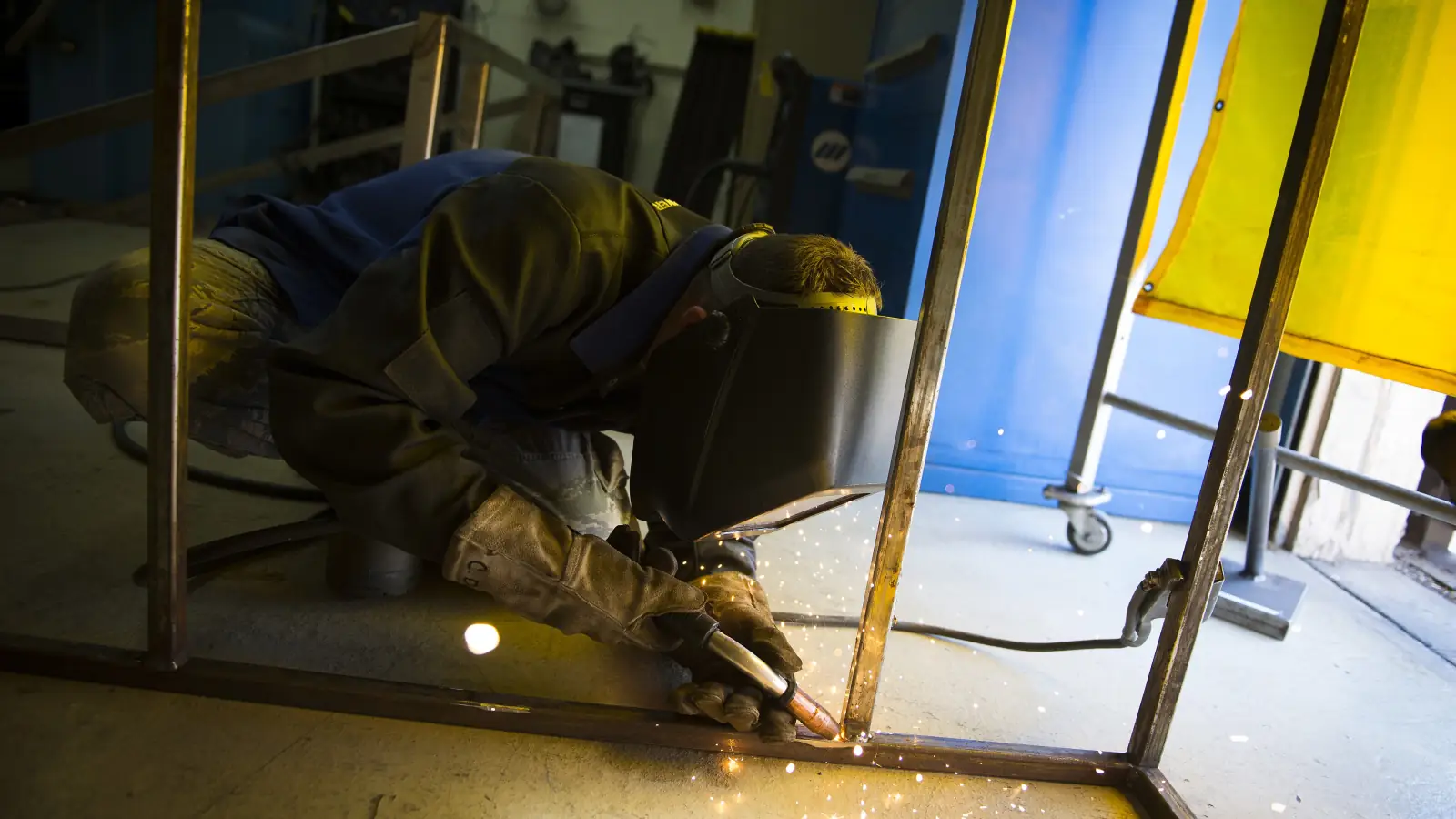
In a workshop you prepare joints, read welding procedure specifications, set up MIG/MAG or TIG equipment and weld frames, tanks, pipe spools or machine parts that are then inspected. On a bridge or steel-frame job you weld at height and outdoors, often on a site far from home. A typical week is five shifts. Many metal companies in Flanders run two or three rotating shifts, and you work the shift pattern the company has agreed with its union delegation.
Hours and shifts
Joint committee 111 builds its guaranteed minimum wages on a 38-hour week. The Brabant table also lists rates for 39- and 40-hour regimes, and Liège-Luxembourg lists 36 to 40 hours, with a lower hourly rate the longer the week, so the monthly total stays close. In 2026 the national guaranteed minimum for a 38-hour week is EUR 17.1244 an hour, after an index rise of 2.81% in July 2026.
Above that floor some provinces use a class system. In West Flanders the 38-hour rates climb from EUR 17.1244 in class 1 to EUR 20.6510 in class 11; East Flanders runs from EUR 17.1244 to EUR 20.7418. Your class depends on the job classification agreed in the company. Shift, night and overtime premiums are fixed in company or provincial agreements, so ask for them in writing.
Recognition and licence, step by step.
What to do, in order, to work as a welder in Belgium.
- 01
Collect your welding papers
Gather your welder qualification certificates (for example ISO 9606-1 tests), your trade diploma and transcripts, and letters from past employers that list the processes and positions you weld. Welding is not a regulated profession in Belgium, so the employer judges your skill, mostly through a practical test. - 02
Ask NARIC-Vlaanderen for a level recognition if useful
For a job in Flanders, a vocational diploma from outside the EEA can be compared by NARIC-Vlaanderen. You apply online, upload the diploma and transcript, and pay the fee shown at the end of the application. A recognition helps the employer place you in the right class of the PC 111 scale. - 03
Pass the employer's welding test
Most Belgian metal companies ask you to weld test pieces before or just after hiring. The pieces are inspected and, if they pass, the company or an inspection body issues a welder qualification under EN ISO 9606-1 for the process, material and position you welded. Keep a copy for your own file. - 04
Keep the qualification valid
An ISO 9606-1 qualification has to be confirmed at regular intervals by your employer or the inspection body, based on the welds you make. Ask who signs the confirmation in your company and who pays for a retest when you move to a new process or material.
Certificates and language.
Belgian metal and steel-construction employers ask first for EN ISO 9606-1 (also written ISO 9606-1) qualifications in the processes they use, most often MAG on carbon steel and TIG on stainless steel. Pipe and pressure-equipment firms that export may also ask for ASME Section IX or AWS D1.1 tests, and the International Welder (IW) diploma is valued by larger firms. On bridge and steel-frame sites you also need the company's working-at-height and site safety instruction before you start.
- EN ISO 9606-1
- ISO 9606-1
- AWS D1.1
- ASME Section IX
- International Welder (IW)
Language at work
In Flemish workshops the foreman, the safety briefing and the work instructions are in Dutch; in Wallonia they are in French. No official language level is set for welding, but you need to follow a welding procedure sheet, read safety signs and talk with the quality inspector. Many port-area companies with international crews also use English on the shop floor.
What welders earn in Belgium.
Belgium has no separate pay figure for welding in our data, so the sector floor is the guide. Under joint committee 111 the national guaranteed minimum is EUR 17.1244 an hour for a 38-hour week, which is already above the GGMMI of EUR 2,233.61 a month in 2026. In the class-based provinces a skilled class pays more: up to EUR 20.6510 an hour in West Flanders and EUR 20.7418 in East Flanders. Companies often pay real wages above these minimums, and both minimum and real wages in the metal sector follow the index. Shift and night premiums come on top under company agreements.
Before you sign.
Points to settle in writing before you sign a welder contract in Belgium.
- Ask which PC 111 province table and which class your hourly rate is based on.
- Check whether the job is in a workshop or on bridge and steel-frame sites under the separate assembly subcommittee.
- Ask which welding processes and positions the employer's ISO 9606-1 test covers and who pays for a retest.
- Get the shift pattern in writing: day work, two shifts or three rotating shifts, and the premium for each.
- Ask whether real wages are paid above the guaranteed minimum and when the next index rise applies.
- Ask who supplies the welding helmet, gloves and protective clothing, and whether travel to outside sites is paid.
What welders earn in other countries
Typical monthly gross pay for foreign hires, from official statistics and collective agreements.
Open welder vacancies in Belgium.
Recent openings from EURES, the European Commission's job portal. You apply directly with the employer.
- TIG lasserXtra · BelgiumNov 22
- ConstructielasserXtra · BelgiumNov 21
- Lasser - samenstellerITZU · BelgiumNov 21
- Metaal monteurTechniek Tielt · BelgiumNov 21
- Allround medewerker metaalTechniek Tielt · BelgiumNov 21
- Lasser ConstructeurTechniek Tielt · BelgiumNov 21
- MetaalbewerkerTechniek Tielt · BelgiumNov 21
- TIG Lasser in JabbekeTechniek Brugge · BelgiumNov 21
FAQ
Questions about working in Belgium.
What do I need before I can work as a welder in Belgium?
Collect your welding papers; Ask NARIC-Vlaanderen for a level recognition if useful; Pass the employer's welding test; Keep the qualification valid.
Which language do I need to work in Belgium?
In Flemish workshops the foreman, the safety briefing and the work instructions are in Dutch; in Wallonia they are in French. No official language level is set for welding, but you need to follow a welding procedure sheet, read safety signs and talk with the quality inspector. Many port-area companies with international crews also use English on the shop floor.
What is the minimum wage in Belgium?
The statutory minimum wage in Belgium is €2,234 a month gross (2026).
Welders are also hired in:
Sources
Checked September 2026. Rules change - confirm details with your employer or the authority before you apply.
Get found by employers hiring for Belgium.
One free profile that employers hiring for Belgium and your other chosen destinations can find.
Create your profileFree. No subscription. No commission on your wages, ever.