Welder jobs in Canada for foreigners.
Welders are no. 2 of 8 on the list of trades Canada recruits from abroad.
Updated September 2026
- Job offer signed
- Permit application sent
- Decision expected12-40 weeks
Key facts
- Main permit route
- Temporary Foreign Worker Program (LMIA)
- Processing time
- 12-40 weeks
- Certificates employers ask for
- EN ISO 9606-1 · ISO 9606-1 · AWS D1.1 · ASME Section IX · International Welder (IW)
- Permits issued by
- Immigration, Refugees and Citizenship Canada (IRCC)
What welders do in Canada.
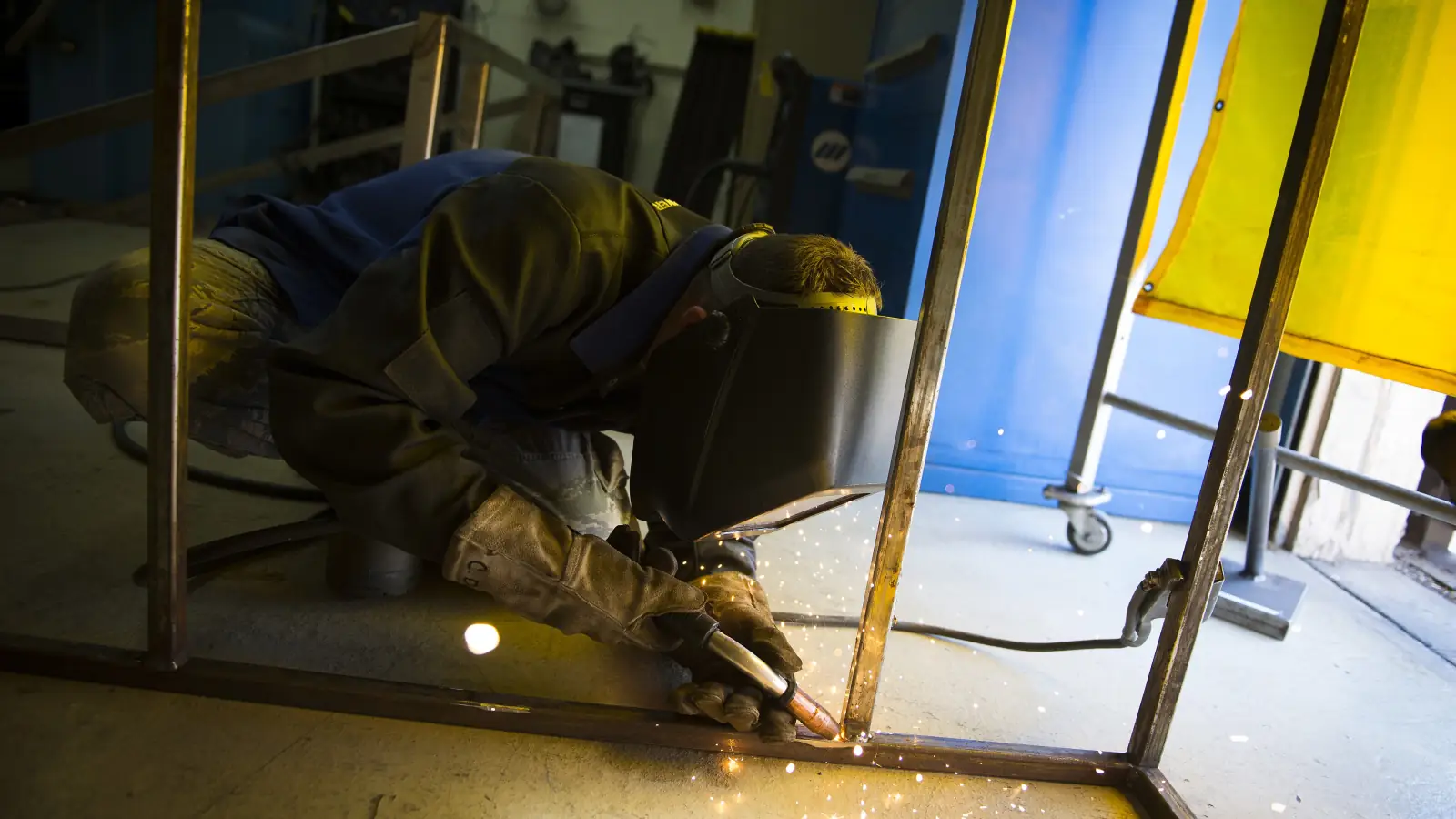
Welding jobs in Canada sit mostly in steel fabrication shops, structural steel for buildings and bridges, and shops that build pressure equipment such as boilers, tanks and piping. Under Canadian standards, anyone welding certain products, buildings and bridge structures must be qualified by the Canadian Welding Bureau (CWB) and work for a CWB-certified company, so most fabrication employers you meet will hold that certification. Alberta pays the highest median for the trade, and the CWB runs its own test centre in Nisku, Alberta, near Edmonton.
A normal week means welding to the procedure specifications and data sheets your company has approved, using processes such as SMAW, FCAW or MCAW, GMAW, SAW and GTAW. You read drawings, fit parts, tack, weld, and pass visual and code inspections. Pressure work in Alberta is supervised by ABSA, the provincial pressure equipment safety authority, so pipe and vessel work there comes with extra paperwork and inspection steps.
Hours and shifts
In British Columbia, a welding shop pays time-and-a-half for every hour over 8 in a day up to 12, and double time for any hour past 12. Hours over 40 in a Sunday-to-Saturday week also earn time-and-a-half, but only the first 8 hours of each day count toward those 40.
Long fabrication days of 10 hours therefore carry 2 overtime hours each day. You can ask in writing to bank overtime and take it later as paid time off. A signed averaging agreement under section 37 of the Employment Standards Act replaces these daily rules, so read it before you sign.
Recognition and licence, step by step.
What to do, in order, to work as a welder in Canada.
- 01
Pass a CWB welder qualification test
A CWB Service Representative watches and judges your practical test, either at your employer, at an Accredited Test Centre or at the Nisku centre. You are tested on the processes and positions you will use. Each test centre sets its own fees and dates. If you fail, a retest can be done within 90 days. - 02
Keep the CWB ticket valid
Most qualifications last two years while you stay continuously employed by a CWB-certified or applicant company. You can check-test within 90 days before or after the expiry date. More than 90 days after expiry, you sit the full test again, so mark the date on your phone. - 03
Challenge the provincial trade certificate
With over five years of welding experience, SkilledTradesBC lets you apply as a Trade Qualifier through its Portal for a CAD 120 fee. Review takes about 10 to 12 weeks, longer for experience outside Canada. You submit an Employer or Statutory Declaration for each job, with references SkilledTradesBC can reach by phone. - 04
Write the Red Seal exam, then the practical
Welder challengers in BC must score 70% or more on the written Interprovincial Red Seal exam before they can apply for the practical exam. You have 24 months from approval and up to four attempts. With one to four years of experience, a free level exam lets you join the apprenticeship at the right level instead. - 05
Add pressure welding if the job needs it
In Alberta, ABSA issues the Grade B pressure welder Certificate of Competency, and you weld pressure equipment only within the limits on your Performance Qualification (PQ) card under the Pressure Welders Regulation. In BC, certified welders apply to Technical Safety BC for a pressure welder certificate after a standardized exam.
Certificates and language.
Canadian fabricators ask first for a current CWB qualification under CSA W47.1, W47.2, W55.3 or W186, which the CWB calls the only nationally recognized welding credential in Canada. The provincial Welder certificate with the Red Seal comes next, and pipe and vessel shops in Alberta ask for an ABSA Grade B certificate and PQ card. Papers you bring, such as ISO 9606-1, AWS D1.1, ASME Section IX or International Welder (IW), help you show experience on your Employer Declarations, and the CWB test then confirms it in Canada.
- EN ISO 9606-1
- ISO 9606-1
- AWS D1.1
- ASME Section IX
- International Welder (IW)
Language at work
Welding shops work in English outside Quebec. You need enough English to read a welding procedure specification, a drawing and safety signs, and to follow a CWB representative during the test. The Red Seal exam can be taken in English or French, and SkilledTradesBC documents and declarations must be in English.
What welders earn in Canada.
Job Bank figures for welders (NOC 72106, 2023-2024) put the national range at CAD 22.00 to CAD 47.00 an hour, with a median of CAD 30.00, about CAD 5,200 a month at 40 hours. Alberta has a median of CAD 38.00 and a range of CAD 25.00 to CAD 52.18, more than double Alberta's general minimum wage of CAD 15 an hour. British Columbia sits at a CAD 35.00 median and Ontario at CAD 28.00. Daily overtime in BC adds 1.5 times pay after 8 hours and double time after 12.
Before you sign.
Points to settle in writing before you sign a welder contract in Canada.
- Ask whether the company is CWB certified and whether your first CWB test happens in-house or at an Accredited Test Centre, and who pays.
- Confirm which processes and positions the job needs, such as GMAW or GTAW, so you prepare the right CWB test plates.
- Ask who pays travel to a test centre if none is close; the CWB says that travel falls to the welder unless agreed.
- For pipe work in Alberta, ask whether you need the ABSA Grade B certificate and PQ card before your start date.
- Ask whether the employer will sign your SkilledTradesBC Employer Declaration for the Red Seal challenge later.
- In BC, check whether the contract includes a section 37 averaging agreement that changes daily overtime.
Good to know.
- Express Entry runs special draws for trade occupations, and this trade is one of them.
What welders earn in other countries
Typical monthly gross pay for foreign hires, from official statistics and collective agreements.
FAQ
Questions about working in Canada.
What do I need before I can work as a welder in Canada?
Pass a CWB welder qualification test; Keep the CWB ticket valid; Challenge the provincial trade certificate; Write the Red Seal exam, then the practical; Add pressure welding if the job needs it.
Which language do I need to work in Canada?
Welding shops work in English outside Quebec. You need enough English to read a welding procedure specification, a drawing and safety signs, and to follow a CWB representative during the test. The Red Seal exam can be taken in English or French, and SkilledTradesBC documents and declarations must be in English.
What is the minimum wage in Canada?
Canada has no single statutory minimum wage. Pay is set by collective agreements for each sector.
Sources
Checked September 2026. Rules change - confirm details with your employer or the authority before you apply.
- CWB Group - Welder qualification testing
- ABSA - Pressure Welders
- SkilledTradesBC - Welder
- SkilledTradesBC - Challenge a Certification Exam
- Job Bank - Wages for Welders and related machine operators (NOC 72106)
- Gov.bc.ca - Overtime pay
- Immigration, Refugees and Citizenship Canada (IRCC)
- Canada.ca - Program requirements for low-wage positions
Get found by employers hiring for Canada.
One free profile that employers hiring for Canada and your other chosen destinations can find.
Create your profileFree. No subscription. No commission on your wages, ever.