Carpenter jobs in Canada for foreigners.
Carpenters are no. 4 of 8 on the list of trades Canada recruits from abroad.
Updated September 2026
- Job offer signed
- Permit application sent
- Decision expected12-40 weeks
Key facts
- Main permit route
- Temporary Foreign Worker Program (LMIA)
- Processing time
- 12-40 weeks
- Certificates employers ask for
- NVQ Level 3 Carpentry and Joinery · CSCS card · Red Seal
- Permits issued by
- Immigration, Refugees and Citizenship Canada (IRCC)
What carpenters do in Canada.
Carpentry jobs come from home builders, framing crews, commercial contractors and renovation firms. In Ontario, General Carpenter is a non-compulsory Red Seal trade, so a builder may hire you on your experience before you hold a Canadian certificate. Framing is the main entry point: Ontario's top hourly band for the trade reaches CAD 48.00 in Job Bank data, and Quebec has the highest provincial median, at CAD 36.84.
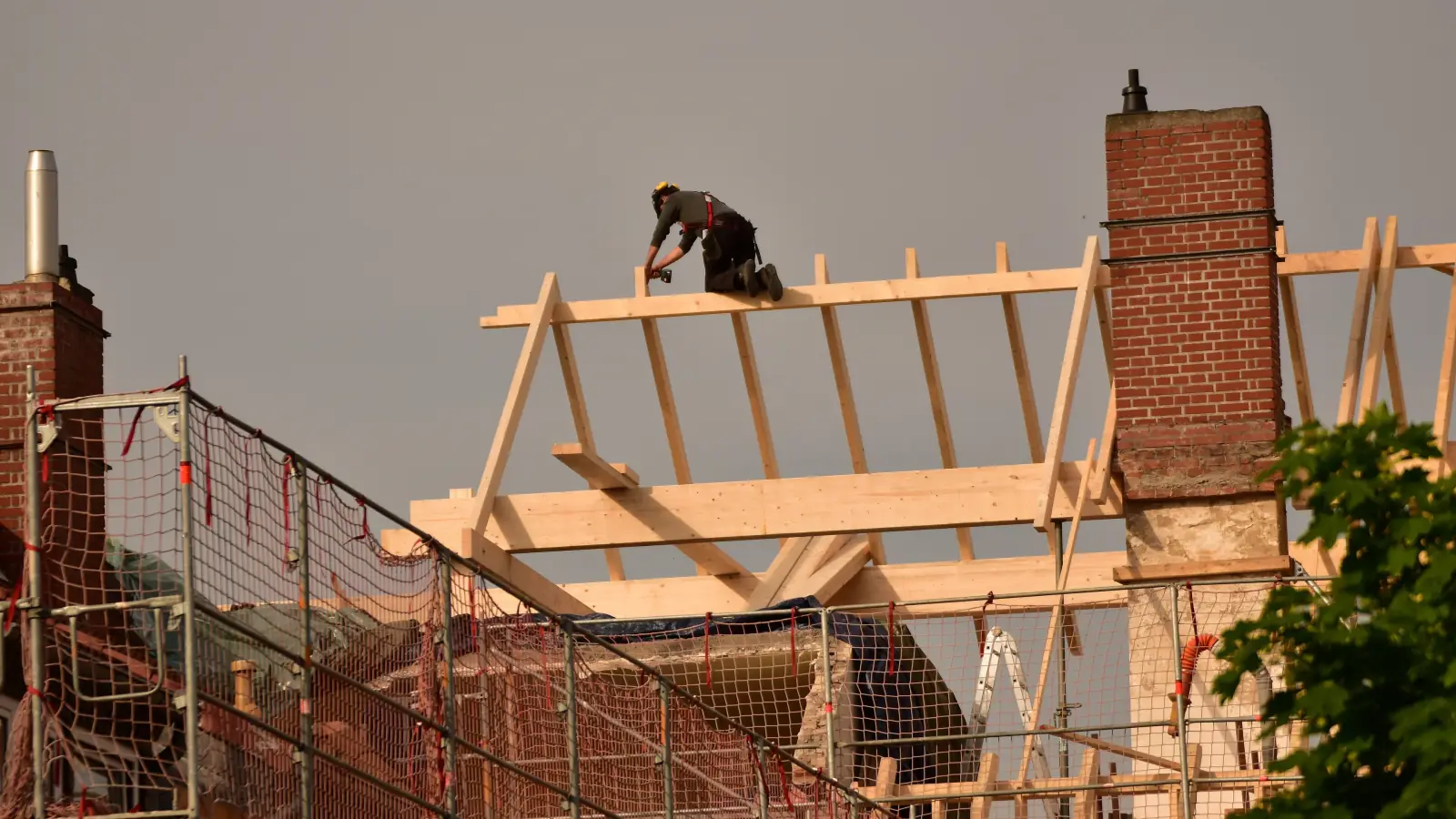
A normal week means building wall panels, floor and roof systems, setting forms for concrete, hanging doors and installing trim, depending on the stage of the build. On houses and small buildings, the work follows Part 9 of the National Building Code of Canada and, in British Columbia, the BC Building Code. Work at height on roofs and upper floors is part of most days, so fall protection equipment and the training to use it are part of the job on most builds.
Hours and shifts
Carpentry crews in British Columbia earn 1.5 times pay for any time between 8 and 12 hours in a day and twice the rate past 12. A week runs Sunday to Saturday, and time beyond 40 hours, counting only the first 8 hours each day, is also paid at 1.5 times.
Overtime worked on a statutory holiday is paid as an average day's pay plus 1.5 times for the hours worked. Ontario sites use a different weekly line of 44 hours. You can make a written request to bank overtime instead of being paid for it in that pay period, and take it later as time off. If you sign an averaging agreement under section 37, the daily overtime rules above give way to the averaging schedule.
Recognition and licence, step by step.
What to do, in order, to work as a carpenter in Canada.
- 01
Take working at heights training in Ontario
On an Ontario construction project, anyone who uses fall protection must first complete a working at heights program approved by the Chief Prevention Officer and taught by an approved provider. The training is valid for 3 years, then a refresher renews it for another 3. Approved providers are listed in the ministry's Marketplace. - 02
Apply for the Ontario Trade Equivalency Assessment
For a General Carpenter certificate, your experience must at least equal the 7,200-hour apprenticeship: 6,480 hours on the job and 720 in school. Skilled Trades Ontario charges CAD 235 plus HST for the TEA. - 03
Write the certifying exam
The Ontario General Carpenter exam is the Red Seal exam: four hours, multiple choice, 70% to pass. Since the trade is non-compulsory, the certificate does not need yearly renewal and holders are not on the Public Register. - 04
In BC, challenge as a Trade Qualifier
SkilledTradesBC sets carpentry at 6,360 work-based hours and 28 weeks of technical training over four years. With over five years of experience, you apply through the Portal for CAD 120. For the Red Seal exam you use the National Building Code of Canada 2020, Part 9. - 05
Or join a BC apprenticeship at the right level
With one to four years of carpentry experience, you can challenge a Standardized Level Exam for Level 1, 2 or 3, which uses the 2018 or 2024 BC Building Code. There is no fee to challenge or rewrite a level exam. Passing places you in the apprenticeship at that level, with an employer or sponsor registering you with SkilledTradesBC.
Certificates and language.
Builders ask for a working at heights card on Ontario projects, and the General Carpenter Certificate of Qualification with the Red Seal for lead hand and site roles. In BC, the Carpenter certificate with the Red Seal plays the same part. Papers from abroad, such as an NVQ Level 3 Carpentry and Joinery or a CSCS card, show your experience in the TEA, and on Ontario projects the working at heights card from an approved provider is the safety training employers check. Employers should confirm that your provider was approved on the date you finished the course, and the ministry answers questions on 1-877-202-0008.
- NVQ Level 3 Carpentry and Joinery
- CSCS card
- Red Seal
Language at work
Carpenters on Canadian sites follow drawings, building code tables and safety talks in English, or in French in Quebec. Level exams in BC use the BC Building Code, and the Red Seal exam is offered in English and French. You need enough spoken English to work in a crew and follow a foreman's instructions at height.
What carpenters earn in Canada.
Job Bank reports carpenters (NOC 72310, 2023-2024) at CAD 22.00 to CAD 44.23 an hour nationally, with a median of CAD 32.12, about CAD 5,568 a month at 40 hours. British Columbia's median is CAD 32.00, against the BC minimum wage of CAD 18.25 an hour from 1 June 2026. Ontario's range is CAD 22.00 to CAD 48.00, Alberta's median CAD 34.00 and Quebec's CAD 36.84. In BC, a 10-hour day carries 2 hours at time-and-a-half.
Before you sign.
Points to settle in writing before you sign a carpenter contract in Canada.
- Ask whether the employer pays for working at heights training before your first Ontario site day.
- Ask whether the work is framing, forming or finishing, since each builds different hours toward the certificate.
- Confirm who supplies hand tools, nail guns and harnesses, and who pays to replace them.
- Ask how travel between sites is paid and whether the crew moves out of town for a project.
- Ask what happens to your hours and pay when weather stops work in winter.
- Check whether the employer will sign your experience declaration for the Red Seal challenge later.
Good to know.
- Express Entry runs special draws for trade occupations, and this trade is one of them.
What carpenters earn in other countries
Typical monthly gross pay for foreign hires, from official statistics and collective agreements.
FAQ
Questions about working in Canada.
What do I need before I can work as a carpenter in Canada?
Take working at heights training in Ontario; Apply for the Ontario Trade Equivalency Assessment; Write the certifying exam; In BC, challenge as a Trade Qualifier; Or join a BC apprenticeship at the right level.
Which language do I need to work in Canada?
Carpenters on Canadian sites follow drawings, building code tables and safety talks in English, or in French in Quebec. Level exams in BC use the BC Building Code, and the Red Seal exam is offered in English and French. You need enough spoken English to work in a crew and follow a foreman's instructions at height.
What is the minimum wage in Canada?
Canada has no single statutory minimum wage. Pay is set by collective agreements for each sector.
Sources
Checked September 2026. Rules change - confirm details with your employer or the authority before you apply.
Get found by employers hiring for Canada.
One free profile that employers hiring for Canada and your other chosen destinations can find.
Create your profileFree. No subscription. No commission on your wages, ever.