Carpenter jobs in Romania for foreigners.
Carpenters are no. 3 of 10 on the list of trades Romania recruits from abroad.
Updated September 2026
- Job offer signed
- Permit application sent
- Decision expected8-16 weeks
Key facts
- Main permit route
- Viză de lungă ședere pentru angajare în muncă (D/AM2)
- Processing time
- 8-16 weeks
- Certificates employers ask for
- NVQ Level 3 Carpentry and Joinery · CSCS card · Red Seal
- Permits issued by
- Inspectoratul General pentru Imigrări (IGI)
What carpenters do in Romania.
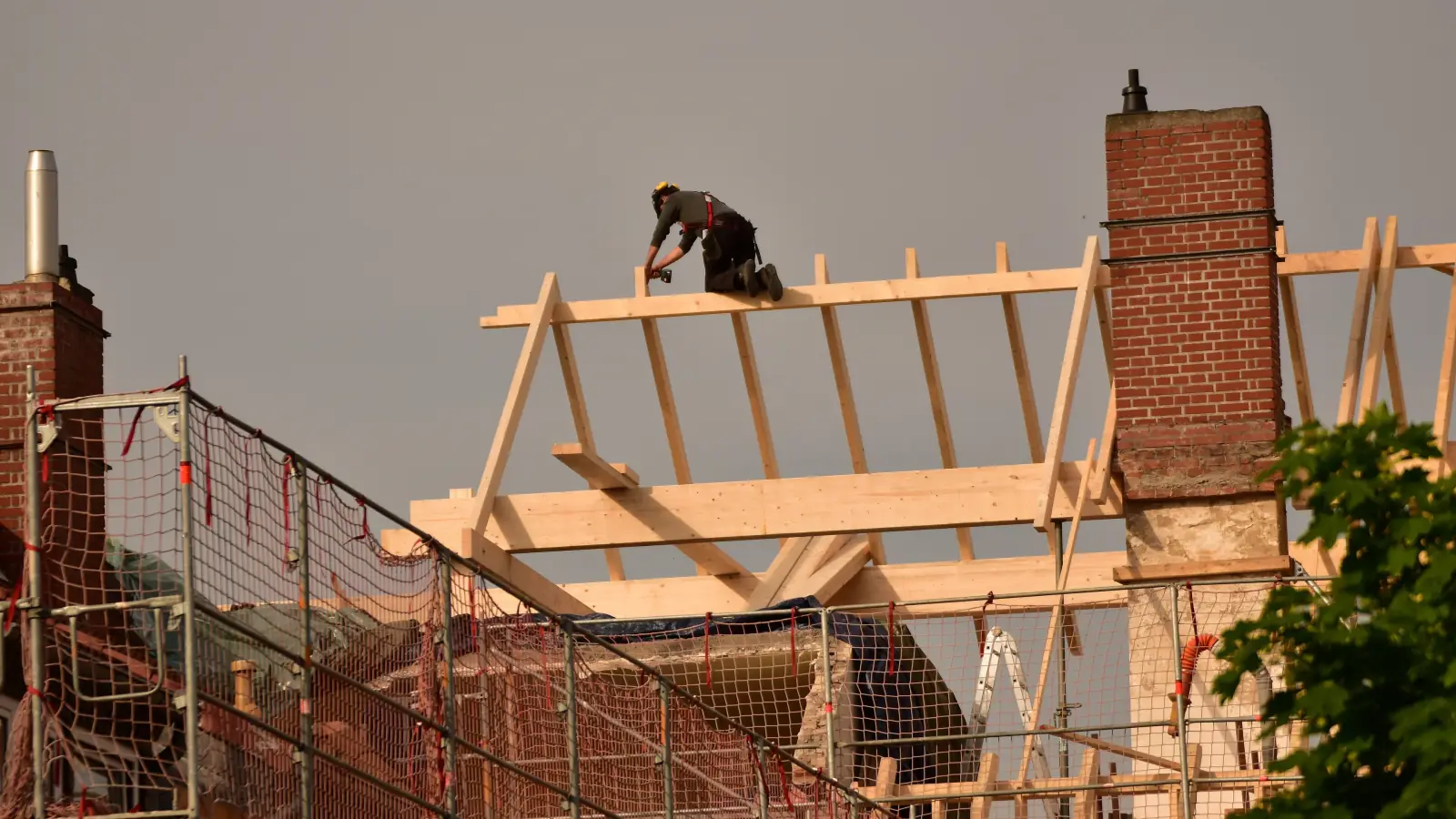
Romanian builders hire carpenters mainly for formwork. You build the timber and panel moulds for concrete slabs, walls and columns on housing blocks, offices and infrastructure. Others work on roofs, timber frames, stairs and fit-out joinery. The busiest building areas are around Bucharest, Ilfov, Cluj-Napoca, Timișoara, Iași and Brașov. Crews often move between sites of the same contractor as each frame is finished. Formwork companies also work as subcontractors to the large general contractors, so your daily boss may be a different firm from the one on your contract.
Your week usually follows the concrete pours. You set out and assemble formwork, check levels and plumb, strip the panels after curing, then clean and move them to the next floor. Roof crews cut and fix rafters, battens and boarding. Panels are lifted by tower cranes run by ISCIR-authorised crane drivers (macaragii). Work from mobile platforms needs an ISCIR platform operator authorisation. A carpenter who gets that authorisation can work on facades and high ceilings without waiting for an operator.
Hours and shifts
Formwork crews in Romania normally keep five 8-hour days. Pours often push the schedule into Saturdays, and the week may then reach the 48-hour limit. Each Saturday or late hour is owed back as paid rest within three months, or paid with a premium of 75% or more on your basic rate.
In summer a site may plan long days and shorter ones later, which is allowed while the average stays under 48 hours over up to 3 weeks. A pour that runs past 10 pm counts as night work and earns at least 25% extra, or one hour off the shift.
Recognition and licence, step by step.
What to do, in order, to work as a carpenter in Romania.
- 01
Have your trade certificate recognised by ANC
Send ANC the Romanian application form, ID, birth certificate and your carpentry or joinery certificate. Each copy needs a certified Romanian translation. The certificate also needs super-legalisation or a certificate of authenticity from the issuing country. - 02
School diploma from a vocational school
If your training was at a vocational school (școală profesională), CNRED evaluates the diploma and sets its level and specialisation. For EU, EEA and Swiss diplomas it decides within 30 working days. CNRED works with the county school inspectorates if a difference exam is needed. - 03
Medical check before the site
Before your first day on site, the occupational health doctor issues a certificate that you are fit for work at height and with power tools. Your employer books this check. - 04
Platform operator course
To drive a mobile elevating work platform you follow an ISCIR training programme and pass an ISCIR exam held in Romanian. Group A covers platforms whose load stays inside the support outline. Group B covers all other mobile platforms. - 05
Yearly stamp on your talon
Your employer's RSVTI officer re-trains and tests you every year. The stamp on your talon lasts 12 months, and the talon itself 4 years. Moving to another type of platform in the same group needs extra training from the RSVTI officer.
Certificates and language.
Romanian contractors look for a carpentry or formwork certificate (dulgher, tâmplar) recognised by ANC, and proof of site experience. NVQ Level 3 Carpentry and Joinery, a CSCS card or Red Seal show your level, but Romanian sites do not ask for them as such. Useful extras are the ISCIR platform operator authorisation and site safety training (SSM). The employer gives the safety training when you start and records it in your file. If you hold an ISCIR platform authorisation from an earlier Romanian employer, bring it: the authorisation stays yours, and only the yearly stamp is renewed by the new company.
- NVQ Level 3 Carpentry and Joinery
- CSCS card
- Red Seal
Language at work
On Romanian sites the foreman briefs in Romanian, and the safety training and your contract are in Romanian too. Basic Romanian for measurements, formwork terms and safety signs helps a lot. The ISCIR platform exam is held in Romanian. Contractors with foreign crews often name a team leader who speaks both languages.
What carpenters earn in Romania.
Formwork and roof carpentry on a building site falls under the construction wage floor: RON 4,582 gross a month in 2026. That is above the general floor of RON 4,325 that applies from 1 July 2026 in other sectors. A pour that runs into the night earns a 25% supplement or more. Saturday hours not returned as rest earn a 75% supplement or more. Your payslip shows 25% pension and 10% health contributions taken from the gross. A platform authorisation makes you more useful on site, so ask whether it brings a higher rate.
Before you sign.
Points to settle in writing before you sign a carpenter contract in Romania.
- Check that the contract pays at least RON 4,582 gross, the 2026 construction minimum.
- Ask whether the work is formwork, roofing or joinery, and on which site and in which city.
- Agree who supplies helmets, harnesses, safety boots and hand tools, and who pays for power tools.
- Ask who pays the ISCIR platform operator course and exam if you will drive a lift, and whether the yearly stamp is renewed at the company's cost.
- Find out how travel between sites and accommodation near the site are paid, and how much is deducted from your pay for them.
- Get Saturday pay written down: paid rest within 90 days or at least 75% extra.
What carpenters earn in other countries
Typical monthly gross pay for foreign hires, from official statistics and collective agreements.
FAQ
Questions about working in Romania.
What do I need before I can work as a carpenter in Romania?
Have your trade certificate recognised by ANC; School diploma from a vocational school; Medical check before the site; Platform operator course; Yearly stamp on your talon.
Which language do I need to work in Romania?
On Romanian sites the foreman briefs in Romanian, and the safety training and your contract are in Romanian too. Basic Romanian for measurements, formwork terms and safety signs helps a lot. The ISCIR platform exam is held in Romanian. Contractors with foreign crews often name a team leader who speaks both languages.
What is the minimum wage in Romania?
The statutory minimum wage in Romania is RON 4,325 a month gross (2026).
Carpenters are also hired in:
Sources
Checked September 2026. Rules change - confirm details with your employer or the authority before you apply.
- EURES (European Commission) - Living and working conditions: Romania
- Autoritatea Națională pentru Calificări (ANC) - Acte necesare recunoaștere certificate
- ISCIR - PT CR 8-2025, Autorizarea personalului de deservire
- CNRED - Studii preuniversitare
- Inspectoratul General pentru Imigrări (IGI)
- Eurostat: Monthly minimum wages (earn_mw_cur)
Get found by employers hiring for Romania.
One free profile that employers hiring for Romania and your other chosen destinations can find.
Create your profileFree. No subscription. No commission on your wages, ever.