Carpenter jobs in Hungary for foreigners.
Carpenters are no. 3 of 10 on the list of trades Hungary recruits from abroad.
Updated September 2026
- Job offer signed
- Permit application sent
- Decision expected8-16 weeks
Key facts
- Main permit route
- Vendégmunkás-tartózkodási engedély
- Processing time
- 8-16 weeks
- Certificates employers ask for
- NVQ Level 3 Carpentry and Joinery · CSCS card · Red Seal
- Permits issued by
- Országos Idegenrendészeti Főigazgatóság (OIF)
What carpenters do in Hungary.
Hungarian builders recruit carpenters from abroad for formwork on concrete structures and for timber roofs on houses, halls and farm buildings. Many arrive through a qualified staffing agency that moves crews between several building projects. Carpentry is one of the trades the country lists as recruited from outside the EU, together with masonry and general site work, so you often share a site with other foreign crews.
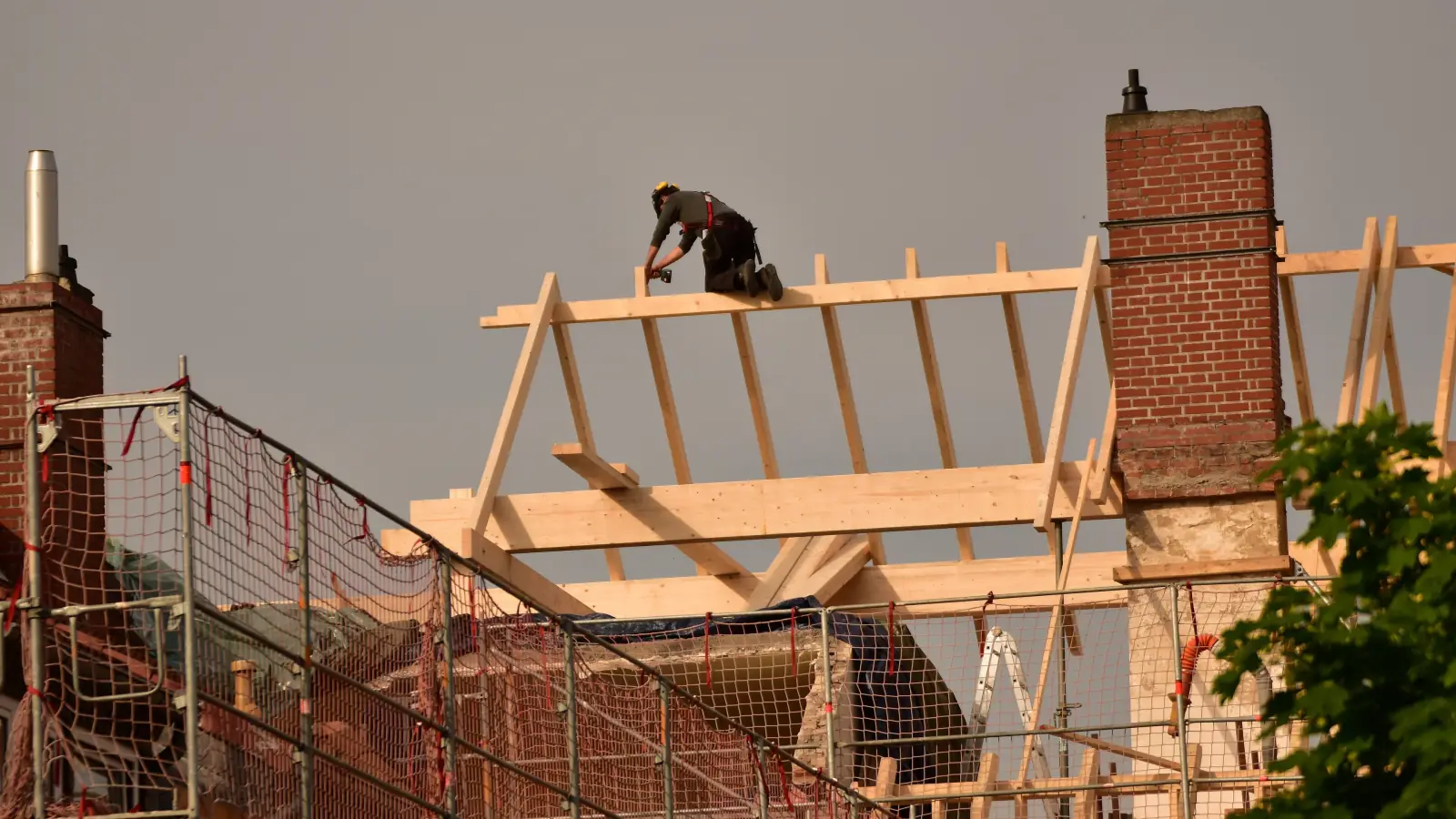
On formwork you put up wall and slab shuttering, props and edge protection, then strip, clean and oil the panels after each pour. On roofing jobs you cut and fix rafters, purlins and battens, and sometimes timber frames for houses. The crew moves with the concrete and delivery schedule; summer days are long, and winter brings shorter weeks when frost stops pours. Good formwork carpenters are measured by speed and by how true the walls come out. Between pours you prepare panels for the next section, repair damaged plywood and sort props and clamps for the crane to lift.
Hours and shifts
Seasonal swings are handled with a munkaidőkeret (working-time frame): long summer weeks are balanced by shorter ones, over a reference period of up to four months or 16 weeks, and up to twelve months under a collective agreement. Within the frame a day may be 12 hours and a week 48 hours.
Hours above the frame, or ordered overtime, pay 50% extra or time off. Ordered overtime stops at 250 hours a year. Two rest days a week are the rule, and at least one rest day each month must fall on a Sunday. A 20-minute break is due after six hours, and another 25 minutes after nine.
Recognition and licence, step by step.
What to do, in order, to work as a carpenter in Hungary.
- 01
Gather your carpentry training proof
Get a certified copy of your carpentry certificate and the subject list that shows practical training. If your qualification was built on a secondary school leaving certificate, add a copy of that too, as MEIK asks for it in such cases. Add references naming the formwork systems you used. - 02
Apply to MEIK
Send the papers with translations and proof of the HUF 45,000 fee to MEIK. Ask it to compare your certificate with the Hungarian carpentry qualification, or let MEIK choose the closest one. Typed translations are fine for English, German, Romanian, Spanish and Ukrainian. - 03
Keep the decision
Within 75 days MEIK confirms that you hold the same right to a post as with the Hungarian vocational qualification. Keep the original safe; agencies and site managers ask to see it when they place you on a new project. - 04
Medical fitness for heights
A doctor checks your fitness before you start, as the Mvt. requires, and periodic checks follow in listed jobs. Formwork and roof work take place at height, so tell the doctor about any balance, eyesight or heart problems. - 05
Safety instruction on each new site
The employer instructs you in safe work when you start and again whenever the workplace, your job or the tools change. Ask that it covers fall protection on slab edges, the shuttering system in use and the crane signals on that site. - 06
Ask about the frame in writing
Before you sign, ask the employer for the start and end dates of the working-time frame and the total hours it plans. The Mt. lets a frame run up to four months or 16 weeks as a rule, and longer only in seasonal or multi-shift work or under a collective agreement, so the settlement may come long after a busy summer.
Certificates and language.
Bring your carpentry or joinery certificate and references from earlier sites. An NVQ Level 3 Carpentry and Joinery, a CSCS card or a Red Seal show skill, but Hungary relies on its own recognition through MEIK. Experience with named formwork systems helps agencies place you quickly, and photos of roofs you built can help at interview. Your employer keeps records of your medical fitness and safety instruction, and site managers may ask to see them. Drawings or photos of timber roofs you built also help a roofing contractor judge your level.
- NVQ Level 3 Carpentry and Joinery
- CSCS card
- Red Seal
Language at work
Formwork crews work by short instructions about sizes, props and pour times, so basic Hungarian or a common language with the foreman is enough to begin. Crane signals are given by hand and radio, so learn them early. Warning signs on site must also be in a language you understand if you do not speak Hungarian. Hungarian drawings use metric measurements in centimetres and millimetres.
What carpenters earn in Hungary.
Carpentry posts require a vocational qualification, which puts the 2026 garantált bérminimum of HUF 373,200 a month under your pay; the plain minimum wage is HUF 322,800. Hours beyond the frame pay 50% extra, Sunday work where the law allows it 50%, and public holidays 100%. Expect 18.5% social security and 15% income tax to be withheld; under-25s are exempt from the income tax. If the frame ends with fewer hours worked than planned through no fault of yours, ask how the contract pays for them. Your wage arrives by the 10th of the following month.
Before you sign.
Points to settle in writing before you sign a carpenter contract in Hungary.
- Whether you will build formwork or timber roofs, and on which projects in which towns.
- That your contract pays a qualified carpenter at least HUF 373,200 a month.
- How the working-time frame works, how long it runs and how extra hours are settled at the end.
- Who provides harnesses, helmets and safety boots for slab-edge and roof work.
- Housing near the building projects and whether rent comes out of your pay.
- Who covers the MEIK fee and translations for your carpentry papers.
What carpenters earn in other countries
Typical monthly gross pay for foreign hires, from official statistics and collective agreements.
FAQ
Questions about working in Hungary.
What do I need before I can work as a carpenter in Hungary?
Gather your carpentry training proof; Apply to MEIK; Keep the decision; Medical fitness for heights; Safety instruction on each new site; Ask about the frame in writing.
Which language do I need to work in Hungary?
Formwork crews work by short instructions about sizes, props and pour times, so basic Hungarian or a common language with the foreman is enough to begin. Crane signals are given by hand and radio, so learn them early. Warning signs on site must also be in a language you understand if you do not speak Hungarian. Hungarian drawings use metric measurements in centimetres and millimetres.
What is the minimum wage in Hungary?
The statutory minimum wage in Hungary is HUF 322,800 a month gross (2026).
Carpenters are also hired in:
Sources
Checked September 2026. Rules change - confirm details with your employer or the authority before you apply.
- Oktatási Hivatal (MEIK) - Külföldi szakképesítés elismerése
- Országgyűlés jogszabálytár - 2012. évi I. törvény a munka törvénykönyvéről (Mt.)
- Országgyűlés jogszabálytár - 1993. évi XCIII. törvény a munkavédelemről (Mvt.)
- NAV - Minimálbér, garantált bérminimum
- Országos Idegenrendészeti Főigazgatóság (OIF)
- Eurostat: Monthly minimum wages (earn_mw_cur)
Get found by employers hiring for Hungary.
One free profile that employers hiring for Hungary and your other chosen destinations can find.
Create your profileFree. No subscription. No commission on your wages, ever.