Carpenter jobs in France for foreigners.
Carpenters are no. 2 of 10 on the list of trades France recruits from abroad.
Updated September 2026
- Job offer signed
- Permit application sent
- Decision expected8-16 weeks
Key facts
- Main permit route
- Carte de séjour salarié / travailleur temporaire
- Processing time
- 8-16 weeks
- Certificates employers ask for
- NVQ Level 3 Carpentry and Joinery · CSCS card · Red Seal
- Permits issued by
- Direction générale des étrangers en France (ANEF)
What carpenters do in France.
In France the trade splits into charpentier, who builds roof frames and timber structures, and menuisier, who makes and fits doors, windows, stairs and floors. Employers range from small family workshops to builders of timber frame houses and firms that restore old and listed buildings. Roof renovation keeps firms busy in every region, and new timber buildings are growing.
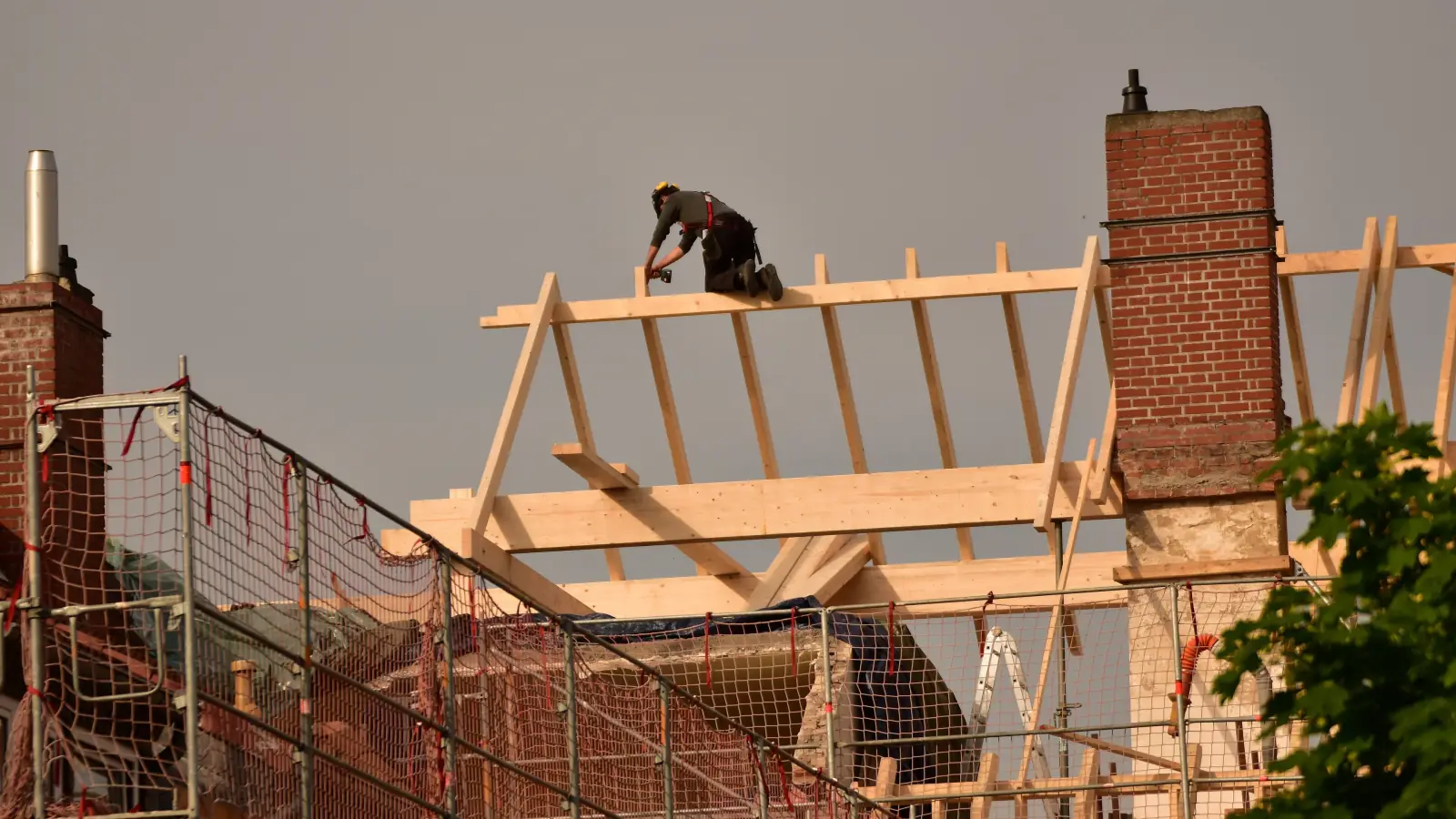
A typical week starts in the workshop. You read technical drawings, often made with 2D or 3D design software, cut and shape solid timber or glulam beams, and prepare tenon and mortise joints or bolted connections. Then you go to site to lift and assemble the frame, often high on a roof. On old buildings you repair or strengthen frames, sometimes with traditional methods required for heritage work. A badly joined beam can bring a roof down, which is why framing is covered by the ten-year building guarantee.
Hours and shifts
Timber framing and joinery firms in the building branch apply IDCC 1596 or IDCC 1597, on a 35-hour base. Roof work depends on weather, and firms often plan longer days in summer and shorter ones in winter within the legal limits. Since 1 July 2025 a decree requires employers to adapt hours, give rest periods and provide shade or fans in hot weather.
When Météo-France issues an orange or red heat warning, building firms can stop work and you are paid compensation for the stopped hours through the sector scheme. Ask your employer how this works on your sites before summer, and how heat changes the start time on roofs.
Recognition and licence, step by step.
What to do, in order, to work as a carpenter in France.
- 01
Check the rules for charpentier
Charpentier is a regulated craft. Self-employed work needs a French CAP or BP, an RNCP title at that level, or three years in the trade in the EU/EEA. People from outside the EU follow similar routes, based on a diploma or on three years of experience. - 02
Send a complete file to the CMA
Send your ID, your diplomas with a translation, proof of experience such as payslips and, if you have one, your job contract. You get a receipt within one month. EU/EEA nationals who hit a problem with French authorities can ask SOLVIT, which proposes a solution within 10 weeks. - 03
Get trained for roof work
Your employer must assess risks in the document unique (DUERP), train you, supply protective gear and compliant equipment, and organise work at height safely. Before the first roof job, ask which harness and fall protection you will use and who checks it. - 04
Have the card made
Site staff need the carte d'identification professionnelle BTP. The employer orders it online and pays EUR 9.80 at hiring. At the end of a fixed term or permanent contract you hand the card back. - 05
Learn the French insurance rule
Firms that build roof frames must hold the garantie décennale before work starts. It covers hidden defects that appear within 10 years and threaten the structure. As an employee you are covered by your firm's policy, but your joints and fixings must match the drawings exactly. - 06
Record your roof safety training
From 16 March 2026 your employer declares the mandatory safety courses you take, such as work at height, in the digital Passeport de prévention managed by the Caisse des dépôts. From 1 January 2027 every safety course is declared. Ask for access so that each new firm can see your training.
Certificates and language.
French firms look for a CAP or BP in charpente or menuiserie, or proven years of timber framing. A UK NVQ Level 3 Carpentry and Joinery, a CSCS card or a Red Seal from Canada supports your CV, and the firm checks your skills on a first job. Employers value proof of skill with glulam, joinery machines and design software. On site you need the carte BTP, and near live cables an habilitation électrique from your employer.
- NVQ Level 3 Carpentry and Joinery
- CSCS card
- Red Seal
Language at work
France sets no official language level for timber framing. You need to read French drawings and cutting lists, follow the lifting plan and safety briefings for roof work, and understand the foreman on site. Words for timber sections, joints and fixings are learned fast on the job, and the drawings themselves use the metric sizes you already know.
What carpenters earn in France.
This site's France data has no pay range for timber framing, so compare any offer with the floors. A 39-hour week at the SMIC of EUR 12.31 is 35 hours at the base rate plus four hours at about EUR 15.39. Your region's grid gives a higher minimum for many coefficients. On mobile sites the regional agreements add daily flat allowances for meals, transport and travel time, set by distance zone. Travel outside working hours is paid at 50% of hourly pay in the larger firms' agreement, unless the firm pays the costs directly.
Before you sign.
Points to settle in writing before you sign a carpenter contract in France.
- Ask whether the job is mostly roof frames, timber frame houses or joinery fitting, and how much time is workshop versus site.
- Ask who supplies harnesses, helmets and fall protection for roof work and how the firm trains you to use them.
- Ask how the firm pays the daily meal, transport and travel allowances for each zone.
- Ask how hours change between summer and winter and how heat warning stoppages are paid.
- Ask which design software and joinery machines you will use and whether training is given.
- Confirm your coefficient on your region's IDCC 1596 or IDCC 1597 grid in writing.
What carpenters earn in other countries
Typical monthly gross pay for foreign hires, from official statistics and collective agreements.
Open carpenter vacancies in France.
Recent openings from EURES, the European Commission's job portal. You apply directly with the employer.
- Menuisier H/F/XABOUTIR EMPLOI · FranceNov 20
- Charpentier bois H/F/XABOUTIR EMPLOI · FranceNov 20
- Formateur Menuisier agenceur H/FNon renseigné · FranceNov 20
- MENUISIER POSEUR (H/F) x LIMOGES BTPOPTINERIS · FranceNov 20
- Poseur de gouttières H/FABOUTIR EMPLOI OUEST · FranceNov 20
- Menuisier poseur H/FABOUTIR EMPLOI OUEST · FranceNov 20
- MENUISIER BOIS H/FCRIT · FranceNov 20
- Technicien Poseur H/FWork&You · FranceNov 19
FAQ
Questions about working in France.
What do I need before I can work as a carpenter in France?
Check the rules for charpentier; Send a complete file to the CMA; Get trained for roof work; Have the card made; Learn the French insurance rule; Record your roof safety training.
Which language do I need to work in France?
France sets no official language level for timber framing. You need to read French drawings and cutting lists, follow the lifting plan and safety briefings for roof work, and understand the foreman on site. Words for timber sections, joints and fixings are learned fast on the job, and the drawings themselves use the metric sizes you already know.
What is the minimum wage in France?
The statutory minimum wage in France is €1,867 a month gross (2026).
Carpenters are also hired in:
Sources
Checked September 2026. Rules change - confirm details with your employer or the authority before you apply.
- Service Public Entreprendre - Charpentier: conditions d'accès et d'exercice en France
- Service Public Entreprendre - Chaleur: quelles obligations pour l'employeur ?
- Légifrance - Convention collective nationale des ouvriers du bâtiment (plus de 10 salariés)
- Service Public Entreprendre - Carte BTP
- Direction générale des étrangers en France (ANEF)
- Service Public - Carte de séjour salarié / travailleur temporaire
Get found by employers hiring for France.
One free profile that employers hiring for France and your other chosen destinations can find.
Create your profileFree. No subscription. No commission on your wages, ever.