HVAC technician jobs in Hungary for foreigners.
HVAC technicians are no. 6 of 10 on the list of trades Hungary recruits from abroad.
Updated September 2026
- Job offer signed
- Permit application sent
- Decision expected8-16 weeks
Key facts
- Main permit route
- Vendégmunkás-tartózkodási engedély
- Processing time
- 8-16 weeks
- Certificates employers ask for
- EU F-Gas Certificate · EPA Section 608 · City & Guilds 2079 · Red Seal
- Permits issued by
- Országos Idegenrendészeti Főigazgatóság (OIF)
What HVAC technicians do in Hungary.
Hungary lists HVAC technicians among the trades it recruits from outside the EU. Building services contractors working on housing, offices, shopping centres and industrial halls employ them, along with service firms that maintain cooling in shops, food plants and server rooms. Service contracts with shops and offices bring regular maintenance visits through the whole year, not only in summer.
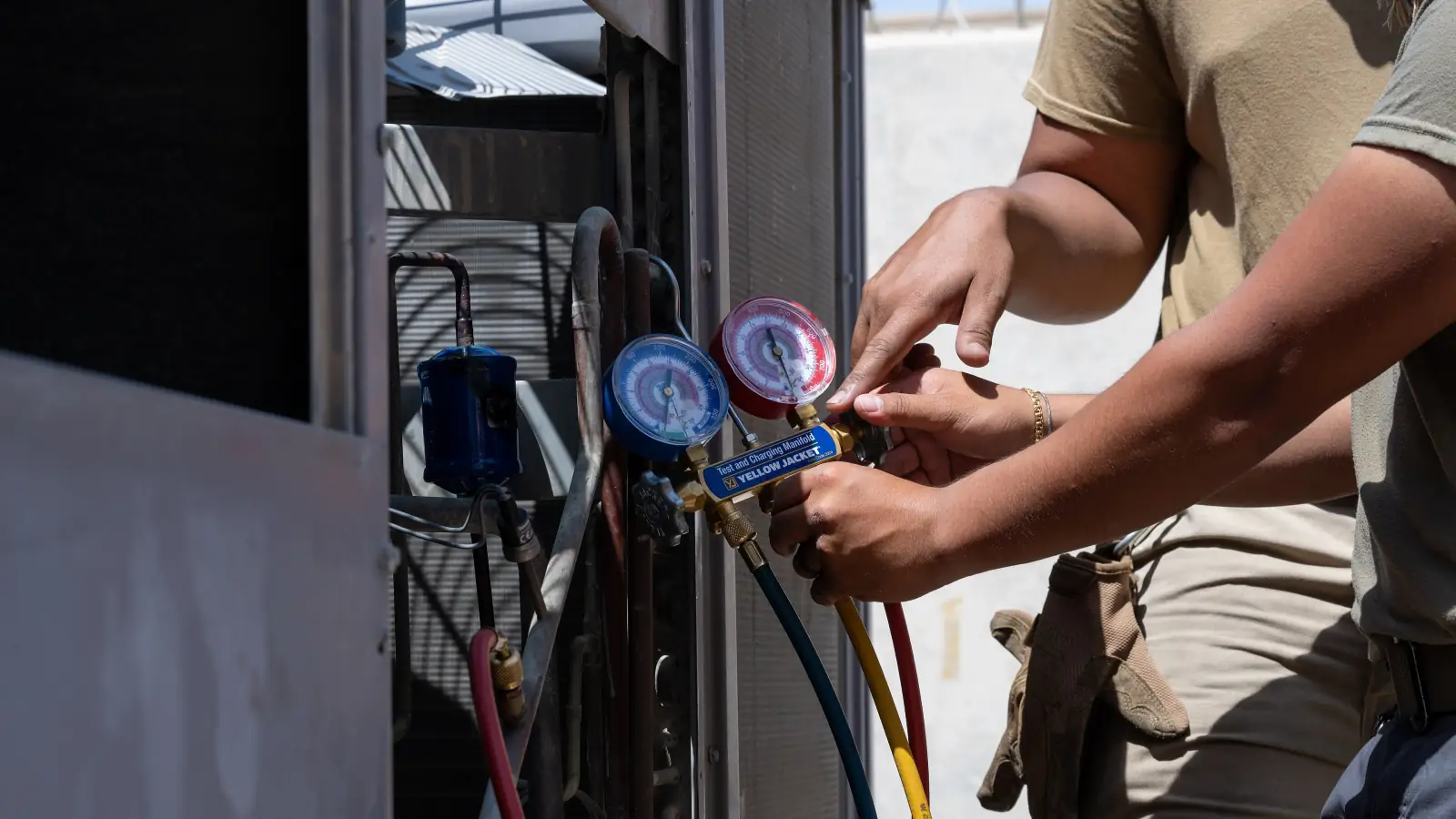
A typical week mixes installation and service: mounting split and multi-split units, heat pumps and ventilation ducts, brazing copper lines, pressure testing, vacuuming and charging systems, then commissioning. Service visits include leak checks, cleaning filters and coils and replacing parts. Summer brings breakdown calls for cooling, and autumn moves the focus to heat pumps and heating systems. You often drive a company van between jobs with a colleague. Commissioning ends with a record of the refrigerant type and amount charged, which the customer keeps with the unit's papers. Ventilation jobs involve hanging ducts from ceilings using lifts and mobile scaffolds.
Hours and shifts
Under the Mt. the general working day is eight hours, Monday to Friday, but service firms often plan unequal schedules. They must give you the schedule in writing at least seven days ahead. With unequal scheduling, outside multi-shift or seasonal work, you still get a rest day after six working days.
Breakdown calls outside scheduled hours count as overtime: 50% extra or equal time off, 100% on a weekly rest day. Calls on public holidays add 100%. Rest between two working days is at least 11 hours, which also applies after a late call-out. After a late call-out, your next shift starts only once that rest is over.
Recognition and licence, step by step.
What to do, in order, to work as a HVAC technician in Hungary.
- 01
Bring your F-gas certificate
Work on refrigeration, air conditioning and heat pumps with fluorinated gases requires an EU F-gas certificate for the person doing it. Bring the original and a translation, and ask the employer whether it is accepted as it is or whether you need a Hungarian exam before handling refrigerant. - 02
Recognise your trade certificate
Send a certified copy of your heating and cooling certificate, the subject list and translations to MEIK with the HUF 45,000 fee. Name the Hungarian qualification you want it compared with, or ask MEIK to decide. MEIK may ask for further proof. - 03
Wait for the MEIK decision
MEIK decides within 75 days. A positive decision classes your post as skilled, so the guaranteed minimum wage applies. Keep a copy for every employer and for any later F-gas paperwork. - 04
Medical fitness check
A doctor checks your fitness for the work before you start. Roof and ladder work and handling heavy outdoor units are part of the job, so the examination considers them, and listed jobs have periodic checks. - 05
Safety instruction for gas and pressure
The employer instructs you when you start and when new equipment or a new technology comes in. Ask that it covers pressurised gas cylinders, brazing with open flame, flammable refrigerants and work on roofs. - 06
Check your driving licence for the van
Service work usually means driving between customers. Bring your driving licence and ask the employer whether it can be used in Hungary as it is or needs exchanging, and who handles and pays for it. A licence issued outside the EU/EEA follows different rules from an EU licence, which is valid as it is.
Certificates and language.
Employers ask first for an EU F-Gas Certificate in the right category for the equipment you will handle. City & Guilds 2079, an American EPA Section 608 or a Canadian Red Seal show skill, but your Hungarian employer decides whether they are enough for refrigerant work. Manufacturer training for heat pumps and VRF systems helps you get better jobs. The MEIK decision is your formal proof of vocational training and lifts you to the guaranteed minimum wage. List the refrigerants you have handled, such as R32, R410A or propane (R290). Experience with ventilation ductwork and air handling units also counts with building services contractors.
- EU F-Gas Certificate
- EPA Section 608
- City & Guilds 2079
- Red Seal
Language at work
You meet customers in homes and offices and fill in service sheets, so some Hungarian helps more here than in factory jobs. Manuals for many units come in several languages. Ask the employer whether service reports and refrigerant records must be written in Hungarian, and who checks them. The Hungarian words for cooling, heating, leak and filter help on the phone with customers. Ask for wiring diagrams of the units you install in a language you read.
What HVAC technicians earn in Hungary.
Installation and service of heating and cooling systems requires a vocational qualification, so the 2026 guaranteed minimum wage of HUF 373,200 a month is the floor, against the general HUF 322,800 minimum. Breakdown calls outside schedule add 50%, or 100% on rest days and holidays. Wages are due by the 10th of the next month. Under 25, you pay no personal income tax; the 18.5% social security contribution still applies. Ask how travel time between customer sites is counted. Annual leave starts at 20 working days and rises with age from 25. Ordered overtime is limited to 250 hours a year.
Before you sign.
Points to settle in writing before you sign a HVAC technician contract in Hungary.
- Whether your F-gas certificate category covers the equipment the firm installs and services.
- Who pays for any Hungarian F-gas exam or retraining, and when it takes place.
- That the contract pays at least HUF 373,200 for a qualified installer.
- Who supplies vacuum pumps, gauges, recovery units and leak detectors.
- How call-outs outside schedule are planned and paid, including at weekends.
- Whether you drive a company van and who pays fuel, tolls and traffic fines.
What HVAC technicians earn in other countries
Typical monthly gross pay for foreign hires, from official statistics and collective agreements.
FAQ
Questions about working in Hungary.
What do I need before I can work as a HVAC technician in Hungary?
Bring your F-gas certificate; Recognise your trade certificate; Wait for the MEIK decision; Medical fitness check; Safety instruction for gas and pressure; Check your driving licence for the van.
Which language do I need to work in Hungary?
You meet customers in homes and offices and fill in service sheets, so some Hungarian helps more here than in factory jobs. Manuals for many units come in several languages. Ask the employer whether service reports and refrigerant records must be written in Hungarian, and who checks them. The Hungarian words for cooling, heating, leak and filter help on the phone with customers. Ask for wiring diagrams of the units you install in a language you read.
What is the minimum wage in Hungary?
The statutory minimum wage in Hungary is HUF 322,800 a month gross (2026).
HVAC technicians are also hired in:
Sources
Checked September 2026. Rules change - confirm details with your employer or the authority before you apply.
- Oktatási Hivatal (MEIK) - Külföldi szakképesítés elismerése
- Országgyűlés jogszabálytár - 2012. évi I. törvény a munka törvénykönyvéről (Mt.)
- NAV - Minimálbér, garantált bérminimum
- Országgyűlés jogszabálytár - 1993. évi XCIII. törvény a munkavédelemről (Mvt.)
- Országos Idegenrendészeti Főigazgatóság (OIF)
- Eurostat: Monthly minimum wages (earn_mw_cur)
Get found by employers hiring for Hungary.
One free profile that employers hiring for Hungary and your other chosen destinations can find.
Create your profileFree. No subscription. No commission on your wages, ever.