HVAC technician jobs in Croatia for foreigners.
HVAC technicians are no. 8 of 10 on the list of trades Croatia recruits from abroad.
Updated September 2026
- Job offer signed
- Permit application sent
- Decision expected6-16 weeks
Key facts
- Main permit route
- Dozvola za boravak i rad
- Processing time
- 6-16 weeks
- Certificates employers ask for
- EU F-Gas Certificate · EPA Section 608 · City & Guilds 2079 · Red Seal
- Permits issued by
- Ministarstvo unutarnjih poslova (Ministry of the Interior)
What HVAC technicians do in Croatia.
Croatian employers advertise this job as instalater grijanja i klimatizacije (heating and air-conditioning installer). It appears on the HZZ list that all counties may use without a labour market test. Companies installing split units, heat pumps and central heating in flats, hotels and offices do most of the hiring, and many also service cooling in shops and restaurants. Hotel and restaurant kitchens and cold rooms also need refrigeration servicing before the season, and offices in Zagreb and other cities need cooling and ventilation maintenance all year.
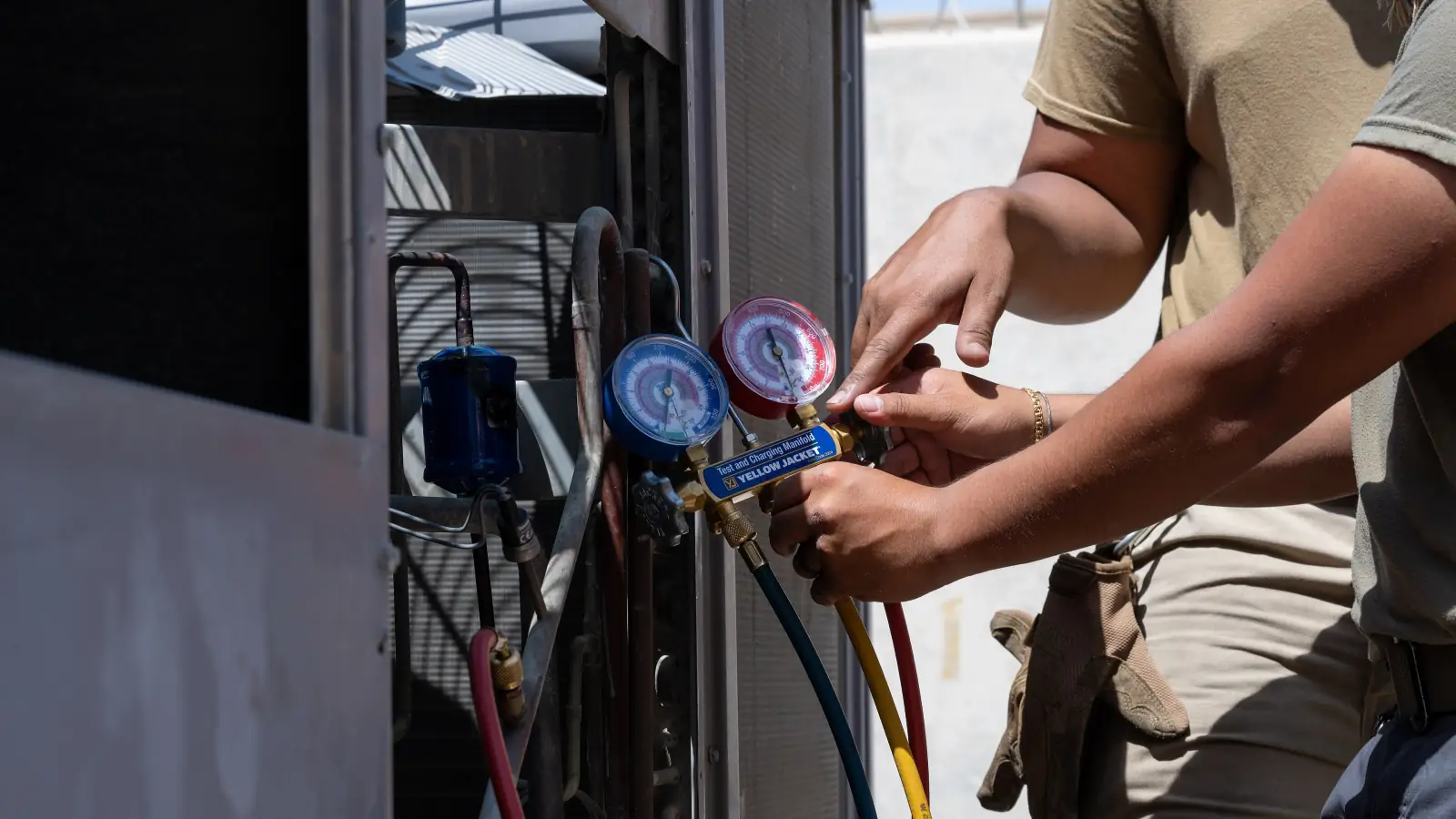
A week can include mounting indoor and outdoor units, running copper lines and drains, vacuuming and charging systems, and fitting boilers and radiators in new flats. Before each summer, hotels and apartment owners on the coast call for installations and servicing, so the spring months are busy. In autumn the focus moves to heating and heat pumps. Paperwork for refrigerant handling is part of every job. Heat pump jobs combine pipe, wiring and refrigerant work, so you often cooperate with other crews.
Hours and shifts
Under the Zakon o radu a full week is 40 hours; overtime is limited to 180 hours a year, or 250 under a collective agreement, and 50 hours a week in total. If your employer is a construction company, the extended Kolektivni ugovor za graditeljstvo applies, with 30% for overtime and night work and 50% for Sundays and holidays.
You have at least 12 hours of rest between working days and 24 hours in a row each week on top of that. Night work under the Labour Act means work between 22:00 and 06:00. Where the construction agreement applies, a second shift adds 10% and the week may reach 56 hours with redistribution.
Recognition and licence, step by step.
What to do, in order, to work as a HVAC technician in Croatia.
- 01
Check the AZVO entry
The AZVO database of regulated professions lists Instalater grijanja i klimatizacije among the vezani obrti, with the Ministarstvo gospodarstva as the competent body for foreign master qualifications. The work permit does not depend on that recognition. - 02
Pass the Croatian refrigerant exam
Firms that install, service or leak-check refrigeration, air conditioning and heat pumps with fluorinated gases need a permit (dozvola) from the Ministarstvo zaštite okoliša i zelene tranzicije. For it, they file the stručni ispit certificate of each worker handling these gases. Training centres approved by the ministry (centri za izobrazbu servisera) run the exam. - 03
Bring your EU F-gas certificate
If you already hold an EU F-gas certificate, bring the original and a translation and ask the employer whether the ministry accepts it for their permit or whether you sit the Croatian exam. The ministry needs a copy of the certificate and your pension insurance record. - 04
Recognise a master title if useful
A foreign master qualification in this trade is recognised by the Ministarstvo gospodarstva for EUR 39.82, or EUR 19.91 for parts. Send certified translations and notarised copies. - 05
Safe-work training
The employer trains you for safe work before you start, in working hours and at its own cost. Ask that it covers work on roofs and facades and the handling of pressurised gas bottles. - 06
Get listed in the company file
The ministry runs an Fgas portal for registered service firms, and permit requests can also be filed through the START Plus e-service. Ask your employer to add your stručni ispit certificate and pension insurance record to its file so that you count as qualified staff.
Certificates and language.
The key paper is proof that you passed the refrigerant handling exam (uvjerenje o položenom stručnom ispitu) in Croatia, or an EU F-gas certificate the employer can use. City & Guilds 2079, the American EPA Section 608 or a Canadian Red Seal show skill, but the ministry permit relies on the stručni ispit. Bring your vocational certificate for heating and cooling, any manufacturer training for heat pumps, and keep your safe-work training record. Experience with propane (R290) or CO2 systems helps with newer installations, and manufacturer training for heat pumps opens warranty work.
- EU F-Gas Certificate
- EPA Section 608
- City & Guilds 2079
- Red Seal
Language at work
You will read installation manuals, fill in service records for refrigerant use and talk with owners of flats and hotel managers. Basic Croatian helps with customers and is useful for the ministry exam paperwork. Ask the training centre in which language the exam is given. A few Croatian phrases about settings and filters make customer visits easier. Ask the training centre for study material for the stručni ispit in advance.
What HVAC technicians earn in Croatia.
Outside the construction sector, the legal floor for this trade is the general 2026 minimum wage of EUR 1,050 a month. Where your employer belongs to construction, the extended agreement's pay groups apply: skilled installers in IV.a earn at least EUR 7.56 an hour (EUR 1,315.60 a month), IV.b EUR 8.00 (EUR 1,391.50) and V.a EUR 8.36 (EUR 1,454.75). Ask which applies to you. Official trips pay a EUR 25 daily allowance under that agreement. Work in your own car is refunded at EUR 0.44 a kilometre under that agreement.
Before you sign.
Points to settle in writing before you sign a HVAC technician contract in Croatia.
- Whether the firm holds the ministry dozvola for work with fluorinated gases and lists you in its file.
- Who pays for the stručni ispit at an approved training centre, and the exam date.
- Whether your employer is in construction, so that the construction pay groups apply.
- Who supplies vacuum pumps, gauges, recovery units and leak detectors.
- How spring pre-season work on the coast is planned, including weekends.
- Whether the pension insurance record the ministry asks for is ready from your first month.
What HVAC technicians earn in other countries
Typical monthly gross pay for foreign hires, from official statistics and collective agreements.
Open HVAC technician vacancies in Croatia.
Recent openings from EURES, the European Commission's job portal. You apply directly with the employer.
FAQ
Questions about working in Croatia.
What do I need before I can work as a HVAC technician in Croatia?
Check the AZVO entry; Pass the Croatian refrigerant exam; Bring your EU F-gas certificate; Recognise a master title if useful; Safe-work training; Get listed in the company file.
Which language do I need to work in Croatia?
You will read installation manuals, fill in service records for refrigerant use and talk with owners of flats and hotel managers. Basic Croatian helps with customers and is useful for the ministry exam paperwork. Ask the training centre in which language the exam is given. A few Croatian phrases about settings and filters make customer visits easier. Ask the training centre for study material for the stručni ispit in advance.
What is the minimum wage in Croatia?
The statutory minimum wage in Croatia is €1,050 a month gross (2026).
HVAC technicians are also hired in:
Sources
Checked September 2026. Rules change - confirm details with your employer or the authority before you apply.
- Ministarstvo zaštite okoliša i zelene tranzicije - Upute serviserima za dobivanje dozvole i upis u registar
- AZVO - Database of regulated professions: Instalater grijanja i klimatizacije
- Ministarstvo gospodarstva - Priznavanje inozemnih stručnih kvalifikacija o stečenom majstorskom zvanju
- HZZ - Lista zanimanja za koja poslodavac nije dužan zatražiti test tržišta rada
- Narodne novine - Kolektivni ugovor za graditeljstvo, pročišćeni tekst (NN 10/2026)
- Ministarstvo unutarnjih poslova (Ministry of the Interior)
- Eurostat: Monthly minimum wages (earn_mw_cur)
Get found by employers hiring for Croatia.
One free profile that employers hiring for Croatia and your other chosen destinations can find.
Create your profileFree. No subscription. No commission on your wages, ever.