HVAC technician jobs in Germany for foreigners.
Foreign HVAC technicians in Germany typically earn €3,300 - €3,900 a month gross. HVAC technicians are no. 9 of 10 on the list of trades Germany recruits from abroad.
Updated September 2026
Minimum wage 2026€2,409
Typical pay€3,300 - €3,900
- Job offer signed
- Permit application sent
- Decision expected8-26 weeks
Key facts
- Typical pay
- €3,300 - €3,900 a month gross
- Main permit route
- Aufenthaltserlaubnis für Fachkräfte mit Berufsausbildung (§ 18a AufenthG)
- Processing time
- 8-26 weeks
- Certificates employers ask for
- EU F-Gas Certificate · EPA Section 608 · City & Guilds 2079 · Red Seal
- Permits issued by
- Bundesagentur für Arbeit (Zentrale Auslands- und Fachvermittlung)
What HVAC technicians do in Germany.
Heating, ventilation and air-conditioning work in Germany is growing with the switch to heat pumps. The trade sits in the SHK crafts, and the reference occupation is Anlagenmechaniker/in für Sanitär-, Heizungs- und Klimatechnik, whose holders work for supply engineering installation firms and for makers of heating and air-conditioning systems. Building-services contractors on large projects such as hospitals, schools and office blocks also hire, and send teams to one site for weeks.
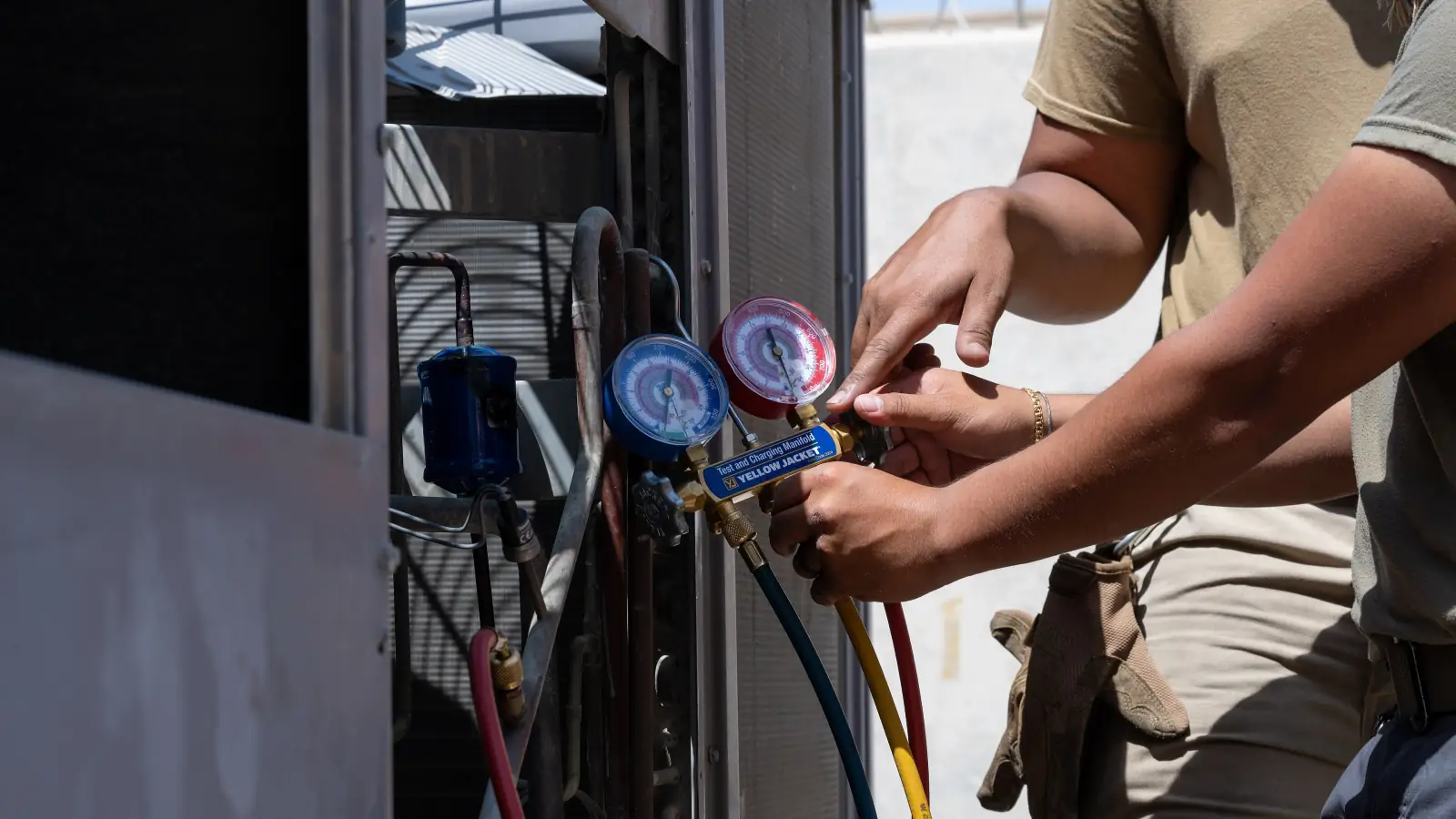
Your week includes fitting air-to-water and ground-source heat pumps in family houses, replacing old oil and gas boilers, installing split air-conditioning in offices and shops, and setting up ventilation with heat recovery. Service work means yearly maintenance, leak checks on refrigerant circuits, reading controller error codes and adjusting settings. Every job that opens a refrigerant circuit needs an F-gas certificate, which makes certified staff especially sought after. Old categories map across: Kategorie II becomes A2 plus B and C for small systems, and Kategorie III becomes D for recovery only.
Hours and shifts
Heating and cooling crews work under the Arbeitszeitgesetz: eight hours a day as a rule and up to ten while the average over six months or 24 weeks stays at eight, with at least 11 hours of rest between shifts. Service firms run a heating-failure rota in winter and see peaks in cooling work in summer.
A night call-out between 23:00 and 06:00 earns paid days off or a fair supplement where no Tarifvertrag sets a rate. The hourly floor is EUR 13.90 in 2026.
Recognition and licence, step by step.
What to do, in order, to work as a HVAC technician in Germany.
- 01
Match your training to SHK
Search the Anerkennungs-Finder for Anlagenmechaniker/in für Sanitär-, Heizungs- und Klimatechnik. It is not regulated in Germany, so recognition is optional, but it shows employers that your heating and air-conditioning training meets the German standard. - 02
Apply to the Handwerkskammer
The chamber where you will work decides; in Hamburg it is the Handwerkskammer Hamburg. The Finder sets the fee at approx EUR 100 to EUR 600, with a receipt inside one month and a decision three months after your papers are complete at the latest. - 03
Get the F-gas Sachkundebescheinigung
Opening a refrigerant circuit needs a personal certificate under Regulation (EU) 2024/573 and the Chemikalien-Klimaschutzverordnung. For stationary systems the Umweltbundesamt maps the old Kategorie I to the new A1 plus B and C. Exams are held by bodies the Länder designate. - 04
Plan for 12 March 2029
The Umweltbundesamt states that older German Sachkundebescheinigungen stay valid until 12 March 2029. A full refresher course converts them, and certificates to the new rules need a refresher at least every seven years. - 05
Know what needs no certificate
According to the Umweltbundesamt, setting up a stationary heat pump or air-conditioner without opening the refrigerant circuit needs no F-gas certificate. Charging, leak checks and recovery do. If you did this work in the last two years, a self-declaration can replace the practical part of the refresher. - 06
Company certificate
Firms that do refrigerant work for customers also need an Unternehmenszertifikat, applied for at the authority responsible for the company's headquarters. Gas boiler swaps follow § 13 NDAV: the firm needs a listing in a gas grid operator's Installateurverzeichnis, and you work under it.
Certificates and language.
The key paper is the EU F-Gas Certificate in its German form, the Sachkundebescheinigung, at the category the job needs: A1 for all equipment sizes, A2 for small systems, B for CO2 and C for ammonia. Employers also value manufacturer training on heat pumps and controls. EPA Section 608, City & Guilds 2079 or Red Seal from abroad show experience; ask whether the employer accepts them or books the German exam. The Handwerkskammer notice as Anlagenmechaniker/in rounds this off.
- EU F-Gas Certificate
- EPA Section 608
- City & Guilds 2079
- Red Seal
Language at work
Recognition as Anlagenmechaniker/in needs no German certificate. The F-gas exam, controller menus, commissioning reports and customer handovers are in German, and you explain heat pump settings to homeowners, so solid workplace German helps you pass the exam and take jobs alone. Ask in which language the manufacturer courses on heat pump controls are held, and whether colleagues can help at first.
What HVAC technicians earn in Germany.
Heating and air-conditioning specialists in Germany typically take home EUR 3,300 to EUR 3,900 gross monthly. Compared with the 2026 legal minimum of EUR 13.90 an hour (EUR 2,409 a month full time), that is EUR 900 to EUR 1,500 more. Holding the right F-gas category often decides whether you can commission heat pumps alone, which moves you up the firm's pay scale. Breakdown rota and night call-outs are paid under the Tarifvertrag or your contract. Weeks away on large building-services sites may add travel time pay and lodging, so check how the firm handles them.
Typical pay of €3,300 - €3,900 a month gross is 1.4 to 1.6 times the statutory minimum wage of €2,409 (2026).
Before you sign.
Points to settle in writing before you sign a HVAC technician contract in Germany.
- Which F-gas category (A1, A2, B or C) the job needs, and who pays the Sachkundebescheinigung exam and its fee.
- Whether your foreign refrigerant certificate is accepted, or you sit the German exam on paid time with a course beforehand.
- How the winter heating-failure rota and the summer cooling peaks change your hours, and how extra hours are balanced.
- Whether the firm provides recovery units, gauges, scales and leak detectors for every refrigerant job you are sent to.
- Who pays manufacturer heat pump and controls courses, plus the travel and overnight stay when they are held elsewhere.
- Whether the firm holds the Unternehmenszertifikat for refrigerant work and a gas Installateurverzeichnis listing for boiler swaps.
What HVAC technicians earn in other countries
Typical monthly gross pay for foreign hires, from official statistics and collective agreements.
Open HVAC technician vacancies in Germany.
Recent openings from EURES, the European Commission's job portal. You apply directly with the employer.
- Fachplaner HLSK (m/w/d) (Fachplaner/in - Energie- und Gebäudetechnik)persona service AG & Co.KG Leipzig-Nord · GermanyNov 21
- Meister Kältetechnik (m/w/d) (Techniker/in - Kältetechnik/Bachelor Professional in Technik)AlphaConsult Premium KG · GermanyNov 21
- Mechatroniker für Klimatechnik mit Entwicklungsmöglichkeiten (m/w/d) (Mechatroniker/in - Kältetechnik)DIEPA GmbH Filiale Berlin Südost · GermanyNov 21
- Kälteanlagenmechaniker (m/w/d) Vollzeit (Mechatroniker/in - Kältetechnik)ARWA Personaldienstleistungen GmbH · GermanyNov 20
- Technischer Zeichner (m/w/d) (Techniker/in - Heizungs-, Lüftungs-, Klimatechnik/Bachelor Professional in Technik)PerSe-Partner GmbH · GermanyNov 20
- Techniker (m/w/d) (Techniker/in - Heizungs-, Lüftungs-, Klimatechnik/Bachelor Professional in Technik)PerSe-Partner GmbH · GermanyNov 20
- Mechatroniker Kältetechnik / Anlagenmechaniker SHK m/w/d (Mechatroniker/in - Kältetechnik)NIHS GmbH · GermanyNov 20
- Mechatroniker Kältetechnik / Anlagenmechaniker SHK m/w/d (Mechatroniker/in - Kältetechnik)NIHS GmbH · GermanyNov 20
FAQ
Questions about working in Germany.
How much do HVAC technicians earn in Germany?
Foreign HVAC technicians in Germany typically earn €3,300 - €3,900 a month gross.
What do I need before I can work as a HVAC technician in Germany?
Match your training to SHK; Apply to the Handwerkskammer; Get the F-gas Sachkundebescheinigung; Plan for 12 March 2029; Know what needs no certificate; Company certificate.
Which language do I need to work in Germany?
Recognition as Anlagenmechaniker/in needs no German certificate. The F-gas exam, controller menus, commissioning reports and customer handovers are in German, and you explain heat pump settings to homeowners, so solid workplace German helps you pass the exam and take jobs alone. Ask in which language the manufacturer courses on heat pump controls are held, and whether colleagues can help at first.
HVAC technicians are also hired in:
Other trades in Germany:
Sources
Checked September 2026. Rules change - confirm details with your employer or the authority before you apply.
- Anerkennung in Deutschland - Your recognition procedure as Anlagenmechaniker/in SHK (Hamburg)
- Umweltbundesamt - FAQ F-Gas-Verordnung, Abschnitt 4: Zertifizierung
- Gesetze im Internet - Chemikalien-Klimaschutzverordnung
- Gesetze im Internet - Niederdruckanschlussverordnung § 13
- Bundesagentur für Arbeit (Zentrale Auslands- und Fachvermittlung)
- Bundesregierung - Mindestlohn 2026 (EUR 13.90 per hour)
- Statistik der Bundesagentur für Arbeit - Fachkräfteengpassanalyse 2025
- Bundesagentur für Arbeit - Entgeltatlas (median pay by occupation)
Get found by employers hiring for Germany.
One free profile that employers hiring for Germany and your other chosen destinations can find.
Create your profileFree. No subscription. No commission on your wages, ever.