HVAC technician jobs in Netherlands for foreigners.
HVAC technicians are no. 6 of 6 on the list of trades Netherlands recruits from abroad.
Updated September 2026
- Job offer signed
- Permit application sent
- Decision expected4-22 weeks
Key facts
- Main permit route
- Highly Skilled Migrant (kennismigrant)
- Processing time
- 4-22 weeks
- Certificates employers ask for
- EU F-Gas Certificate · EPA Section 608 · City & Guilds 2079 · Red Seal
- Permits issued by
- Immigratie- en Naturalisatiedienst (IND)
What HVAC technicians do in Netherlands.
Heating, cooling and ventilation is a growing part of the Dutch installation branch. The Cao Metaal en Techniek covers the design, assembly, repair and maintenance of central heating, warm water systems, air conditioning, ventilation and cooling, plus refrigeration and freezer installations. The ILT, the Dutch inspectorate, adds the equipment where refrigerant rules apply: stationary refrigeration, air conditioning and heat pumps, refrigerated transport units and reefer containers.
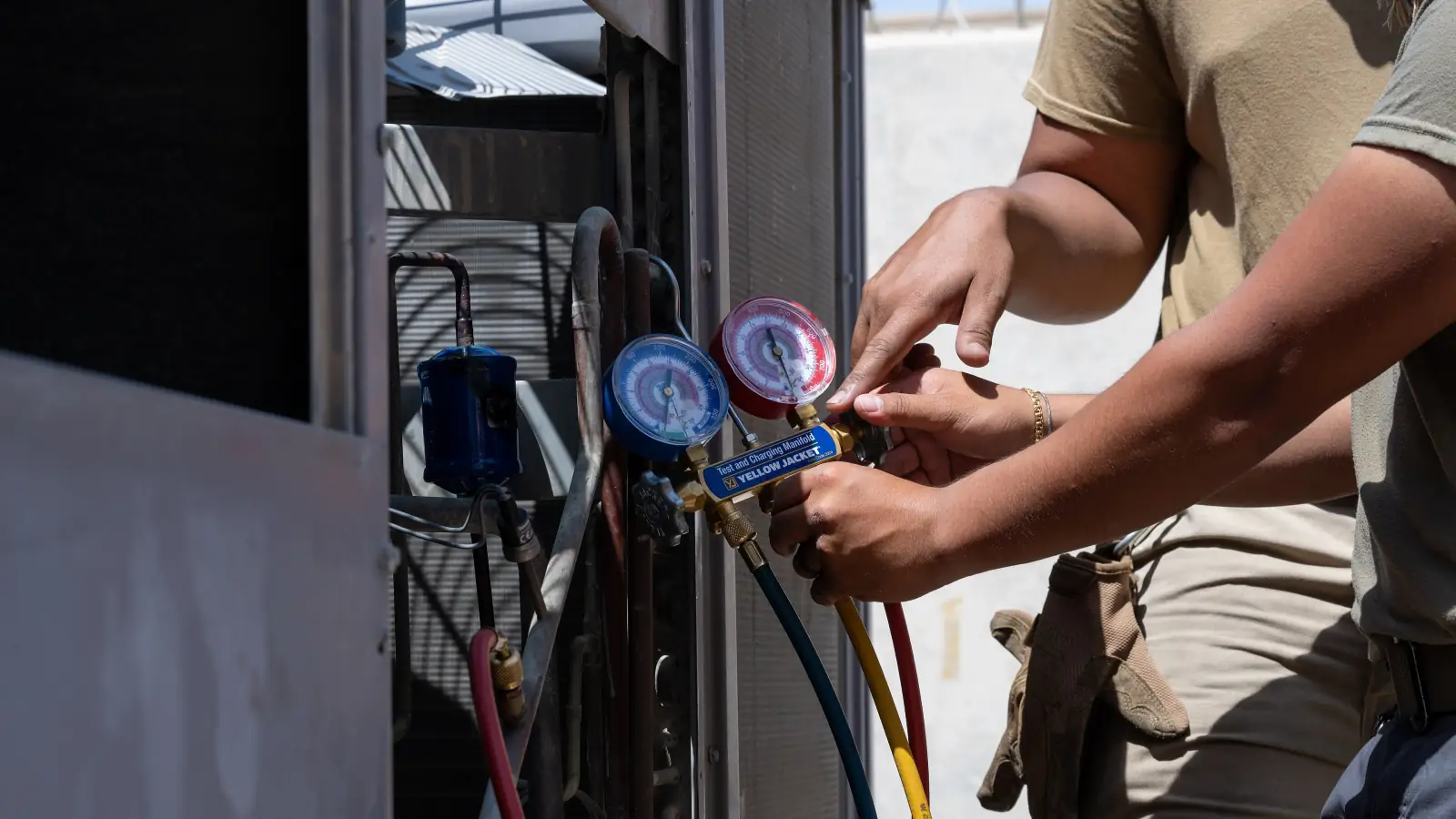
Employers include installers that fit heat pumps in homes, service firms that maintain climate systems in offices, hospitals and data rooms, and refrigeration companies that serve supermarkets, cold stores and transport fleets. A week often mixes planned maintenance rounds with call-outs for breakdowns. You check pressures and leaks, recover and refill refrigerant, replace compressors and fans, and log each job in a service app.
Hours and shifts
The cao week is 38 hours on average over at most a year. Climate service firms often run a standby rota for breakdowns. Before standby starts the employer agrees with the works council what the standby allowance is and how travel and phone costs are paid. Hours you actually work during a standby call are paid at overtime rates, and the Arbeidstijdenwet rest rules still apply.
Where a firm runs shift work, with no gap between the shifts and regular rotation, you get a shift allowance of 14% of your salary. Work on a Saturday outside the roster pays 0.89% of the monthly salary per hour, and work on a Sunday or public holiday pays 1.12% per hour. Work outside the roster on a weekday pays 0.78% of the monthly salary per hour for the first two hours, then 0.89%.
Recognition and licence, step by step.
What to do, in order, to work as a HVAC technician in Netherlands.
- 01
Check your F-gas certificate
Anyone who installs, services, leak-checks or decommissions refrigerant equipment needs a personal certificate, in the Netherlands the BRL 200 persoonscertificaat, earned by passing an exam at an exam institute. The ILT states that certificates from other EU countries are valid in the Netherlands, so an EU F-gas certificate carries over. - 02
Take the BRL 200 exam if your certificate is from outside the EU
A certificate issued outside the EU is not on this list, so you sit the BRL 200 exam at a Dutch exam institute. Ask your employer to book and pay for it. Once you pass, you appear in the Centraal Register Techniek, where employers and the ILT check certified people. - 03
Confirm the firm holds BRL 100
The company you work for needs a BRL 100 bedrijfscertificaat from a certifying body, with work instructions, the right tools and certified staff. If you later work as a sole trader you need both BRL 100 and BRL 200. The Centraal Register Techniek lists certified firms. - 04
Choose pay, pension or time off for overtime
Breakdown work brings overtime. Under the cao you choose each quarter, in writing, whether overtime and its allowances are paid out, used to buy pension, or taken as paid time off of up to ten days a year. Time off left at the end of the year can be paid, put into pension or carried into the first quarter. - 05
Have your diploma evaluated
IDW compares your technical diploma with Dutch levels for EUR 148.83. Upload it in My IDW and give the PDF to the employer, who uses it with your experience to choose your salary group under the cao.
Certificates and language.
The key document is the refrigerant certificate. Employers ask for the EU F-Gas Certificate or the Dutch BRL 200 persoonscertificaat, and their firm must hold BRL 100. Certificates such as EPA Section 608, City & Guilds 2079 or a Red Seal from outside the EU show your training, but you still pass the BRL 200 exam before handling refrigerants here. Your vocational diploma with an IDW evaluation and a site safety passport complete the file.
- EU F-Gas Certificate
- EPA Section 608
- City & Guilds 2079
- Red Seal
Language at work
No legal Dutch level applies to climate and refrigeration work. The BRL 200 exam is taken at a Dutch exam institute, so ask in which languages it is offered before you book. On the job you read Dutch service reports and manufacturer manuals, often in English, and you explain faults to building managers and households. Dutch helps a lot in home heat pump work, where you explain settings and maintenance to the household, and in reading the ILT rules on leak checks and recovery that you must record.
What HVAC technicians earn in Netherlands.
The pay data for this trade has no separate figure, so the cao is the guide. From 1 March 2026 group D starts at EUR 2,914 and group G at EUR 3,391, rising to EUR 4,188 in group H after 7 working years. The legal floor is EUR 14.99 an hour from 1 July 2026, about EUR 2,598 a month. Shift work adds 14% of salary, standby hours worked are paid as overtime, and 8% holiday pay is paid on top. Wages rose 3% on 1 March 2026.
Before you sign.
Points to settle in writing before you sign a HVAC technician contract in Netherlands.
- Check whether your F-gas certificate is from an EU country, which the ILT accepts, or if you need the BRL 200 exam first.
- Ask who books and pays the BRL 200 exam and any resit.
- Look up the firm in the Centraal Register Techniek for its BRL 100 certificate.
- Ask how the standby rota for breakdowns works and what the standby allowance is.
- Ask if the job includes shift work with the 14% shift allowance.
- Get your salary group in writing and whether heat pump and refrigeration work move you up a group.
What HVAC technicians earn in other countries
Typical monthly gross pay for foreign hires, from official statistics and collective agreements.
Open HVAC technician vacancies in Netherlands.
Recent openings from EURES, the European Commission's job portal. You apply directly with the employer.
- Monteur KoeltechniekNetherlandsNov 19
- Servicemonteur KoeltechniekNetherlandsNov 19
- Servicemonteur KoeltechniekNetherlandsNov 18
- Allround Medewerker Koel- en Klimaattechniek (V-196227)NetherlandsNov 17
- junior servicemonteur klimaatinstallatiesNetherlandsNov 11
- Koel Monteur AircoNetherlandsNov 11
- Servicemonteur koeltechniekNetherlandsNov 11
- CV-MonteurNetherlandsNov 11
FAQ
Questions about working in Netherlands.
What do I need before I can work as a HVAC technician in Netherlands?
Check your F-gas certificate; Take the BRL 200 exam if your certificate is from outside the EU; Confirm the firm holds BRL 100; Choose pay, pension or time off for overtime; Have your diploma evaluated.
Which language do I need to work in Netherlands?
No legal Dutch level applies to climate and refrigeration work. The BRL 200 exam is taken at a Dutch exam institute, so ask in which languages it is offered before you book. On the job you read Dutch service reports and manufacturer manuals, often in English, and you explain faults to building managers and households. Dutch helps a lot in home heat pump work, where you explain settings and maintenance to the household, and in reading the ILT rules on leak checks and recovery that you must record.
What is the minimum wage in Netherlands?
The statutory minimum wage in Netherlands is €2,598 a month gross (2026).
HVAC technicians are also hired in:
Other trades in Netherlands:
Sources
Checked September 2026. Rules change - confirm details with your employer or the authority before you apply.
Get found by employers hiring for Netherlands.
One free profile that employers hiring for Netherlands and your other chosen destinations can find.
Create your profileFree. No subscription. No commission on your wages, ever.