HVAC technician jobs in United Arab Emirates for foreigners.
HVAC technicians are no. 4 of 7 on the list of trades United Arab Emirates recruits from abroad.
Updated September 2026
- Job offer signed
- Permit application sent
- Decision expected2-8 weeks
Key facts
- Main permit route
- Work permit to recruit a worker from outside the UAE
- Processing time
- 2-8 weeks
- Certificates employers ask for
- EU F-Gas Certificate · EPA Section 608 · City & Guilds 2079 · Red Seal
- Permits issued by
- Ministry of Human Resources and Emiratisation (MoHRE)
What HVAC technicians do in United Arab Emirates.
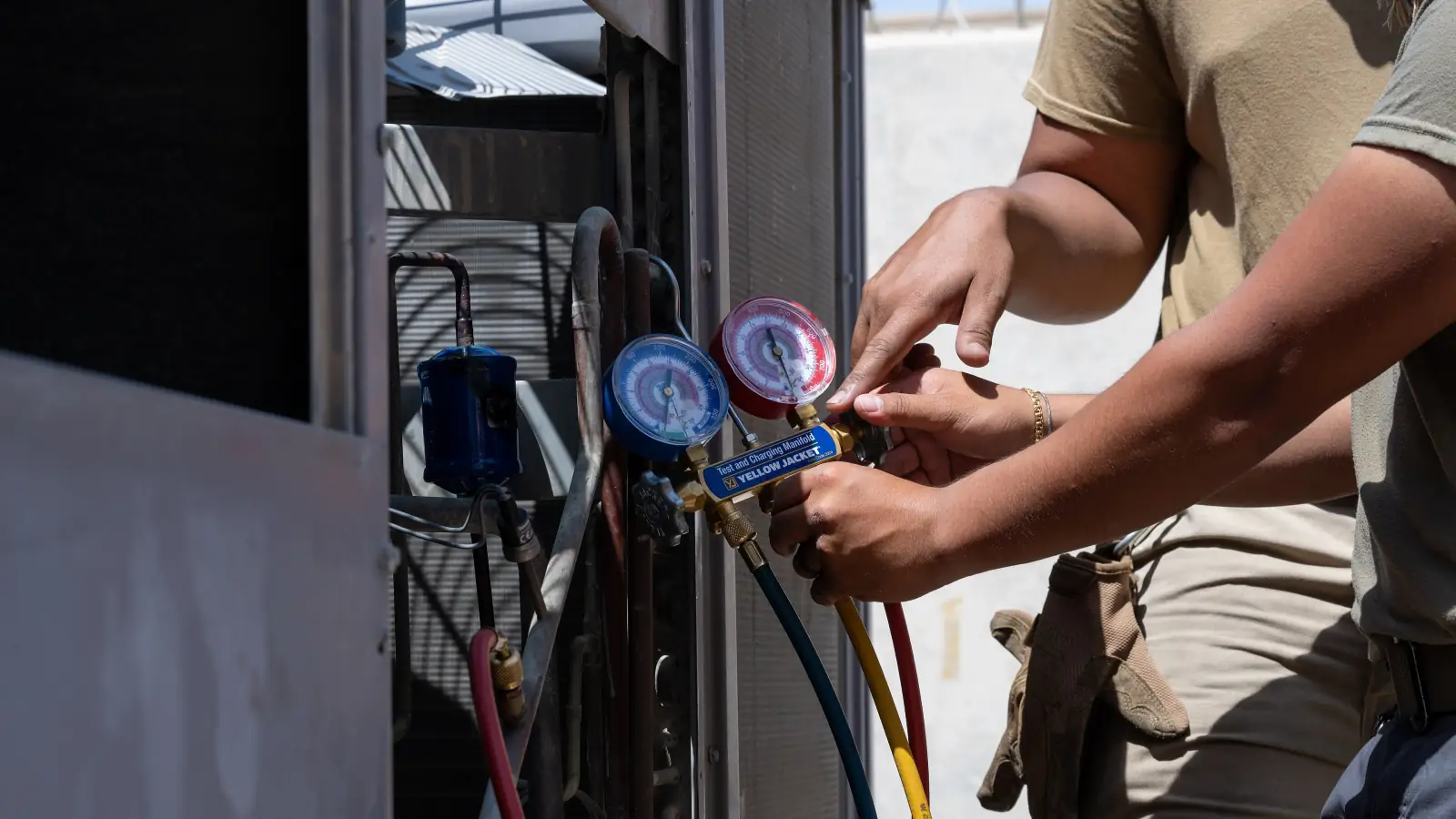
Air conditioning runs almost all year in the UAE, so cooling work is steady. Employers are MEP contractors, facility-management firms, district cooling operators and AC service companies in Dubai, Abu Dhabi and Sharjah. You install split and package units, chillers, air handling units and ductwork, charge refrigerant, clean coils and filters, and answer breakdown calls when a building gets hot.
Cooling towers and evaporative condensers are a big part of the job. Dubai Municipality requires every cooling water system, with its tanks, pumps, pipes and filters, to be emptied, cleaned and disinfected at least every six months, fitted with automatic biocide dosing, inspected monthly by a competent person and tested monthly for total bacteria count. You keep the logs that inspectors ask to see. The same rules cover evaporative condensers, which work like small cooling towers with less water and no fill pack, and are common on mid-size buildings.
Hours and shifts
Contracts follow the 8-hour day and 48-hour week, plus up to 2 hours of overtime a day at 25% above basic rate. Service companies run shifts and on-call rotas, and summer is their peak; breakdown calls between 10 pm and 4 am are paid at 50% extra. In Ramadan the day is 2 hours shorter, though breakdown rotas still run.
The summer midday ban covers rooftop condensers and cooling towers in direct sun: from 15 June to 15 September nobody works there from half past twelve until 3 pm. Plant rooms and indoor units can still be serviced, so supervisors plan roof jobs for early morning and evening and keep your day within 8 hours. MoHRE also asks employers to supply shade, cooling equipment, drinking water and first aid kits for outdoor jobs during those months, and roof crews should have all four close by.
Recognition and licence, step by step.
What to do, in order, to work as a HVAC technician in United Arab Emirates.
- 01
Check whether you are technician level
An AC technician post may sit in MoHRE level 3, technicians, which needs a diploma or higher, or in level 7 or 8 for installers and plant operators, where the permit needs no certificate. Level 3 is treated as skilled work when the diploma is attested and the monthly salary is AED 4,000 or above. - 02
Have your HVAC diploma legalised
For a level 3 post, the diploma travels through two offices in the country that issued it: its foreign ministry, then the UAE embassy or consulate. Carry the legalised original with you, since the employer scans it for the MoHRE permit and some clients ask to see it. - 03
Show refrigerant handling training
Bring EPA Section 608, an EU F-Gas Certificate or City & Guilds 2079 if you hold one. UAE service firms use them as proof that you can recover, charge and leak-test refrigerant safely, and many give a practical test on a split unit. - 04
Learn the cooling-tower water rules
Cooling water is where Legionella grows fastest, between 20 and 45 °C. Dubai Municipality wants the treatment system checked every month by a competent person, a total bacteria count every month, and the whole tower drained and disinfected again whenever Legionella is found, so you will log biocide readings on each visit. - 05
Know the district cooling side
In Abu Dhabi, district cooling plants and networks run under licences from the Department of Energy, which issues integrated, standalone and retail district cooling licences. Jobs with these operators involve large chillers, cooling towers and building transfer stations rather than single units.
Certificates and language.
UAE employers look for refrigerant handling proof: EPA Section 608, an EU F-Gas Certificate or City & Guilds 2079. A Red Seal also helps with international contractors. For building plant you add the client's permit training, and for work inside ducts, heat exchangers and condensers a confined-space briefing, since Dubai Municipality lists these as confined spaces. Training in cooling-tower water treatment and Legionella control is a strong plus, because the cooling system's risk assessment must cover the competence and training of the staff who run it.
- EU F-Gas Certificate
- EPA Section 608
- City & Guilds 2079
- Red Seal
Language at work
Job cards, service reports and equipment manuals for UAE cooling plant are almost always in English. Residents and building managers report faults in English or Arabic, often by phone. Practise reading pressure and temperature charts, writing a short service note and explaining what you fixed. The work permit carries no language exam for this trade.
What HVAC technicians earn in United Arab Emirates.
Cooling and refrigeration pay in the UAE is not in our data yet, and no legal minimum salary applies, so compare offers on basic salary plus whatever the on-call rota adds. Summer breakdowns between 10 pm and 4 am earn 50% extra on basic hourly pay, and a call on your weekly rest day earns 50% extra or a day off in lieu. A level 3 technician post becomes skilled from AED 4,000 a month. Ask whether a phone, fuel or vehicle allowance is paid for service rounds, and remember that gratuity counts basic pay only.
Before you sign.
Points to settle in writing before you sign a HVAC technician contract in United Arab Emirates.
- The offer names your work: split and package units, chillers, district cooling or cooling towers.
- Your employer supplies recovery machines, gauges, leak detectors and a vehicle or transport for service calls.
- You know how the summer on-call rota and night breakdowns are paid.
- Rooftop work is planned outside 12:30 pm to 3 pm from 15 June to 15 September.
- You know who keeps the cooling-tower biocide and bacteria logs and who signs them.
- Your EPA 608, F-Gas or City & Guilds 2079 certificate is listed if it affects your grade or pay.
What HVAC technicians earn in other countries
Typical monthly gross pay for foreign hires, from official statistics and collective agreements.
FAQ
Questions about working in United Arab Emirates.
What do I need before I can work as a HVAC technician in United Arab Emirates?
Check whether you are technician level; Have your HVAC diploma legalised; Show refrigerant handling training; Learn the cooling-tower water rules; Know the district cooling side.
Which language do I need to work in United Arab Emirates?
Job cards, service reports and equipment manuals for UAE cooling plant are almost always in English. Residents and building managers report faults in English or Arabic, often by phone. Practise reading pressure and temperature charts, writing a short service note and explaining what you fixed. The work permit carries no language exam for this trade.
What is the minimum wage in United Arab Emirates?
United Arab Emirates has no single statutory minimum wage. Pay is set by collective agreements for each sector.
HVAC technicians are also hired in:
Other trades in United Arab Emirates:
Sources
Checked September 2026. Rules change - confirm details with your employer or the authority before you apply.
- Dubai Municipality - Technical Guidelines (44) for Controlling Legionella in Water Systems
- Dubai Municipality - Technical Guidelines (39) for Confined Spaces Entry
- u.ae - Skill levels of jobs in the UAE
- Abu Dhabi Department of Energy - Home (district cooling licences)
- Ministry of Human Resources and Emiratisation (MoHRE)
Get found by employers hiring for United Arab Emirates.
One free profile that employers hiring for United Arab Emirates and your other chosen destinations can find.
Create your profileFree. No subscription. No commission on your wages, ever.