HVAC technician jobs in Canada for foreigners.
HVAC technicians are no. 5 of 8 on the list of trades Canada recruits from abroad.
Updated September 2026
- Job offer signed
- Permit application sent
- Decision expected12-40 weeks
Key facts
- Main permit route
- Temporary Foreign Worker Program (LMIA)
- Processing time
- 12-40 weeks
- Certificates employers ask for
- EU F-Gas Certificate · EPA Section 608 · City & Guilds 2079 · Red Seal
- Permits issued by
- Immigration, Refugees and Citizenship Canada (IRCC)
What HVAC technicians do in Canada.
Heating, ventilation and air conditioning work in Canada splits between residential service companies, commercial refrigeration firms and mechanical contractors on new buildings. Winters keep furnace and boiler crews busy, and summers bring air conditioning and heat pump calls. Grocery chains, cold storage plants and arenas employ refrigeration staff to keep their systems running around the clock.
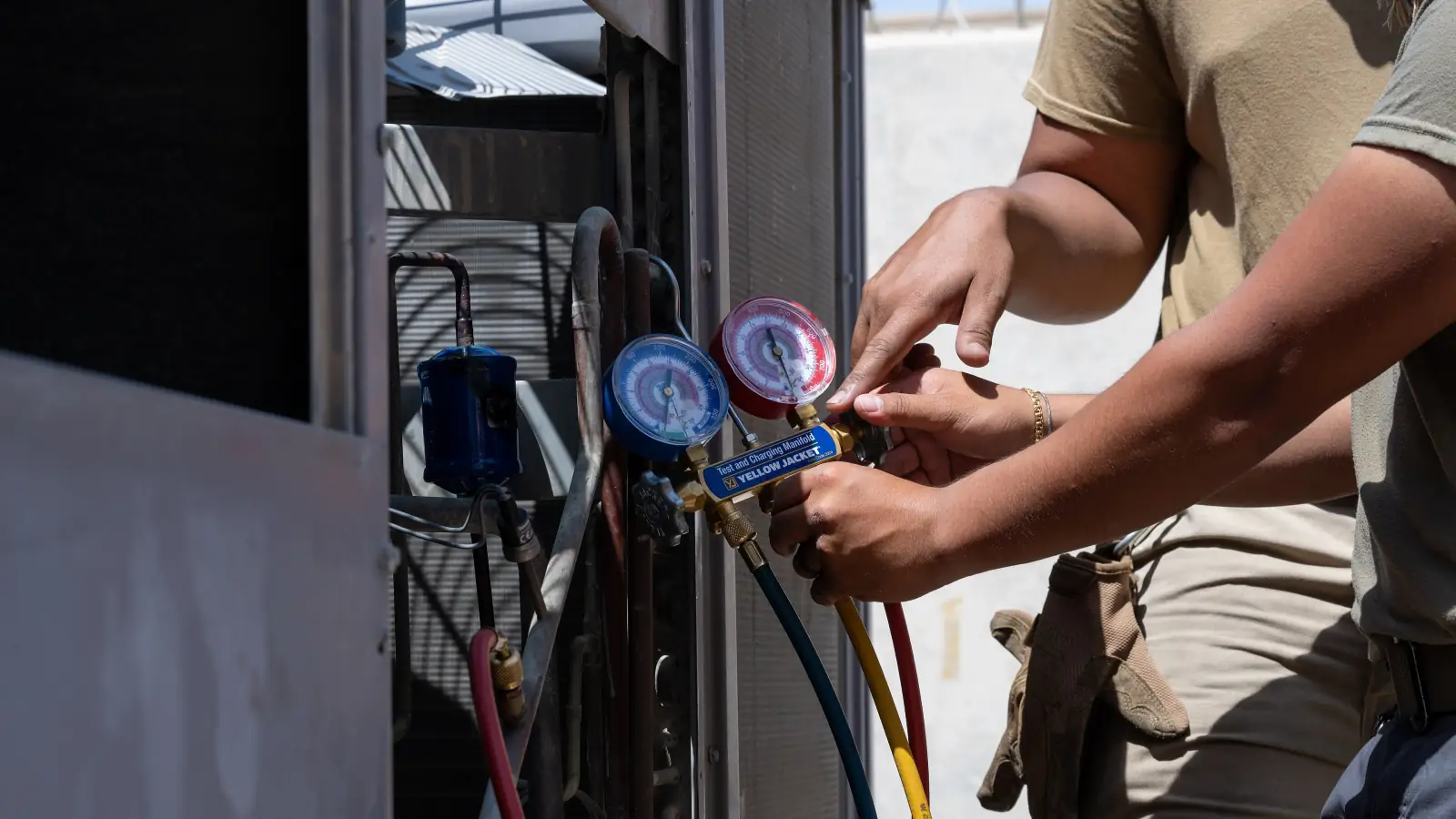
Your week can include installing and commissioning rooftop units, recovering and charging refrigerant, brazing copper lines, wiring controls and answering breakdown calls. In Ontario, the refrigeration and air conditioning trade (313A) is compulsory, and so is the BC refrigeration and air conditioning trade under Skilled Trades Certification. Gas-fired furnaces and boilers in Ontario also fall under the Technical Standards and Safety Authority (TSSA), which certifies gas technicians and lists registered fuels contractors that homeowners can look up. Commercial jobs on larger equipment above 400,000 BTUH lead toward the senior G.1 level.
Hours and shifts
Service work in Ontario often runs on-call rotations. The province caps a regular schedule at 8 hours a day and 48 hours a week unless you agree in writing to more, and you keep at least 11 hours off in a row each day; this does not apply when you are called in from on-call outside normal hours.
Hours past 44 in a week are paid at 1.5 times. In British Columbia, daily overtime applies: 1.5 times after 8 hours, double after 12. Ask how on-call standby time is paid. Between two shifts, Ontario gives at least 8 hours off unless the two shifts total 13 hours or less, and each week you get 24 hours off in a row or 48 hours over two weeks.
Recognition and licence, step by step.
What to do, in order, to work as a HVAC technician in Canada.
- 01
Check which trade code fits your work
Skilled Trades Ontario has two trades: Refrigeration and Air Conditioning Systems (313A), a compulsory Red Seal trade of 9,000 hours (8,280 on the job and 720 in school), and Residential Air Conditioning Systems (313D). Pick the one that matches your experience before you apply. - 02
Send the Trade Equivalency Assessment
Submit the TEA form with verifiable proof of experience and CAD 235 plus HST. Once approved, a Provisional Certificate of Qualification or Registered Training Agreement lets you work while you prepare for the exam. - 03
Pass the 313A exam and renew yearly
The 313A exam is the Red Seal exam, with a 70% pass mark. Because the trade is compulsory, you renew the Certificate of Qualification each year and appear on the Public Register. - 04
Add TSSA gas certification for furnaces
TSSA certifies gas technicians at G.3, G.2 and G.1 under the Technical Safety and Standards Act, 2000, after training with an accredited provider and an exam booked through the Client Portal. For a G.1 challenge, TSSA asks for proof of 3,500 hours at the G.2 level plus 500 supervised hours on equipment over 400,000 BTUH. Certificates from another province can be matched; otherwise an Out-of-Province Certificate Assessment gets an answer within 20 business days. - 05
Register in BC before you start
In BC you must be a registered apprentice, trade qualifier or certified journeyperson to do refrigeration and air conditioning work. Experienced arrivals apply through the SkilledTradesBC Portal for CAD 120.
Certificates and language.
Employers ask for the provincial refrigeration and air conditioning certificate with the Red Seal (313A in Ontario), and, for gas heating, a TSSA G.2 or G.3 gas technician certificate in Ontario. G.3 holders keep a practical skills sign-off form. TSSA certificates are renewed before they expire, and one left unrenewed for more than 12 months after expiry has to be reinstated. Exam fees sit in TSSA's Natural Gas and Hydrogen, Propane, and Liquid Fuels fee schedules. Credentials from abroad, such as an EU F-Gas Certificate, EPA Section 608 or City & Guilds 2079, count as evidence of refrigerant handling in your assessment file.
- EU F-Gas Certificate
- EPA Section 608
- City & Guilds 2079
- Red Seal
Language at work
HVAC work means reading wiring diagrams, equipment manuals and gas codes, and explaining repairs to building managers and homeowners. The Red Seal exam is in English or French. SkilledTradesBC does not ask for IELTS or CELPIP to register an apprentice or write an exam, but trade schools running technical training may ask for results before you enrol.
What HVAC technicians earn in Canada.
Job Bank lists NOC 72402 (2023-2024) at CAD 22.00 to CAD 56.00 an hour nationally, with a median of CAD 37.50, close to CAD 6,500 a month at 40 hours. Ontario's median is CAD 37.00 and its top band CAD 58.00, more than double Ontario's CAD 17.95 minimum wage from 1 October 2026. British Columbia and Alberta both show a CAD 40.00 median, and BC's top band reaches CAD 62.00. After-hours callouts past the weekly overtime line pay 1.5 times.
Before you sign.
Points to settle in writing before you sign a HVAC technician contract in Canada.
- Ask whether the job is 313A refrigeration work or residential air conditioning (313D), since the code sets your exam.
- Ask whether you need a TSSA gas certificate for the furnaces in this job, and who pays the training and exam.
- Confirm how on-call standby and callouts are paid, in money per shift or per call.
- Check whether a service van, gauges and recovery machine are provided, and who pays fuel.
- Ask whether you start on a Provisional Certificate or Registered Training Agreement in the compulsory trade.
- In BC, ask the employer to register you with SkilledTradesBC before your first day on a refrigeration system.
What HVAC technicians earn in other countries
Typical monthly gross pay for foreign hires, from official statistics and collective agreements.
FAQ
Questions about working in Canada.
What do I need before I can work as a HVAC technician in Canada?
Check which trade code fits your work; Send the Trade Equivalency Assessment; Pass the 313A exam and renew yearly; Add TSSA gas certification for furnaces; Register in BC before you start.
Which language do I need to work in Canada?
HVAC work means reading wiring diagrams, equipment manuals and gas codes, and explaining repairs to building managers and homeowners. The Red Seal exam is in English or French. SkilledTradesBC does not ask for IELTS or CELPIP to register an apprentice or write an exam, but trade schools running technical training may ask for results before you enrol.
What is the minimum wage in Canada?
Canada has no single statutory minimum wage. Pay is set by collective agreements for each sector.
HVAC technicians are also hired in:
Other trades in Canada:
Sources
Checked September 2026. Rules change - confirm details with your employer or the authority before you apply.
- Skilled Trades Ontario - Refrigeration and Air Conditioning Systems (313A)
- TSSA - Fuels Industry Professional
- SkilledTradesBC - Skilled Trades Certification
- Ontario.ca - Your guide to the Employment Standards Act: Hours of work
- Job Bank - Wages for Heating, refrigeration and air conditioning (NOC 72402)
- Immigration, Refugees and Citizenship Canada (IRCC)
- Canada.ca - Program requirements for low-wage positions
Get found by employers hiring for Canada.
One free profile that employers hiring for Canada and your other chosen destinations can find.
Create your profileFree. No subscription. No commission on your wages, ever.