Construction worker jobs in Croatia for foreigners.
Construction workers are no. 1 of 10 on the list of trades Croatia recruits from abroad.
Updated September 2026
- Job offer signed
- Permit application sent
- Decision expected6-16 weeks
Key facts
- Main permit route
- Dozvola za boravak i rad
- Processing time
- 6-16 weeks
- Certificates employers ask for
- CSCS card · SafePass · OSHA 10 · VCA
- Permits issued by
- Ministarstvo unutarnjih poslova (Ministry of the Interior)
What construction workers do in Croatia.
Croatian building sites hire general labour under several titles on the HZZ list that all counties can fill without a labour market test: radnik visokogradnje (building construction worker), radnik niskogradnje (civil engineering worker), armirač i betonirac (steel fixer and concrete worker), monter građevinskih elemenata and rukovatelj građevinskim strojevima (plant operator). General contractors, road and civil engineering firms and subcontractors take on these roles. Fasader, izolater and krovopokrivač are related titles on the same list, for facades, insulation and roofs, and crane drivers appear as rukovatelj kranom.
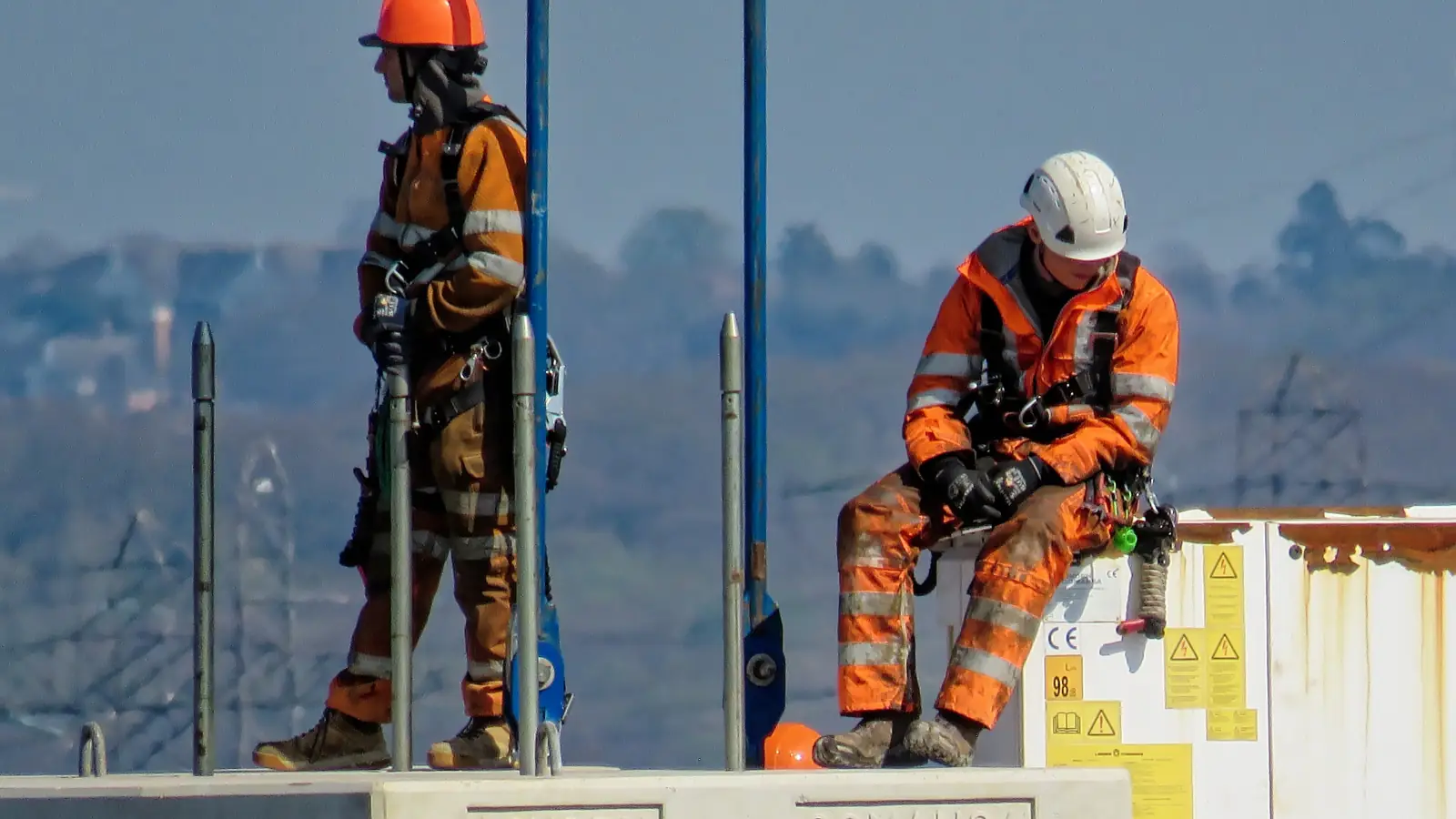
Your tasks depend on the title. In building construction you carry materials, prepare and pour concrete, tie reinforcement, and clean and secure the site. In civil engineering you work on roads, trenches, pipelines and foundations, often far from towns. Machine operators run excavators and loaders. Work starts early, follows the pour and delivery schedule and moves from site to site, so field allowances and accommodation are a normal part of the job. Where road crews work at night to keep traffic moving, the 30% night supplement applies.
Hours and shifts
Every construction employer in Croatia applies the extended Kolektivni ugovor za graditeljstvo. It sets a 40-hour week, days up to 10 hours and a cap of 56 hours, or 60 in exceptional cases. You can say no to weeks over 48 hours without any adverse consequences. Overtime is limited to 250 hours a year.
Supplements: overtime and night work are 30% each, Sundays and holidays 50%, and a second shift 10%. Civil works pay more for tough conditions: 10% in trenches deeper than 3 metres, 30 to 40% in tunnels, 25% for blasting and 50% for caisson or diving work, as listed by the Tax Administration.
Recognition and licence, step by step.
What to do, in order, to work as a construction worker in Croatia.
- 01
Pick the right job title
Agree with the employer which HZZ title fits your work: radnik visokogradnje, radnik niskogradnje, armirač i betonirac or rukovatelj građevinskim strojevima. Each is exempt from the labour market test in all counties. The title decides your duties and your pay group. - 02
Show your experience
HZZ checks that your experience matches the employer's request. Bring references or a work book listing sites and dates. Translate papers unless they are in English or a related language in Latin script. - 03
Machine operators bring licences
If you will drive excavators, loaders or cranes, bring every operator certificate you hold and its translation. Ask the employer which Croatian proof the site needs for that machine and who arranges it. - 04
Occupational medical check
Work at height, in trenches or with machines often counts as work with special conditions. The employer then sends you to an occupational medicine specialist before the contract and pays for the exam. - 05
Safety training on day one
Before you work alone the employer trains you for safe work, in paid hours. Personal protective equipment is supplied by the employer, and the law lets you leave the workplace if there is a direct danger to life. - 06
Know your rights when there is danger
Under the Zakon o zaštiti na radu you may stop work and leave the place when there is a direct threat to life or health, until the employer fixes it. You keep your pay, and the labour inspector establishes the facts within 48 hours of being told.
Certificates and language.
Croatia has no national site card, so the British CSCS card, the Irish SafePass, the American OSHA 10 or the Dutch VCA certificate count only as proof that you know site safety. Employers still give you their own safe-work training. Plant operators should bring machine licences, and steel fixers proof of reinforcement work. Keep your medical certificate for special conditions and the training record together; site inspectors and safety officers ask for them. Ask whether the site needs proof of training for work in trenches or confined spaces. Bring a list of the machines and power tools you have used, with years.
- CSCS card
- SafePass
- OSHA 10
- VCA
Language at work
Most instructions come from a foreman by voice and hand signal, so short Croatian phrases for materials, directions and dangers go a long way. Operators need to understand banksman signals and radio calls. Ask that safety briefings and written instructions are explained in a language you understand. Short safety talks at the start of a shift are a good moment to ask questions.
What construction workers earn in Croatia.
Auxiliary and semi-skilled site work (PKV) is in job group II, at EUR 6.64 an hour or EUR 1,155 a month. A starting skilled worker such as an armirač is in group III at EUR 6.90 (EUR 1,201.20), and fully skilled work in IV.b pays EUR 8.00 (EUR 1,391.50). Croatia's 2026 minimum wage is EUR 1,050, so even group II sits above it. Allowances: EUR 25 per night away, EUR 20 for daily commuting sites, EUR 80 a month for food if no meals are provided. Monthly amounts in the agreement are the hourly rate times 174 hours.
Before you sign.
Points to settle in writing before you sign a construction worker contract in Croatia.
- Which HZZ title is on the permit and which job group, II, III or IV, it puts you in.
- Whether tunnel, trench or blasting work is planned, and the matching supplement in writing.
- That helmets, boots, high-visibility clothing and gloves are provided by the employer.
- Where the workers' housing is, how many share a room and whether it is free.
- Whether the EUR 25 field allowance or EUR 80 food payment is shown on the monthly obračun.
- For plant work, which machine you will operate and who arranges the local proof of competence.
What construction workers earn in other countries
Typical monthly gross pay for foreign hires, from official statistics and collective agreements.
Open construction worker vacancies in Croatia.
Recent openings from EURES, the European Commission's job portal. You apply directly with the employer.
- POMOĆNI RADNIK/ICA U OPUZENUNeretvansko-primorsko-vrgorski vodovod d.o.o. · CroatiaNov 20
- POMOĆNI RADNIK / RADNICA U NISKOGRADNJIKAVELJ d.o.o. · CroatiaNov 20
- KV TESAR/ICAOSNOVA d.o.o. · CroatiaNov 19
- KV ZIDAR/ICAOSNOVA d.o.o. · CroatiaNov 19
- ARMIRAČ / ARMIRAČICANOVA-GRADNJA GG d.o.o. · CroatiaNov 19
- POMOĆNI GRAĐEVINSKI RADNIK / POMOĆNA GRAĐEVINSKA RADNICANOVA-GRADNJA GG d.o.o. · CroatiaNov 19
- POMOĆNI/A RADNIK/ICA U TESARSKIM I KROVOPOKRIVAČKIM RADOVIMAKOKOR d.o.o. · CroatiaNov 19
- GRAĐEVINSKI RADNIK/ICAIZNI GRADNJA j.d.o.o. · CroatiaNov 19
FAQ
Questions about working in Croatia.
What do I need before I can work as a construction worker in Croatia?
Pick the right job title; Show your experience; Machine operators bring licences; Occupational medical check; Safety training on day one; Know your rights when there is danger.
Which language do I need to work in Croatia?
Most instructions come from a foreman by voice and hand signal, so short Croatian phrases for materials, directions and dangers go a long way. Operators need to understand banksman signals and radio calls. Ask that safety briefings and written instructions are explained in a language you understand. Short safety talks at the start of a shift are a good moment to ask questions.
What is the minimum wage in Croatia?
The statutory minimum wage in Croatia is €1,050 a month gross (2026).
Construction workers are also hired in:
Sources
Checked September 2026. Rules change - confirm details with your employer or the authority before you apply.
- Narodne novine - Kolektivni ugovor za graditeljstvo, pročišćeni tekst (NN 10/2026)
- Porezna uprava - Nepravilnosti pri isplatama minimalnih plaća radnicima zaposlenima u graditeljstvu
- HZZ - Lista zanimanja za koja poslodavac nije dužan zatražiti test tržišta rada
- Narodne novine - Zakon o zaštiti na radu (NN 71/2014)
- Ministarstvo unutarnjih poslova (Ministry of the Interior)
- Eurostat: Monthly minimum wages (earn_mw_cur)
Get found by employers hiring for Croatia.
One free profile that employers hiring for Croatia and your other chosen destinations can find.
Create your profileFree. No subscription. No commission on your wages, ever.