Construction worker jobs in Portugal for foreigners.
Construction workers are no. 1 of 8 on the list of trades Portugal recruits from abroad.
Updated September 2026
- Job offer signed
- Permit application sent
- Decision expected8-16 weeks
Key facts
- Main permit route
- Visto de residência para exercício de atividade profissional subordinada
- Processing time
- 8-16 weeks
- Certificates employers ask for
- CSCS card · SafePass · OSHA 10 · VCA
- Permits issued by
- AIMA - Agência para a Integração, Migrações e Asilo
What construction workers do in Portugal.
General site work is one of the jobs Portugal recruits for most. IMPIC, which licenses every builder, groups much of the heavy site work in its fifth category: demolitions (Demolições), earthworks (Movimentação de terras), scaffolding and temporary structures (Andaimes e outras estruturas provisórias) and repair of structural concrete. Firms licensed for these subcategories hire you as a site hand.
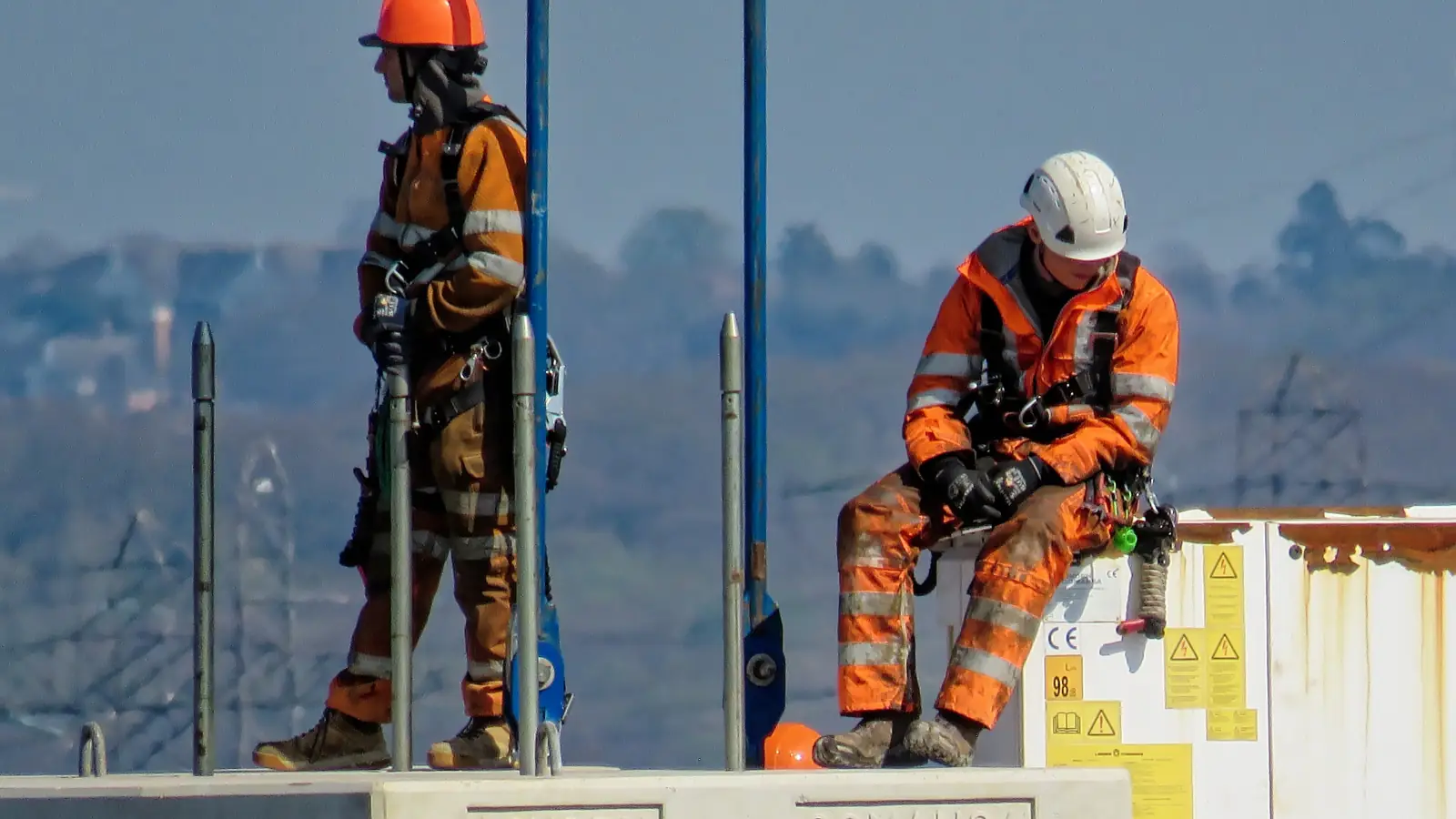
You dig and backfill trenches, move materials, help pour and finish concrete, strip out old buildings, put up and take down temporary structures and keep the site clean and safe. Big jobs run in the Lisbon and Porto metro areas, on roads and on public works, and smaller ones across the country. A typical week is five days on one site, with the van leaving the yard early. Demolition and strip-out jobs come with dust, noise and heavy lifting, so firms value people who follow safety rules closely, keep the site tidy and look after their own protective gear every day.
Hours and shifts
Portuguese law caps the normal day at 8 hours and the week at 40. Your contract has to state the hours and any averaging over a longer period, which builders sometimes use to work longer days in dry months. The contract must also say whether you work at one site or at several, which is common for groundwork crews.
Many site hands start on a temporary agency contract. That follows the fixed-term rules: a contract with an end date lasts at most 2 years with up to 2 renewals, and a contract tied to the end of a project (termo incerto) lasts at most 4 years and ends with a compensation payment. Holiday is at least 22 working days a year.
Recognition and licence, step by step.
What to do, in order, to work as a construction worker in Portugal.
- 01
Know who holds the licence
Site labour itself needs no licence in Portugal. The builder holds the IMPIC permit, and for demolition and earthworks on public works it must also have a qualified technician linked to it by contract. Ask the name of the firm that holds the licence for your site. - 02
Look the firm up on IMPIC
The IMPIC public search for alvará holders works by licence number, NIF, company name, postcode, district or council. It also shows the highest class the firm holds, from 1 to 9, which tells you how large a project it may run. - 03
Check the insurance declaration
To keep its licence, a builder sends IMPIC a declaration from its insurer covering employees for construction work, on the collective model under Portaria 256/2011. IMPIC checks every year that the firm still meets the rules, and it can amend or cancel a licence. - 04
Bring any machine or safety papers
If you operated a dumper, mini excavator or plate compactor at home, bring proof of training and any licence. Machine skills often move you up from the helper grade. - 05
Exchange your driving licence for site vans and trucks
A licence issued outside the EU/EEA is swapped for a Portuguese one at IMT through A Minha Carta de Condução, for EUR 30 or about EUR 27 online. Heavy categories C and E also need a psychological assessment certificate. After 2 years of residence the swap needs a practical driving exam.
Certificates and language.
Portuguese sites do not use the CSCS card, SafePass, OSHA 10 or VCA, but holding one shows an employer you know site safety basics. What matters more here is a valid driving licence and any training for small plant such as dumpers or excavators. The firm must hold an IMPIC licence for the subcategory of work, such as demolition or earthworks, and accident insurance covering construction activity. If you hold a category C licence, the IMT exchange also asks for a psychological assessment certificate.
- CSCS card
- SafePass
- OSHA 10
- VCA
Language at work
On Portuguese sites the foreman speaks Portuguese, and safety briefings, signs and the site plan are in Portuguese too. You need enough to follow orders, warnings and the names of tools. No official language level is set for general site work. Start with the words for danger, stop, lift and lower, and the names of the machines on site. Hand signals for cranes and dumpers are learned on the job, together with the Portuguese words that go with them.
What construction workers earn in Portugal.
The legal minimum in 2026 is EUR 920 a month, paid 14 times a year, which many entry-level site jobs start close to. Your contract names a collective agreement and a category, and moving from a helper grade to a qualified one raises the rate. If the firm provides a room or meals, their value counts as pay, but it cannot be more than the cash you receive. Holiday months bring the subsídio de férias on top. Ask too how long your probation period is, because its length depends on the type of contract you sign.
Before you sign.
Points to settle in writing before you sign a construction worker contract in Portugal.
- Ask the name of the firm holding the IMPIC licence for your site, and search it in the public register.
- Ask whether you are hired by the builder or by a temporary agency, and on which type of contract.
- Check who provides safety boots, helmet, gloves, dust masks, ear protection and high-visibility clothing, and how often they are replaced.
- Ask how you travel from your lodging to sites outside the city, and whether travel time is paid.
- Get in writing the value of any room or meals the firm deducts from your pay.
- Ask whether you will operate a dumper, excavator or compactor, and who pays for the training, the licence exchange and any medical certificate.
What construction workers earn in other countries
Typical monthly gross pay for foreign hires, from official statistics and collective agreements.
Open construction worker vacancies in Portugal.
Recent openings from EURES, the European Commission's job portal. You apply directly with the employer.
- TRABALHADOR NÃO QUALIFICADO DA CONSTRUÇÃO DE EDIFÍCIOSPortugalNov 18
- TRABALHADOR NÃO QUALIFICADO DA CONSTRUÇÃO DE EDIFÍCIOSPortugalNov 14
- TRABALHADOR NÃO QUALIFICADO DE ENGENHARIA CIVILPortugalOct 23
- TRABALHADOR NÃO QUALIFICADO DA CONSTRUÇÃO DE EDIFÍCIOSPortugalSep 19
- TRABALHADOR NÃO QUALIFICADO DA CONSTRUÇÃO DE EDIFÍCIOSPortugalAug 12
- TRABALHADOR NÃO QUALIFICADO DA CONSTRUÇÃO DE EDIFÍCIOSPortugalJul 9
FAQ
Questions about working in Portugal.
What do I need before I can work as a construction worker in Portugal?
Know who holds the licence; Look the firm up on IMPIC; Check the insurance declaration; Bring any machine or safety papers; Exchange your driving licence for site vans and trucks.
Which language do I need to work in Portugal?
On Portuguese sites the foreman speaks Portuguese, and safety briefings, signs and the site plan are in Portuguese too. You need enough to follow orders, warnings and the names of tools. No official language level is set for general site work. Start with the words for danger, stop, lift and lower, and the names of the machines on site. Hand signals for cranes and dumpers are learned on the job, together with the Portuguese words that go with them.
What is the minimum wage in Portugal?
The statutory minimum wage in Portugal is €920 a month gross (2026).
Construction workers are also hired in:
Other trades in Portugal:
Sources
Checked September 2026. Rules change - confirm details with your employer or the authority before you apply.
Get found by employers hiring for Portugal.
One free profile that employers hiring for Portugal and your other chosen destinations can find.
Create your profileFree. No subscription. No commission on your wages, ever.