Farm worker jobs in Ireland for foreigners.
Farm workers are no. 4 of 6 on the list of trades Ireland recruits from abroad.
Updated September 2026
- Job offer signed
- Permit application sent
- Decision expected10-20 weeks
Key facts
- Main permit route
- General Employment Permit
- Processing time
- 10-20 weeks
- Certificates employers ask for
- Tractor driving licence · Pesticide application certificate · National forklift licence
- Permits issued by
- Department of Enterprise, Tourism and Employment - Employment Permits
What farm workers do in Ireland.
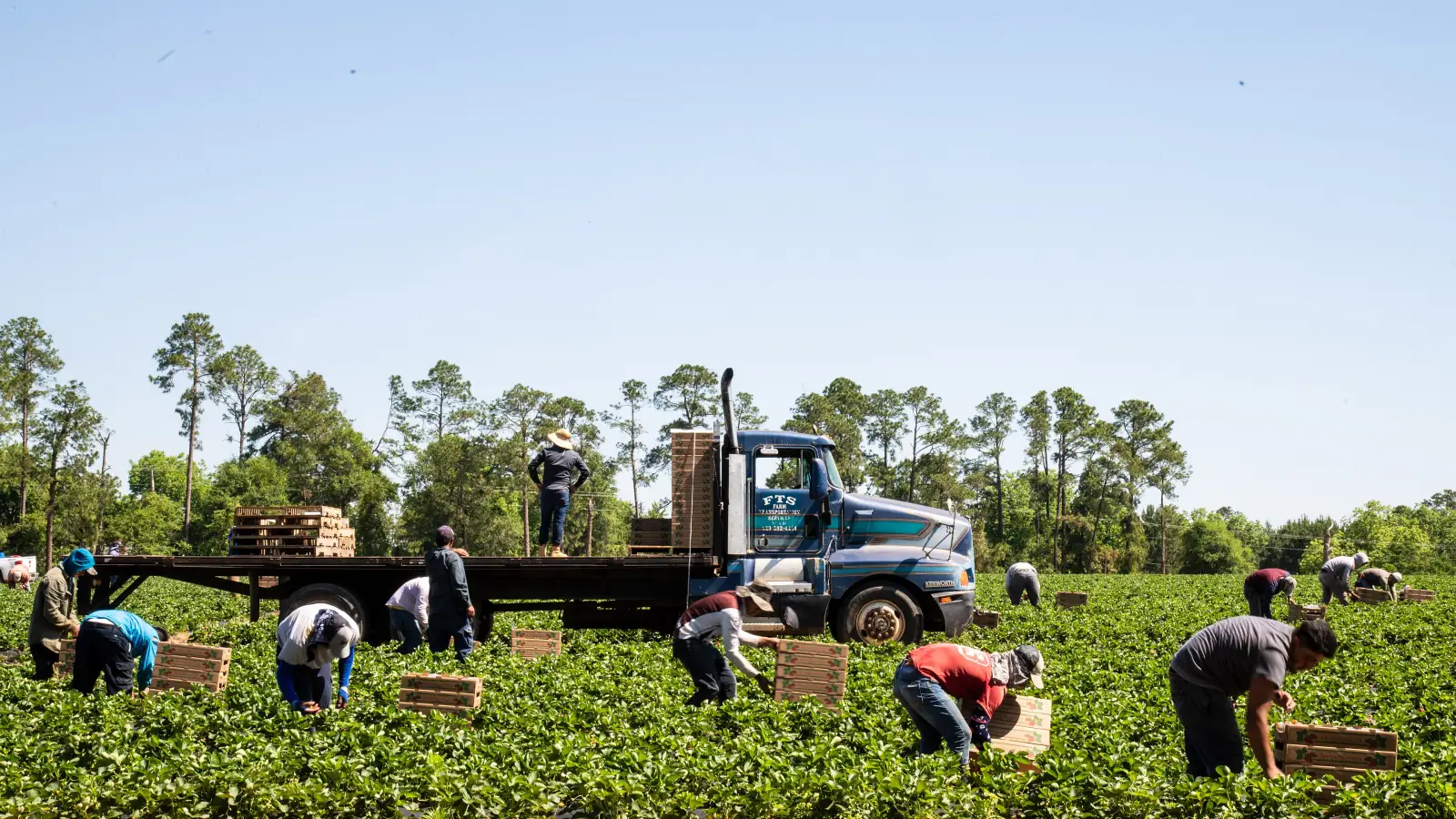
Irish farms recruit help on dairy farms, beef and sheep holdings, tillage farms and horticulture units growing mushrooms, soft fruit and vegetables. Dairy farm assistants are the main group, because grass-based herds need milking twice a day through the spring calving season.
A dairy week starts before dawn with the morning milking, then feeding calves, scraping yards, moving cows between paddocks and the evening milking. In spring you help at calving, which the Health and Safety Authority (HSA) warns is when cows and heifers can turn aggressive. Summer brings silage, fencing and reseeding; winter brings housing cattle and handling slurry. In horticulture you pick, grade and pack produce in tunnels or packhouses. On every farm you drive a tractor, so your licence category matters. Tillage farms need tractor work with sprayers, drills and trailers at sowing and harvest, and mushroom and soft fruit growers keep crews picking through most of the year.
Hours and shifts
The Organisation of Working Time Act covers farm employees: an average of 48 hours a week, 11 hours of rest in each 24 hours, and a weekly 24-hour rest. Farms often use a split day around two milkings, with a long midday break. During calving and silage, weeks above 48 hours are allowed as long as the average over the reference period stays within the limit, so ask how quieter months balance the busy ones.
You get 4 working weeks of paid leave a year and the 10 public holidays, or a paid day instead. Sunday milking is normal, and if your rate does not include Sunday work, you are owed a premium or time off in lieu. Relief milkers and part-time staff build up leave at 8% of the hours they work.
Recognition and licence, step by step.
What to do, in order, to work as a farm worker in Ireland.
- 01
Show your farming background
Farm work is not a regulated profession in Ireland. If you hold an agricultural college award, download a NARIC Ireland comparability statement from QQI. Bring references that state herd size, milking parlour type and the machinery you have driven. - 02
Get the category W tractor licence
In Ireland, tractors and work vehicles need a category W licence, available from age 16. A W licence from the EU or EEA is valid as it is. A licence issued outside the EU/EEA is exchanged at the NDLS only if it comes from a recognised state, for EUR 65; otherwise you sit the theory test and the W driving test. - 03
Register as a professional pesticide user
Since 26 November 2015 only a professional user registered with the Department of Agriculture, Food and the Marine (DAFM) may apply plant protection products authorised for professional use. You first finish a pesticide user course with a listed training provider, then register with DAFM. Since 26 November 2016 the sprayer itself must also have passed a Pesticide Application Equipment Test by a DAFM-registered inspector. - 04
Do the farm safety induction
Your employer goes through the farm's risk assessment with you under the HSA farm safety rules: bulls fitted with a ring and chain, using a tractor as a mobile refuge when you enter a bull's field, staying clear of cows and heifers after calving, guarded PTO shafts on tankers and agitators, and keeping out of slurry tanks. Slurry gives off dangerous gas at high levels when it is agitated, and drowning in slurry is the most common slurry death on Irish farms.
Certificates and language.
Irish farmers ask for a category W licence for tractors, DAFM registration as a professional pesticide user for spraying jobs, and proof of milking experience with the parlour type used. Horticulture growers value a forklift card for the packhouse. A manual handling certificate and a first aid course are pluses. Experience with grass-based dairy, calf rearing and artificial insemination records is often worth more than a formal award. For spraying work, bring any pesticide training certificate from home so the course provider can see what you already know.
- Tractor driving licence
- Pesticide application certificate
- National forklift licence
Language at work
Work instructions, the farm risk assessment and HSA safety signs are in English, and farmers often explain jobs quickly in the yard. The W theory test is in English. No CEFR level is set for this work; you need enough English to follow safety warnings around machines, livestock and slurry, and to report a sick animal.
What farm workers earn in Ireland.
No Irish pay figure for this job is listed in our data, so the floor is the 2026 national minimum wage of EUR 14.15 an hour, about EUR 2,391 a month. Many farms offer a room on the farm: the most an employer can count towards the minimum wage is EUR 33.42 a week for lodging and EUR 1.27 an hour for board. Horticulture permits carry a yearly floor of EUR 32,691. Ask about pay for calving-season overtime and Sunday milking.
Before you sign.
Points to settle in writing before you sign a farm worker contract in Ireland.
- Ask whether the job is dairy, beef, tillage or horticulture, and the herd size or crop, plus the months of the busiest season.
- Check that your tractor licence covers category W in Ireland, or who pays for the W test.
- Ask who pays the pesticide user course and DAFM registration if spraying is part of the job.
- Get the milking times and the split-day pattern in writing, with how calving-season overtime is paid.
- If you live on the farm, check the lodging charge stays at or below EUR 33.42 a week.
- Ask to see the farm risk assessment and who trains you on bulls, calving pens, slurry agitation and PTO shafts.
What farm workers earn in other countries
Typical monthly gross pay for foreign hires, from official statistics and collective agreements.
Open farm worker vacancies in Ireland.
Recent openings from EURES, the European Commission's job portal. You apply directly with the employer.
FAQ
Questions about working in Ireland.
What do I need before I can work as a farm worker in Ireland?
Show your farming background; Get the category W tractor licence; Register as a professional pesticide user; Do the farm safety induction.
Which language do I need to work in Ireland?
Work instructions, the farm risk assessment and HSA safety signs are in English, and farmers often explain jobs quickly in the yard. The W theory test is in English. No CEFR level is set for this work; you need enough English to follow safety warnings around machines, livestock and slurry, and to report a sick animal.
What is the minimum wage in Ireland?
The statutory minimum wage in Ireland is €2,391 a month gross (2026).
Other trades in Ireland:
Sources
Checked September 2026. Rules change - confirm details with your employer or the authority before you apply.
- Citizens Information - Categories of motor vehicles and minimum age of drivers
- DAFM Pesticide Controls - Professional users and sprayer operators
- HSA - Working with cattle
- HSA - Slurry
- DETE - Ministers announce new employment permits (May 2026)
- Department of Enterprise, Tourism and Employment - Employment Permits
- DETE - Employment permit salary thresholds roadmap
- Citizens Information - Minimum wage
Get found by employers hiring for Ireland.
One free profile that employers hiring for Ireland and your other chosen destinations can find.
Create your profileFree. No subscription. No commission on your wages, ever.