Hospitality worker jobs in Italy for foreigners.
Hospitality workers are no. 5 of 8 on the list of trades Italy recruits from abroad.
Updated September 2026
- Job offer signed
- Permit application sent
- Decision expected12-30 weeks
Key facts
- Main permit route
- Nulla osta al lavoro subordinato (Decreto Flussi)
- Processing time
- 12-30 weeks
- Certificates employers ask for
- HACCP · Food hygiene certificate · RSA (Responsible Service of Alcohol)
- Permits issued by
- Sportello Unico per l'Immigrazione (Ministero dell'Interno)
What hospitality workers do in Italy.
Hotels, campsites, bars, beach clubs and restaurants hire front-of-house staff across Italy. Hotels mostly apply the CCNL for the tourism sector signed by Federalberghi and Faita Federcamping (code H052), covering about 584,000 employees. Bars and restaurants usually apply the Pubblici Esercizi agreement (code H05Y).
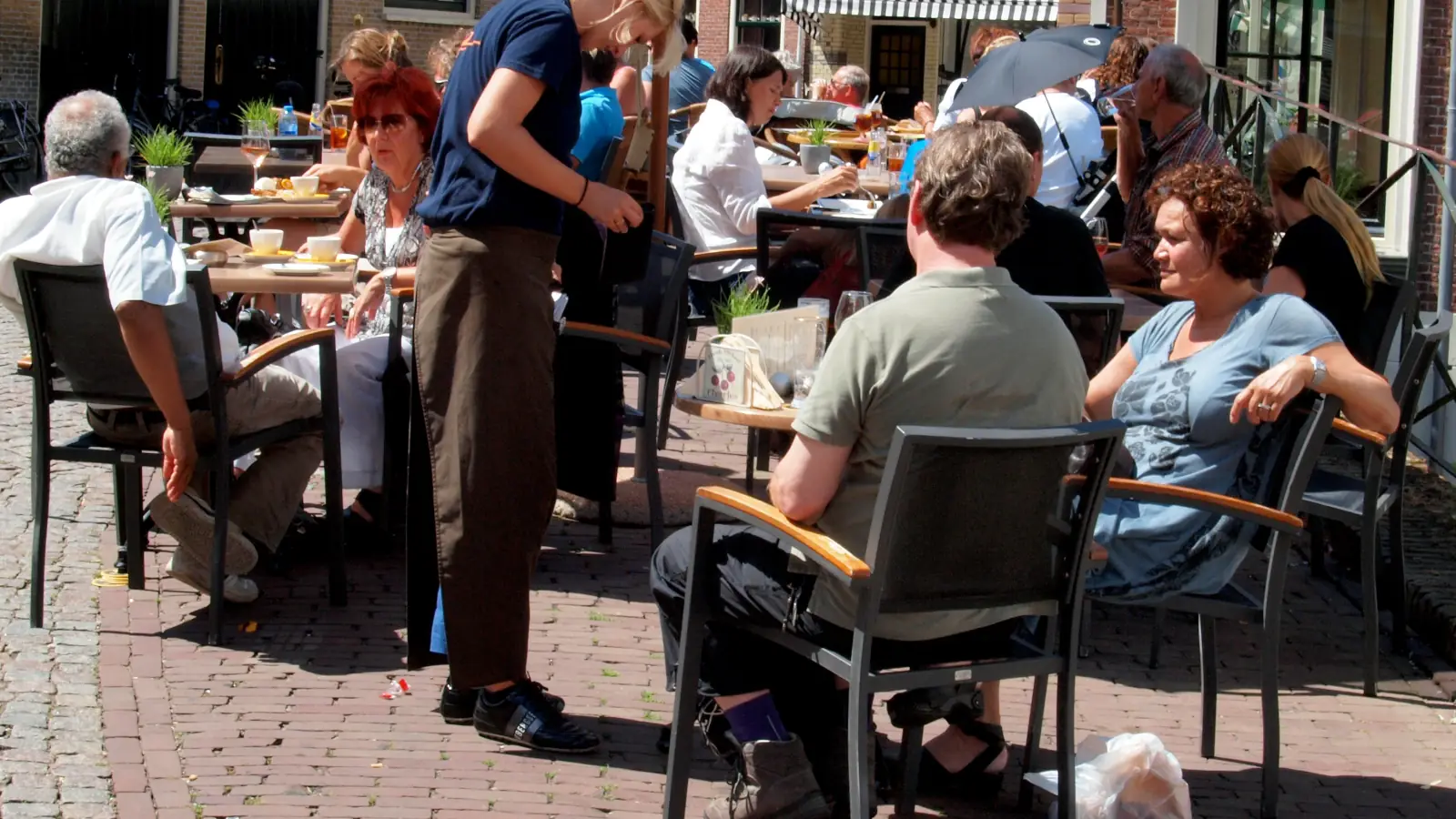
Jobs include reception, waiting tables, bar service, room service, housekeeping, breakfast and beach service. In a coastal hotel you might set up breakfast at 7, serve lunch, take a break and come back for dinner. Seasons run from spring to autumn at the sea and lakes and from December to April in the Alps. Rome, Florence and Venice hire all year.
Hours and shifts
The ministry's cost table for bars, restaurants and catering under the Pubblici Esercizi agreement counts a 40-hour week (2,088 hours a year) and 26 days of holiday. Hotels apply the tourism agreement's own schedule.
Service work is often split into two blocks a day, and weekends and public holidays are normal working days. By law you get at least 11 hours of rest in a row every day, unless the work is split during the day, and a 24-hour rest each week. Your average week, overtime included, stays within 48 hours.
Recognition and licence, step by step.
What to do, in order, to work as a hospitality worker in Italy.
- 01
Check which tourism agreement applies
A hotel under Federalberghi uses the CCNL Turismo, while a bar or restaurant under FIPE uses the Pubblici Esercizi agreement. Both have their own job classification. Ask which one your employer applies, since pay and holiday rules follow it. - 02
Do the hygiene briefing for food service
If you serve food or drinks, you work inside the venue's HACCP-based food safety system under Regulation (EC) No 852/2004. Expect training on allergens, hand hygiene and storing food before your first breakfast or bar shift. - 03
Complete the safety training at hiring
Under article 37 of D.Lgs. 81/2008 you get safety training on carrying trays, chemicals for room cleaning, stairs and fire procedures. Keep the attestato, since it counts in your next tourist season. - 04
Agree your level and season dates
Front-of-house roles sit in the lower and middle levels of the classification, from 7 upwards. Get the start and end date of the season and your level written in the contract, and ask whether the contract can be extended.
Certificates and language.
Venues ask for a HACCP or food hygiene certificate for anyone serving food or drinks. An RSA (Responsible Service of Alcohol) certificate from abroad shows experience at the bar, though Italy does not require it. Reception jobs value hotel software experience, and bar jobs value a barista or cocktail course. The Italian safety training attestato is given by your employer.
- HACCP
- Food hygiene certificate
- RSA (Responsible Service of Alcohol)
Language at work
Guests in Italy speak many languages, so English, German or French adds value at reception and on the floor. You still need Italian for colleagues, orders and allergens. Reception and guest relations jobs often ask for two or three languages, though there is no official level. Safety training must suit your language under D.Lgs. 81/2008.
What hospitality workers earn in Italy.
There is no statutory minimum wage in Italy; your floor is the tourism or Pubblici Esercizi agreement. In the ministry's Pubblici Esercizi table for September 2026, annual base pay is EUR 16,682 at level 7, EUR 17,899 at level 6, EUR 18,178 at level 6S and EUR 20,312 at level 4. That is about EUR 1,390, EUR 1,492, EUR 1,515 and EUR 1,693 a month over 12 months, before the 13th and 14th month. Tips are extra and not part of the minimum. Board and lodging in seasonal hotels may be included or deducted.
Before you sign.
Points to settle in writing before you sign a hospitality worker contract in Italy.
- Ask whether the venue applies the CCNL Turismo or the Pubblici Esercizi agreement, and your level.
- Ask for the exact season dates and how many hours a week you will work.
- Ask how split shifts are organised and how many days off you get each week.
- Ask whether staff housing and meals are free or deducted, and the amount.
- Ask whether you need a uniform and who pays for it and its cleaning.
- Ask how tips are shared among staff and whether they appear on the payslip.
What hospitality workers earn in other countries
Typical monthly gross pay for foreign hires, from official statistics and collective agreements.
Open hospitality worker vacancies in Italy.
Recent openings from EURES, the European Commission's job portal. You apply directly with the employer.
- lavapiattiGI GROUP S.P.A. · ItalyNov 17
- lavapiattiGI GROUP S.P.A. · ItalyNov 17
- lavapiattiGI GROUP S.P.A. · ItalyNov 17
- cameriere/camerieraGI GROUP S.P.A. · ItalyNov 17
- addetto alla reception/addetta alla receptionGI GROUP S.P.A. · ItalyNov 17
- cameriere/camerieraGI GROUP S.P.A. · ItalyNov 17
- lavapiattiGI GROUP S.P.A. · ItalyNov 17
- lavapiattiGI GROUP S.P.A. · ItalyNov 17
FAQ
Questions about working in Italy.
What do I need before I can work as a hospitality worker in Italy?
Check which tourism agreement applies; Do the hygiene briefing for food service; Complete the safety training at hiring; Agree your level and season dates.
Which language do I need to work in Italy?
Guests in Italy speak many languages, so English, German or French adds value at reception and on the floor. You still need Italian for colleagues, orders and allergens. Reception and guest relations jobs often ask for two or three languages, though there is no official level. Safety training must suit your language under D.Lgs. 81/2008.
What is the minimum wage in Italy?
Italy has no single statutory minimum wage. Pay is set by collective agreements for each sector.
Hospitality workers are also hired in:
Sources
Checked September 2026. Rules change - confirm details with your employer or the authority before you apply.
- Ministero del Lavoro - Costo orario pubblici esercizi, ristorazione collettiva e commerciale e turismo (DD n. 63 del 10 luglio 2025)
- CNEL - Report CCNL vigenti al 30 giugno 2025 (turismo)
- Normattiva - D.Lgs. 66/2003, art. 7 (riposo giornaliero)
- European Commission - Food hygiene
- Sportello Unico per l'Immigrazione (Ministero dell'Interno)
Get found by employers hiring for Italy.
One free profile that employers hiring for Italy and your other chosen destinations can find.
Create your profileFree. No subscription. No commission on your wages, ever.